Highlight
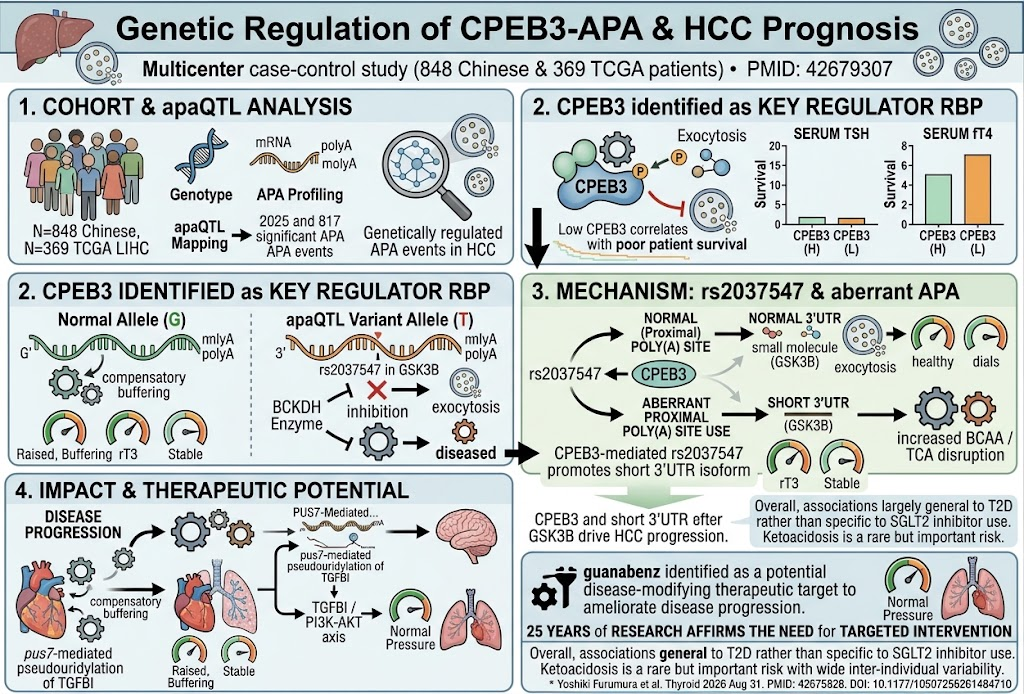
1. Genetic variants significantly influence alternative polyadenylation (APA) patterns in hepatocellular carcinoma (HCC), impacting patient prognosis.
2. CPEB3, an RNA-binding protein, emerges as a key regulator of APA linked to HCC survival.
3. The apaQTL variant rs2037547 in GSK3B modulates APA via CPEB3, promoting aggressive tumor behaviors.
4. Targeting APA dysregulation offers new avenues for prognostic stratification and personalized HCC therapy.
Study Background
Hepatocellular carcinoma (HCC) remains a leading cause of cancer-related mortality worldwide, complicated by heterogeneous molecular mechanisms influencing tumor progression and patient outcomes. Post-transcriptional regulation, particularly through alternative polyadenylation (APA) which modulates the length of 3′ untranslated regions (3’UTRs), plays a crucial role in gene expression control. Dysregulation of APA has been increasingly implicated in oncogenesis, but how inherited genetic variants affect APA dynamics in HCC and subsequently influence prognosis is poorly understood. The identification of APA quantitative trait loci (apaQTLs) linked to survival could unveil novel biomarkers and therapeutic targets to enhance clinical management of HCC.
Study Design
This investigation utilized a two-stage survival analysis integrating genotype data and APA profiling from two well-characterized cohorts: 848 Chinese patients and 369 patients from The Cancer Genome Atlas Liver Hepatocellular Carcinoma (TCGA LIHC) cohort. Prognosis-APA quantitative trait loci (apaQTL) mapping identified genetic variants associated with APA events correlated with HCC outcomes. Functional validation experiments delineated the biological role of identified variants and RNA-binding proteins (RBPs) influencing APA during HCC progression.
Key Findings
The analysis uncovered a total of 2,025 APA events in the Chinese cohort and 817 in the TCGA cohort, with 859 APA events significantly linked to poorer prognosis in HCC. These APA events were notably enriched in genes involved in RNA splicing and metabolic pathways, highlighting dysregulated RNA processing in tumor progression.
Genome-wide apaQTL mapping identified 32,034 significant variants predominantly localized within 3’UTRs and RBP-binding regions, underscoring the critical role of post-transcriptional regulatory elements. Among candidate RBPs, Cytoplasmic Polyadenylation Element Binding Protein 3 (CPEB3) was prioritized given its strong correlation between low expression and adverse patient survival outcomes. Experimental data showed that reduced CPEB3 expression enhanced HCC cell proliferation, migration, and invasion in vitro, affirming its tumor-suppressive role.
A functionally significant apaQTL variant, rs2037547 located within the GSK3B gene, was identified and validated in both cohorts. This single nucleotide polymorphism influenced proximal polyadenylation site selection via CPEB3, resulting in increased expression of a shortened 3’UTR isoform of GSK3B. Functionally, this change likely disrupted microRNA binding or mRNA stability, thereby upregulating GSK3B expression and promoting malignant phenotypes such as increased proliferation, invasion, and migration in HCC cells.
Collectively, these findings clarify a mechanistic pathway where genetic variation orchestrates APA through CPEB3, contributing to HCC progression and survival differences.
Expert Commentary
The discovery of the rs2037547 apaQTL as a regulator of the APA pattern in GSK3B mediated by CPEB3 provides compelling molecular insight into HCC heterogeneity. This pathway’s involvement in modulating 3’UTR isoform expression illuminates post-transcriptional gene regulation as a critical yet underexplored dimension in cancer biology.
While the study robustly connects apaQTL to survival and tumor behavior, further exploration is needed to translate these findings into clinical practice. This includes validation in diverse populations, exploration of APA-targeted therapies, and integration with existing molecular classifiers for HCC prognosis.
Conclusion
This comprehensive analysis delineates the genetic regulation of alternative polyadenylation mediated by CPEB3 as a pivotal factor influencing hepatocellular carcinoma outcomes. The identification of rs2037547 as a functional apaQTL highlights novel prognostic biomarkers and potential targets for personalized therapeutic intervention in HCC. These advances refine molecular understanding and herald new avenues for improved patient stratification and tailored treatments in this challenging malignancy.
Funding and Clinical Trials
The study was supported by grants from national cancer research programs and utilized publicly available TCGA datasets. No specific clinical trials were associated with the current genetic and mechanistic study.
References
Wang H, Zhang S, Zhang C, et al. Genetic regulation of CPEB3-mediated alternative polyadenylation associated with survival of patients with hepatocellular carcinoma. Hepatology (Baltimore, Md.). 2026 Sep 1; PMID: 42679307.
Tian B, Manley JL. Alternative polyadenylation of mRNA precursors. Nat Rev Mol Cell Biol. 2017 Jan;18(1):18-30.
Elkon R, Ugalde AP, Agami R. Alternative cleavage and polyadenylation: extent, regulation and function. Nat Rev Genet. 2013 Jul;14(7):496-506.
Masamha CP, Wagner EJ. The contribution of alternative polyadenylation to the cancer phenotype. Carcinogenesis. 2018 Jan 1;39(1):2-10.