The Foot Health Status Questionnaire was successfully translated and culturally adapted into Arabic (Foot Health Status Questionnaire-Ar).
It demonstrates excellent test-retest reliability and internal consistency across four evaluated domains.
Construct validity is supported by significant correlations with established foot function and health quality measures.
This validated instrument facilitates accurate foot health assessments for Arabic-speaking populations, enhancing clinical care and research quality.
Study Background
Foot health issues are common and significantly affect quality of life, physical function, and overall well-being. Comprehensive evaluation tools that capture patient-reported outcomes are essential for managing foot problems effectively. The Foot Health Status Questionnaire (FHSQ) is a validated, multidimensional instrument widely used internationally to assess pain, function, footwear, and general foot health domains. However, cultural and linguistic differences necessitate carefully translated and psychometrically validated versions for the Arabic-speaking population to ensure accurate assessment and applicability. Saudi Arabia, like other Arabic-speaking regions, faces a substantial burden of foot conditions, including diabetic foot complications and musculoskeletal disorders, highlighting the need for culturally appropriate, reliable measurement tools.
Study Design
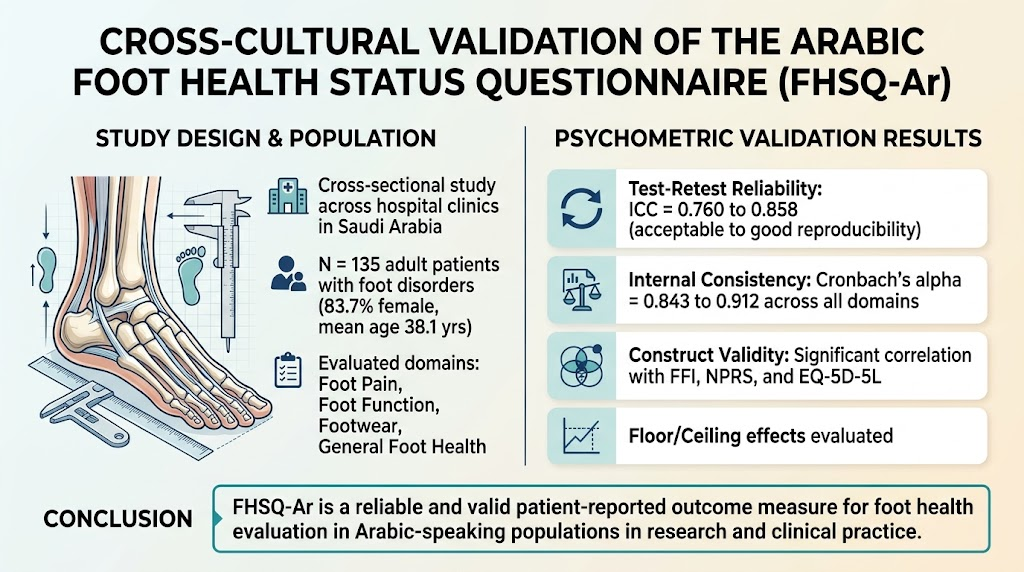
This cross-sectional psychometric study aimed to translate, culturally adapt, and validate the FHSQ into Arabic (Foot Health Status Questionnaire-Ar) and evaluate its reliability and validity in patients with various foot problems.
Participants included 135 adult patients (mean age 38.1 years, predominately female at 83.7%) with diverse foot disorders attending outpatient clinics across multiple private and public hospitals in Saudi Arabia. The original FHSQ underwent a rigorous translation process, including forward and backward translation and expert committee review to ensure semantic and conceptual equivalence.
Measurement properties assessed included:
– Test-retest reliability via intraclass correlation coefficient (ICC)
– Internal consistency using Cronbach’s alpha
– Construct validity by correlating FHSQ-Ar domains with the Foot Function Index (FFI), Numeric Pain Rating Scale (NPRS), and EuroQol 5-Dimension 5-Level (EQ-5D-5L) questionnaire
– Floor and ceiling effects to evaluate score distribution and sensitivity
Key Findings
The Foot Health Status Questionnaire-Ar exhibited robust psychometric properties:
– Test-retest reliability: ICC values ranged from 0.760 to 0.858 across four domains, indicating good stability over time.
– Internal consistency: Cronbach’s alpha values were between 0.843 and 0.912, surpassing acceptable thresholds (>0.7), confirming domain homogeneity.
– Construct validity: Significant, moderate to strong Pearson correlations were demonstrated between FHSQ-Ar domains and related constructs:
– The Foot Function Index scores correlated well with the function and pain domains of the FHSQ-Ar.
– Numeric Pain Rating Scale scores aligned closely with the pain domain.
– EuroQol 5-Dimension 5-Level scores demonstrated expected associations with both physical function and general foot health domains.
– Floor and ceiling effects: These were minimal, indicating the scale’s capability to differentiate patients across a broad spectrum of foot health status.
These psychometric results confirm that the FHSQ-Ar is a reliable and valid tool suitable for clinical foot health evaluation and research in Arabic-speaking populations.
Expert Commentary
The validation of the FHSQ in Arabic addresses a significant gap in patient-reported outcome measurement for foot disorders in Arabic-speaking countries. Given the high prevalence of foot problems, particularly diabetic foot complications in this region, the availability of a culturally adapted, psychometrically sound instrument enhances clinicians’ ability to monitor patient status and tailor interventions.
Notably, the study cohort’s predominance of females and middle-aged adults reflects typical outpatient demographics but may limit generalizability to male or elderly populations with distinct foot health profiles. Future research could expand validation to these groups and diverse Arabic dialects.
Additionally, compared to other regional validations of patient-reported outcome measures, this study’s comprehensive approach, including multiple convergent measures and thorough reliability assessments, strengthens confidence in the instrument’s robustness. However, longitudinal responsiveness and sensitivity to clinical change remain to be assessed in follow-up studies.
Conclusion
The Foot Health Status Questionnaire-Ar is a rigorously translated and culturally adapted instrument demonstrating strong reliability and validity in assessing foot health among Arabic-speaking patients. Incorporation of the FHSQ-Ar in routine clinical practice and research will facilitate standardized assessment, enable cross-cultural comparisons, and ultimately improve foot care outcomes in this population. Continued evaluation of its responsiveness and applicability in broader patient subgroups is recommended to maximize its clinical utility.
Funding and Clinical Trials Registration
The article did not specify funding sources or clinical trials registration details.
References
– Deathe AB, Elliott T. The Foot Health Status Questionnaire: cross-sectional validation in a variety of foot pathologies. J Foot Ankle Res. 2010;3:11. doi:10.1186/1757-1146-3-11
– Budiman-Mak E, Conrad KJ, Mazza J. The Foot Function Index: a measure of foot pain and disability. J Clin Epidemiol. 1991;44(6):561–570.
– Herdman M, Gudex C, Lloyd A, et al. Development and preliminary testing of the new five-level version of EQ-5D (EQ-5D-5L). Qual Life Res. 2011;20(10):1727-1736.
– Shayani AM, Albarakati AJ, Alzahrani H. Cross-cultural adaptation, reliability, and validity of the Arabic version of the Foot Health Status Questionnaire. Clin Rehabil. 2026 Apr 15;40(10):1387-1398. PMID: 41983937.