Highlight
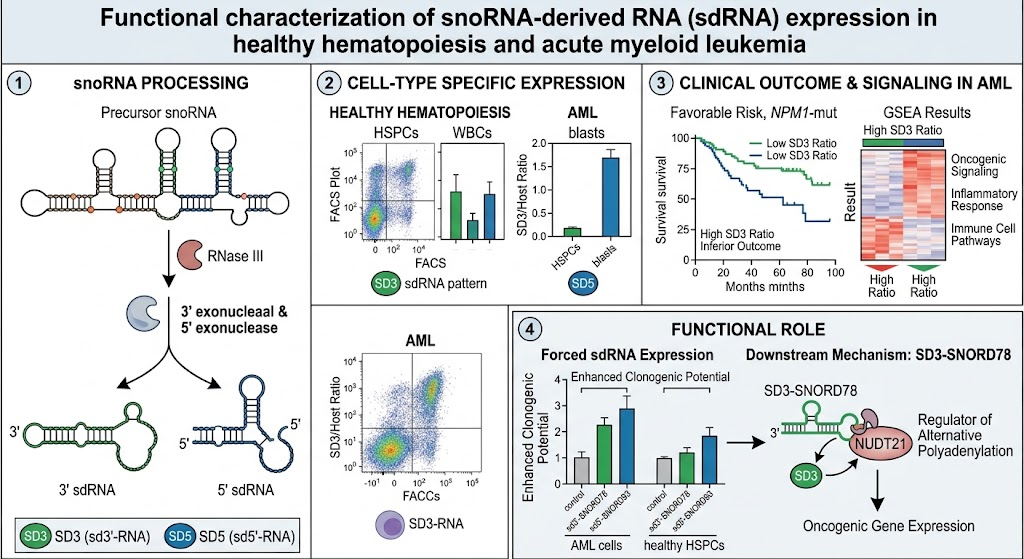
- snoRNA-derived RNAs (sdRNAs) display distinctive expression patterns across healthy hematopoietic stem and progenitor cells (HSPCs), normal white blood cells, and acute myeloid leukemia (AML) blasts.
- High ratios of 3′-sdRNAs to their precursor snoRNA-host genes correlate with poorer prognosis, even within favorable-risk NPM1-mutated AML patients.
- Forced expression of specific sdRNAs augments clonogenic potential and elicits unique gene expression signatures, implicating sdRNAs as functional regulatory molecules in hematopoiesis and leukemia.
- NUDT21, a regulator of alternative polyadenylation, is identified as a downstream effector of sd3′-SNORD78, illustrating mechanistic links to oncogenic pathways.
Study Background
Acute myeloid leukemia (AML) remains a clinically challenging hematologic malignancy characterized by clonal expansion of immature myeloid cells, often leading to poor survival rates. Despite advances in molecular characterization, understanding regulatory noncoding RNA species that influence leukemia pathogenesis and patient outcomes is incomplete. Small nucleolar RNAs (snoRNAs) are noncoding RNAs involved in ribosomal RNA modification but have emerged as players in leukemogenesis and leukemic cell maintenance. snoRNAs are further processed into snoRNA-derived RNAs (sdRNAs), whose biological roles in healthy hematopoiesis and AML are not fully understood. Given the critical need for biomarkers to stratify AML prognosis and therapeutic response, this study investigates the expression profiles and functional relevance of sdRNAs in healthy and leukemic hematopoietic cells.
Study Design
This translational study leveraged high-throughput RNA profiling to quantify snoRNA and sdRNA expression in sorted hematopoietic stem and progenitor cells (HSPCs), healthy white blood cells (WBCs), and a cohort of 159 intensively treated AML patient samples at initial diagnosis. The AML cohort included patients with various molecular subtypes, notably those harboring NPM1 mutations with favorable risk profiles. Bioinformatic analyses correlated sdRNA expression ratios to clinical outcomes, including therapy response and survival. Functional assays involved forced expression of select sdRNAs (sd3′-SNORD78, sd3′-SNORD76, and sd5′-SNORD93) in AML and healthy HSPCs to assess impact on clonogenic capacity and downstream gene expression. Molecular targets and pathways modulated by sdRNAs were explored, exemplified by characterization of NUDT21 regulation by sd3′-SNORD78.
Key Findings
Distinct sdRNA profiles enabled discrimination among HSPCs, normal WBCs, and AML blasts, underscoring cell-type-specific regulation. The pivotal finding was that an elevated ratio of 3′-derived sdRNAs relative to their host snoRNA genes was significantly associated with inferior clinical outcomes in AML. This prognostic signature held true even among patients with NPM1-mutated AML generally considered to have favorable prognosis and initial therapeutic response, thus uncovering a high-risk subgroup masked by conventional stratification.
Biological pathway analyses linked high sd3′-RNA ratios to dysregulation of oncogenic signaling pathways, inflammatory responses, and immune-related processes, suggesting a broad impact on leukemic biology. Experimental overexpression of individual sdRNAs, such as sd3′-SNORD78, increased colony-forming potential in AML cell models, indicating enhanced leukemic proliferation or survival capacity. These sdRNAs induced distinct gene expression signatures in both leukemic and normal hematopoietic cells, confirming their role as standalone regulatory effectors beyond mere degradation products.
The study further identified NUDT21, a key modulator of alternative polyadenylation and oncogenic transcript expression, as a direct downstream target of sd3′-SNORD78 in AML cells. This finding provides a mechanistic insight into how sdRNAs may alter post-transcriptional gene regulation to foster malignant phenotypes.
Expert Commentary
The elucidation of snoRNA-derived RNA functions represents an exciting frontier in leukemia biology. This comprehensive study robustly characterizes sdRNAs as discrete regulatory molecules with prognostic relevance and functional impact in hematopoiesis and AML. The ability of sdRNA expression patterns to refine risk stratification within established favorable subgroups, such as NPM1-mutated patients, may influence future clinical decision-making and personalized therapy.
Mechanistically, the targeting of RNA-processing factors like NUDT21 by sdRNAs highlights a novel axis of post-transcriptional regulation contributing to leukemogenesis. These findings invite further research into sdRNAs as biomarkers and potential therapeutic targets. Limitations include the need for longitudinal validation and exploration of the therapeutic feasibility of modulating sdRNA activity.
Conclusion
This study advances the understanding of snoRNA-derived RNAs as functional regulators in normal and malignant hematopoiesis. Their unique expression profiles hold promise for improved prognostic stratification in AML, identifying high-risk patient subsets within currently favorable groups. Functional assays establish sdRNAs as active participants in leukemic biology, potentially via modulation of alternative polyadenylation and oncogenic pathways exemplified by NUDT21 targeting. These insights pave the way for novel biomarker development and innovative RNA-based therapeutic strategies in AML management.
Funding and ClinicalTrials.gov
The study by Zinz et al. was supported by institutional and governmental research funding; however, specific grant numbers were not disclosed in the available abstract. The clinical trial registration details were not provided. Further details will likely be available in the full published article.
References
1. Zinz R, Rohde C, Pauli C, et al. Functional characterization of snoRNA-derived RNA (sdRNA) expression in healthy hematopoiesis and acute myeloid leukemia. Leukemia. 2026 Sep 4. PMID: 42697931.
2. Falaleeva M, Stamm S. Processing of snoRNAs as a new source of regulatory non-coding RNAs: snoRNA fragments form a new class of functional RNAs in the cell. Bioessays. 2013;35(1):46–54.
3. Cech TR, Steitz JA. The noncoding RNA revolution-trashing old rules to forge new ones. Cell. 2014;157(1):77–94.
4. Papaioannou MD, et al. The role of noncoding RNAs in hematopoiesis and hematologic malignancies. Blood. 2020;135(20):1810–1822.