Highlight
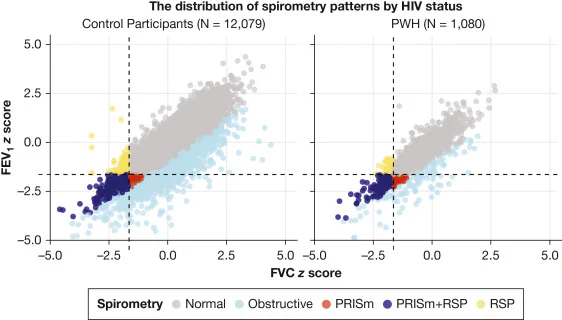
The study found that people with HIV (PWH) in well-treated, high-income settings have a significantly higher prevalence of preserved ratio impaired spirometry (PRISm) and restrictive spirometry pattern (RSP) compared to matched controls from the general population. These lung function impairments were independently associated with HIV status, persisted even in never-smokers, and correlated with a greater burden of respiratory symptoms in PWH.
Study Background
People living with HIV (PWH) face a heightened risk for respiratory comorbidities, including chronic obstructive pulmonary disease (COPD) and other lung function abnormalities. With effective antiretroviral therapy (ART), PWH now live longer, shifting clinical focus to long-term complications, including emerging spirometric abnormalities such as preserved ratio impaired spirometry (PRISm) and restrictive spirometry patterns (RSPs). PRISm is characterized by a forced expiratory volume in one second (FEV1) below the lower limit of normal (LLN) with a preserved FEV1 to forced vital capacity (FVC) ratio. RSP involves a normal FEV1/FVC ratio but a reduced FVC below the LLN. Both patterns may portend increased morbidity but remain under-investigated in PWH, especially in well-treated individuals residing in high-income regions.
Study Design
This cross-sectional study analyzed data from 1,080 PWH enlisted in the Copenhagen Comorbidity in HIV Infection Study and 12,079 age- and sex-matched controls from the Copenhagen General Population Study. Spirometric measures obtained included FEV1, FVC, and the FEV1/FVC ratio to categorize lung function patterns: PRISm was defined as an FEV1/FVC ratio greater than or equal to the LLN with FEV1 below LLN, while RSP was defined as an FEV1/FVC ratio at or above LLN with FVC below the LLN. Multivariable logistic regression models adjusted for traditional risk factors such as smoking status, body mass index (BMI), educational level, alcohol consumption, diabetes, and hypertension, as well as HIV-specific factors.
Key Findings
The prevalence of PRISm among PWH was 10.5% (95% CI, 8.8%-12.4%), compared to 3.5% (95% CI, 3.2%-3.8%) in matched controls (P < .01). Similarly, RSP prevalence was 10.6% (95% CI, 8.9%-12.6%) in PWH versus 3.2% (95% CI, 2.9%-3.5%) among controls (P < .01). Notably, these differences remained statistically significant when restricting the analysis to never-smokers, underscoring the influence of HIV independent of tobacco exposure.
In univariable analyses, HIV status was significantly associated with higher odds of PRISm and RSP. After adjusting for age, sex, smoking, BMI, and education, the odds ratio (OR) for PRISm was 3.58 (95% CI, 2.77-4.63) and for RSP was 4.55 (95% CI, 3.51-5.91). With additional adjustment for alcohol use, diabetes, and hypertension, HIV remained independently associated with PRISm (OR 3.40; 95% CI, 2.59-4.47) and RSP (OR 4.34; 95% CI, 3.29-5.73).
PWH exhibiting PRISm or RSP reported a higher burden of respiratory symptoms compared to those without these spirometric impairments, highlighting the clinical relevance of these findings for patient quality of life.
Expert Commentary
This study adds important clinical insight into the nuanced lung function abnormalities evident in well-controlled HIV populations, distinct from classical obstructive lung disease. The independent association between HIV and lung function impairment patterns such as PRISm and restrictive spirometry suggests potential HIV-specific pathogenic mechanisms, such as systemic inflammation, immune activation, or direct viral effects on pulmonary tissue. Clinicians should be aware of these emerging spirometric phenotypes as they may signify subclinical pulmonary compromise that merits surveillance and possible intervention.
However, limitations inherent to the cross-sectional design preclude causal inference, and the generalizability to PWH in low-income settings or with uncontrolled infection may differ. Further longitudinal and mechanistic studies are warranted to elucidate the progression, outcomes, and potential therapeutic targets for HIV-associated lung impairments.
Conclusion
PWH in high-income, well-treated cohorts experience a substantially higher prevalence of PRISm and RSP compared with matched population controls, independent of traditional risk factors such as smoking. These findings identify PRISm and RSP as potentially distinct phenotypes of HIV-associated pulmonary impairment with significant symptomatic burden. Integrating spirometry assessments in routine HIV care could improve early detection and management of respiratory comorbidities, ultimately enhancing clinical outcomes in this population.
Funding and Clinical Trials
The study was registered on ClinicalTrials.gov (NCT02382822). Specific funding sources were not detailed in the abstract but can be referred from the original publication.
References
- Heidari SL, Loft JA, Çolak Y, et al. Prevalence and Risk Factors of Preserved Ratio Impaired Spirometry in People With HIV and Matched Population Control Participants. Chest. 2026 Jun 18;170(5):1532-1542. PMID: 42314937.
- Durham AL, Adcock IM. The relationship between COPD and lung cancer. Lung Cancer. 2015 Jan;90(1):121-7.
- Gingo MR, Morris A. Chronic Obstructive Pulmonary Disease in HIV Infection: A Review of the Literature. AIDS Patient Care STDS. 2013 Dec;27(12):615-24.
- Arjaans S, Visker JJ, Le Cessie S, et al. Lung Function Impairment in People Living with HIV: Evidence and Mechanisms. J Clin Med. 2020 Sep 30;9(10):3170.
Specialty calculators
For clinical reference; use professional judgment.