Highlight
- Telemedicine electronic questionnaire follow-up for post-operative strabismus patients was feasible and safe in a large cohort.
- High patient satisfaction was reported among respondents, emphasizing usability and confidence in remote care.
- The telemedicine approach substantially reduced patient travel burden, with a mean travel avoidance exceeding 250 miles per patient.
- No postoperative complications were missed among patients managed exclusively by telemedicine at week one follow-up.
Study Background
Strabismus surgery is commonly performed to correct ocular misalignment, requiring postoperative follow-up to monitor for complications and assess functional outcomes such as diplopia resolution and medication adherence. Traditionally, in-person follow-up visits at post-operative week one (POW1) serve as important clinical checkpoints. However, these visits can present logistical challenges, including travel burden and disruption for patients and caregivers. With advances in telemedicine, ophthalmology has seen increasing use of remote consultations, but evidence specific to post-operative strabismus management remains limited. The COVID-19 pandemic accelerated telemedicine adoption, offering opportunities to re-evaluate follow-up protocols. This study explores an innovative approach using electronic questionnaires augmented by patient-submitted ocular photographs to remotely assess POW1 status after strabismus surgery.Study Design
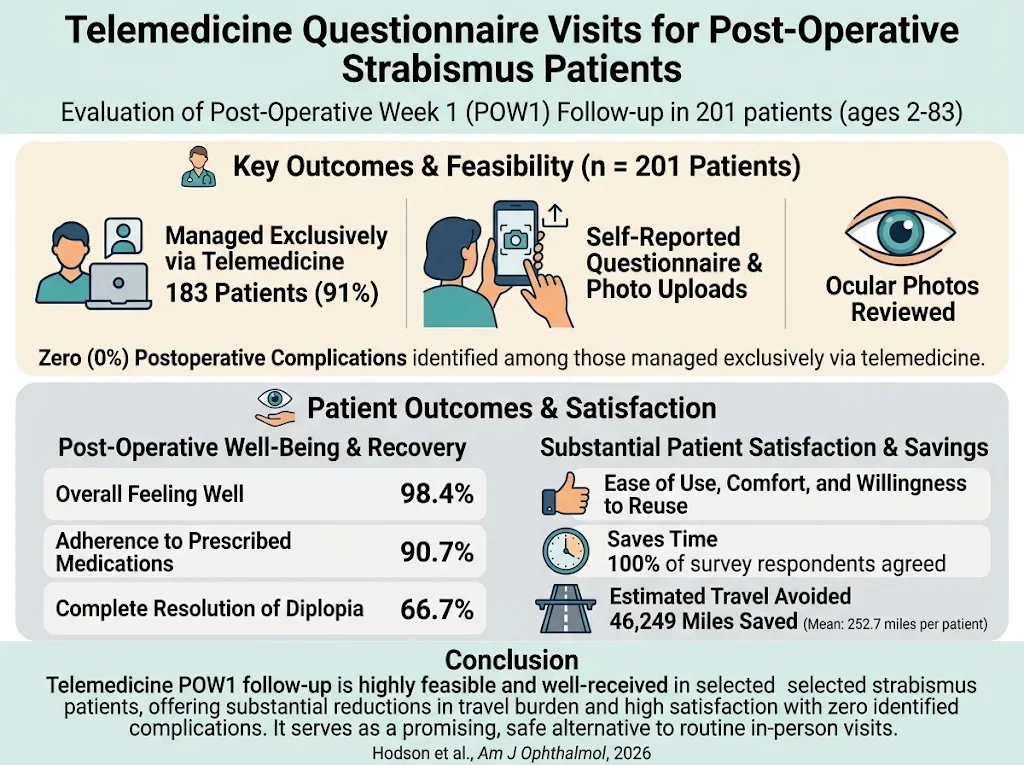
This retrospective observational case series analyzed 201 patients aged 2 to 83 years undergoing strabismus surgery at a single tertiary academic center between March 2020 and February 2026. Patients selected for telemedicine follow-up completed an electronic POW1 questionnaire capturing postoperative well-being, diplopia status, medication adherence, and submitted ocular photographs for clinician review. A subset of 28 patients participated in a telephone satisfaction survey. The main outcomes measured were patient-reported postoperative health status, diplopia resolution, medication compliance, complication detection, patient satisfaction with telemedicine usability, and estimated travel avoidance calculated from patients’ travel distances.Key Findings
Among the 201 patients enrolled, 183 (91%) completed the telemedicine follow-up exclusively without requiring in-person POW1 visits, demonstrating high patient uptake and feasibility. – Patient-Reported Outcomes: – 98.4% of respondents reported feeling well postoperatively. – Complete resolution of diplopia was reported by 66.7%. This percentage reflects meaningful functional recovery in a majority. – Medication adherence was high, with 90.7% indicating compliance. – Complications: – No postoperative complications were identified in patients followed solely via telemedicine, suggesting safety in selected patients. – Patient Satisfaction: – Twenty-eight patients responded to a telephone survey, indicating strong satisfaction with the telemedicine platform. – Ease of use, comfort, and willingness to reuse telemedicine for follow-up were highly rated. – All respondents agreed that telemedicine saved time compared to traditional in-person visits. – Travel Burden: – Estimated travel avoidance was substantial, totaling 46,249 miles for the cohort, averaging 252.7 miles per patient. – This reduction has potential implications for cost savings, patient convenience, and environmental impact. – Qualitative Feedback: – Free-text responses revealed that patients valued reassurance during recovery, clarity regarding expected postoperative symptoms, and had pertinent ophthalmic concerns that were addressed remotely. These results collectively support telemedicine as a feasible, patient-centered approach to POW1 follow-up in strabismus surgery.Expert Commentary
The study contributes important evidence supporting telemedicine integration into post-operative ophthalmologic care pathways. By leveraging patient-reported outcomes and digital imaging, clinicians can effectively monitor recovery while minimizing patient burden. Limitations include the retrospective design and potential selection bias because patients deemed suitable for telemedicine may represent a lower-risk subgroup. The satisfaction survey sample was relatively small and self-selected, possibly overestimating positive feedback. Future prospective studies with randomized assignment and standardized clinical endpoints would strengthen generalizability. Additionally, some complex cases or those with concerning symptoms may still require in-person evaluation to prevent missed complications. This approach is best viewed as complementing, not completely substituting, traditional care. Nonetheless, the technological framework is aligned with current digital health trends and can be scaled with further validation and integration into electronic health record systems. Mechanistically, photographic assessment of ocular alignment and anterior segment status by expert clinicians may sufficiently detect early complications such as infection or dehiscence.Conclusion
Telemedicine follow-up using electronic questionnaires and patient-submitted ocular photographs at post-operative week one is a safe, effective, and patient-preferred strategy for selected strabismus surgery patients. It offers the advantages of increased convenience, reduced travel burden, and maintained clinical oversight without detected compromise in safety outcomes. As telemedicine evolves, this model may inform post-operative care protocols beyond strabismus, encouraging broader adoption within ophthalmology and surgical specialties. Further prospective, controlled studies are warranted to validate these findings and refine patient selection criteria to optimize telemedicine implementation.Funding and Clinical Trials
No specific funding was reported for this retrospective study. No clinical trial registration was indicated.References
1. Hodson C, Dewan S, Depala K, Donahue S. Evaluating the Effectiveness of Telemedicine Questionnaire Visits for Post-Operative Strabismus Patients. Am J Ophthalmol. 2026 Nov 17. PMID: 43044711. 2. Saleem SM, Pasquale LR, Sidoti PA, Tsai JC. Virtual Ophthalmology: Telemedicine in a COVID-19 Era. Am J Ophthalmol. 2020;216:237-242. doi:10.1016/j.ajo.2020.04.029 3. Tuan PM, Wang L, Golesic E, et al. Telemedicine in Postoperative Ophthalmic Care. Curr Opin Ophthalmol. 2021;32(6):550-555. doi:10.1097/ICU.0000000000000740 4. Rathi S, Tsui E, Mehta N, Zahid S, Schuman JS. The Current State of Teleophthalmology in the United States. Ophthalmology. 2017;124(12):1729-1734. doi:10.1016/j.ophtha.2017.05.031Specialty calculators
For clinical reference; use professional judgment.