Highlight
The extended follow-up results of the phase 2 FORTE trial affirm that carfilzomib-lenalidomide-dexamethasone followed by autologous stem cell transplantation (KRd-ASCT) significantly improves progression-free survival compared to KRd alone or carfilzomib-cyclophosphamide-dexamethasone with ASCT (KCd-ASCT) in newly diagnosed, transplant-eligible multiple myeloma patients. Further, carfilzomib plus lenalidomide maintenance enhances progression-free survival and improves measurable residual disease (MRD) dynamics, demonstrating durable disease control with manageable safety.
Study Background
Multiple myeloma (MM) is a hematologic malignancy characterized by clonal proliferation of plasma cells in the bone marrow. Despite treatment advances, including high-dose chemotherapy and autologous stem cell transplantation (ASCT), relapse remains common, underscoring the need for effective induction and maintenance regimens. Carfilzomib, a second-generation proteasome inhibitor, combined with immunomodulatory agents like lenalidomide, has shown promising efficacy in MM. However, long-term outcomes of carfilzomib-based induction regimens followed by ASCT, and the impact of carfilzomib-containing maintenance remain to be fully elucidated in younger, transplant-eligible patients.
Study Design
The phase 2 FORTE trial enrolled newly diagnosed multiple myeloma patients aged ≤65 years eligible for ASCT. The trial employed a two-step randomization: initially (R1), patients were randomized to one of three induction regimens—carfilzomib-lenalidomide-dexamethasone followed by ASCT (KRd-ASCT), 12 cycles of KRd without transplantation (KRd12), or carfilzomib-cyclophosphamide-dexamethasone followed by ASCT (KCd-ASCT). Upon completion of initial therapy, eligible patients underwent a second randomization (R2) to maintenance therapy with either carfilzomib plus lenalidomide (KR) or lenalidomide alone (R) until disease progression or unacceptable toxicity. The primary endpoints included progression-free survival (PFS) and safety, with secondary outcomes including PFS2 (progression after second-line therapy), overall survival (OS), and MRD dynamics assessed by sensitive assays.
Key Findings
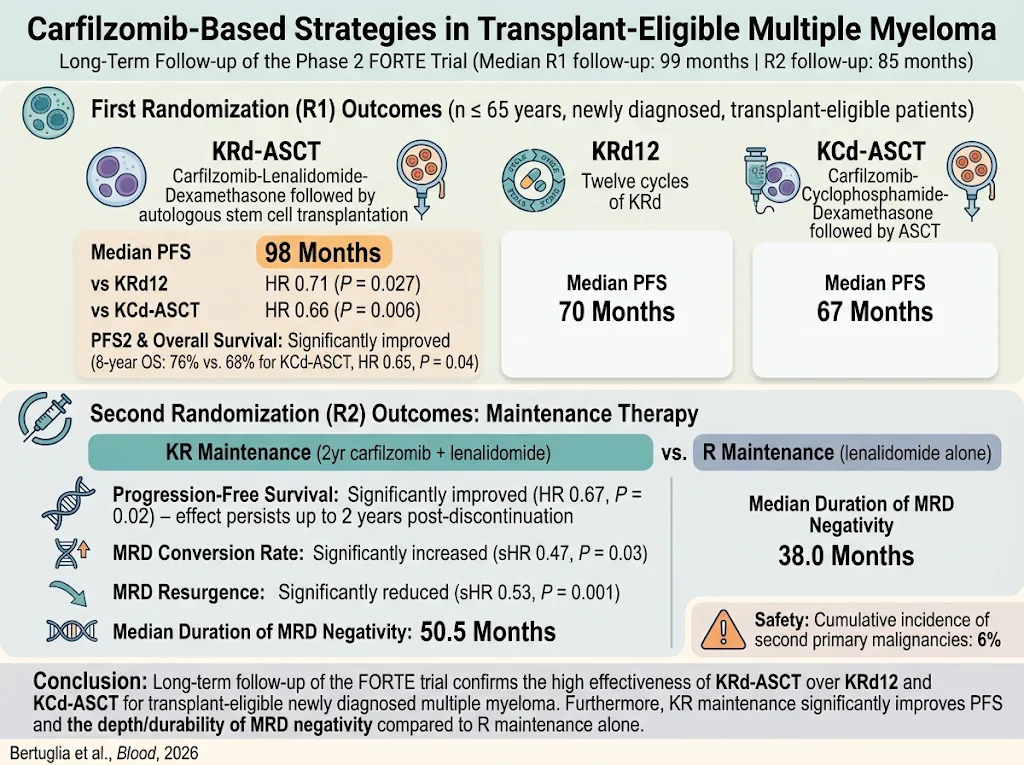
With a median follow-up of 99 months from R1 and 85 months from R2, the KRd-ASCT arm demonstrated superior long-term outcomes. The median PFS was 98 months for KRd-ASCT compared to 70 months for KRd12 (hazard ratio [HR] 0.71, p=0.027) and 67 months for KCd-ASCT (HR 0.66, p=0.006). Notably, PFS2, reflecting durability of disease control beyond first relapse, was also significantly improved with KRd-ASCT versus the other arms. In terms of overall survival, KRd-ASCT showed a significant benefit compared to KCd-ASCT (8-year OS: 76% vs 68%, HR 0.65, p=0.04), suggesting a meaningful survival advantage with the KRd platform coupled with transplant.
Maintenance therapy with carfilzomib plus lenalidomide (KR) yielded a significant PFS benefit over lenalidomide alone (HR 0.67, p=0.02). This benefit was notable during active treatment and persisted for up to two years after discontinuation of carfilzomib, although no statistically significant differences in PFS2 or OS were observed between maintenance strategies. Importantly, KR maintenance effectively increased the rate of MRD conversion (residual disease elimination) during active therapy (subdistribution HR 0.47, p=0.03) and reduced MRD resurgence (relapse at molecular level) compared to lenalidomide alone (sHR 0.53, p=0.001).
Median duration of sustained MRD negativity was longer with KR maintenance (50.5 months) versus lenalidomide maintenance (38 months), correlating with prolonged PFS in MRD-negative patients receiving KR (HR 0.60, p=0.031). For MRD-positive patients, KR conferred benefits predominantly during the period of carfilzomib administration (HR 0.46, p=0.05). The overall safety profile was consistent with known toxicities of the agents, and the cumulative incidence of second primary malignancies was relatively low (6%).
Expert Commentary
The FORTE trial’s long-term data underscore the clinical value of carfilzomib-based induction combined with ASCT in transplant-eligible multiple myeloma. The robust PFS and OS benefits with KRd-ASCT compared to other regimens reinforce the role of intensified proteasome inhibitor and immunomodulatory drug combinations in achieving deep and durable remissions. Importantly, maintenance therapy integrating carfilzomib demonstrates enhanced control of minimal residual disease, a critical prognostic factor and surrogate endpoint for long-term outcomes in MM.
These findings align with mechanistic insights into proteasome inhibitor efficacy in eradicating myeloma clones and underscore the benefit of sustained suppression beyond induction. Nonetheless, the absence of OS advantage with KR maintenance versus lenalidomide alone suggests further research is warranted to optimize maintenance duration and patient selection.
While phase 2 and relatively young patient populations may limit broad generalizability, the prolonged follow-up adds valuable evidence supporting KRd-ASCT as a frontline standard in younger, fit patients, with KR maintenance offering an important adjunct. Future studies with larger cohorts and integration of novel agents may further refine therapeutic strategies.
Conclusion
Extended follow-up of the FORTE trial confirms that KRd induction with ASCT yields superior progression-free and overall survival compared to KRd alone or KCd with ASCT in transplant-eligible multiple myeloma patients. Maintenance with carfilzomib plus lenalidomide further improves progression-free survival and promotes sustained MRD negativity, underpinning its role in consolidating deep responses. These findings highlight a potent therapeutic approach that may inform contemporary standards of care and motivate ongoing research into individualized myeloma management.
Funding and Clinical Trial Registration
The FORTE trial was funded by multiple institutional and possibly industry collaborators, with clinical trial registration number NCT02203643.
References
- Bertuglia G, D’Agostino M, Rota-Scalabrini D, et al. Carfilzomib-based strategies in transplant-eligible multiple myeloma: long-term follow-up of the phase 2 FORTE trial. Blood. 2026 Nov 16; PMID:43038178.
- Kumar SK, Rajkumar V, Kyle RA, et al. Multiple myeloma. Nat Rev Dis Primers. 2017;3:17046.
- Moreau P, Attal M, Facon T. Frontline therapy of multiple myeloma. Blood. 2015;125(20):3076-3084.
- Munshi NC, Avet-Loiseau H, Rawstron AC, et al. Minimal residual disease in multiple myeloma: ready for prime time? Blood. 2017;130(16):1702-1710.
Specialty calculators
For clinical reference; use professional judgment.