Highlight
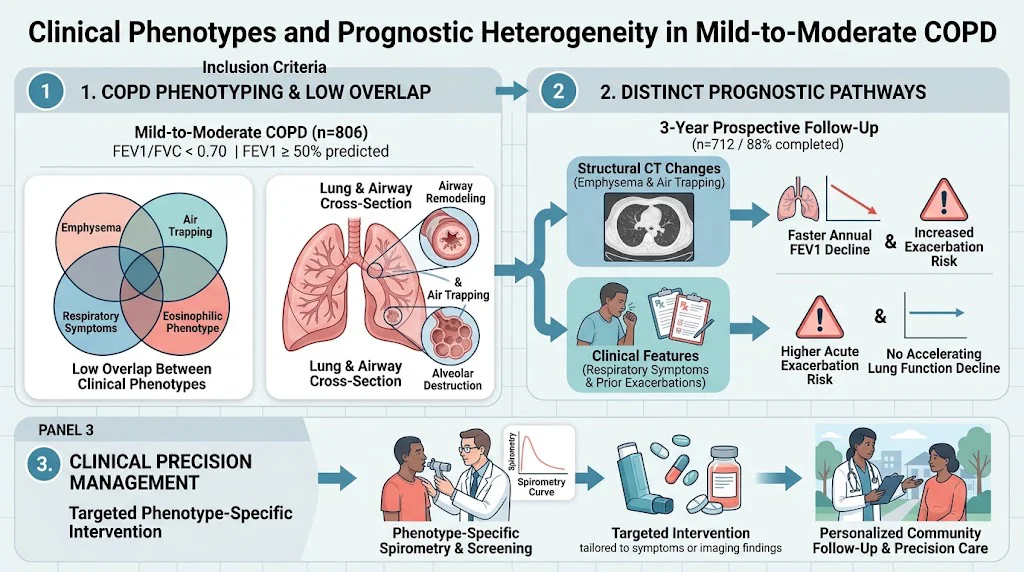
This prospective community-based cohort study of 806 individuals with mild-to-moderate chronic obstructive pulmonary disease (COPD) elucidates key clinical phenotypes characterized by emphysema, air trapping, airway remodeling, respiratory symptoms, and exacerbation history. The study demonstrates prognostic heterogeneity with variable lung function decline and exacerbation rates among phenotypes, highlighting the importance of targeted, precision management even in early COPD stages.
Study Background
Chronic obstructive pulmonary disease (COPD) is a leading global cause of morbidity and mortality, with early disease stages frequently under-recognized. Mild-to-moderate COPD, defined spirometrically by a post-bronchodilator FEV1/FVC ratio <0.70 and FEV1 ≥50% predicted, represents a critical intervention window. However, this stage is clinically heterogeneous. Understanding phenotypes and prognosis in mild-to-moderate COPD is imperative to optimize management strategies and prevent progression, exacerbations, and healthcare burden. Prior studies have largely focused on moderate-to-severe COPD, leaving a gap concerning early disease phenotyping and longitudinal outcomes in the community setting.
Study Design and Methods
This investigation analyzed baseline and 3-year follow-up data from a prospective, community-based cohort including 806 participants diagnosed with mild-to-moderate COPD according to the spirometric criteria above. Participants underwent comprehensive clinical characterization encompassing respiratory symptoms, exacerbation history in the preceding year, quantitative computed tomography (CT) for emphysema and air trapping metrics, and assessments of airway remodeling. Respiratory health outcomes evaluated over the 3 years included incidence of acute exacerbations and rate of lung function decline, as measured by annual change in forced expiratory volume in 1 second (FEV1).
Key Findings
Phenotypic Characterization and Overlap: The study found mild-to-moderate COPD individuals exhibited more pronounced emphysema, air trapping, and airway remodeling than controls with preserved spirometry. Importantly, these pathophysiological features had low overlap with clinical symptom burden or eosinophilic inflammatory phenotype, delineating distinct and largely non-overlapping clinical phenotypes within this population.
Prognostic Heterogeneity: Lung function decline and exacerbation incidence showed significant inter-individual variability. Emphysema and air trapping were independently associated with accelerated annual FEV1 decline and increased exacerbation risk, signifying structural lung damage as a driver of disease progression. Conversely, respiratory symptoms and prior year exacerbations predicted future acute exacerbation risk but did not correlate with faster lung function decline, indicating distinct mechanistic pathways for symptom exacerbation versus progressive airflow limitation.
Longitudinal Outcomes: Over 3 years, participants with mild-to-moderate COPD experienced a more rapid decline in lung function and higher exacerbation rates compared to those with preserved spirometry. The rate of FEV1 decline varied widely, underscoring the need for individualized risk stratification.
Expert Commentary
This robust prospective cohort highlights that mild-to-moderate COPD is not a uniform entity but encompasses diverse clinical phenotypes with different prognostic implications. The dissociation between symptoms and structural lung changes suggests that relying solely on symptomatic assessment may overlook individuals at high risk for disease progression. Quantitative imaging biomarkers such as emphysema and air trapping provide objective risk indicators and should be integrated into clinical evaluation where feasible.
The eosinophilic phenotype’s minimal overlap with other phenotypes in this early disease stage raises questions about its role in mild COPD and optimal targeting of anti-inflammatory therapies.
While the community-based design strengthens generalizability, limitations include potential selection bias and reliance on CT biomarkers that may not be universally accessible. Further work is needed to elucidate the biological mechanisms underlying phenotypic divergence and to validate precision treatment algorithms tailored to identified subgroups.
Conclusion
This study provides compelling evidence that mild-to-moderate COPD is phenotypically heterogeneous with variable prognoses. Early identification of emphysema and air trapping phenotypes can inform risk stratification and targeted interventions to prevent progressive lung function decline and exacerbations. Incorporating multidimensional clinical and imaging assessments into routine care can propel precision medicine approaches in COPD from mild stages onwards, ultimately improving long-term outcomes.
Funding and ClinicalTrials.gov
The study was conducted under the ECOPD study investigators group. Specific funding sources and clinical trial registration details were not provided in the abstract.
References
Wu F, Wan Q, Zhou K, et al. Clinical Phenotypes and Prognostic Heterogeneity of Mild-to-Moderate Chronic Obstructive Pulmonary Disease: A Prospective Community-Based Cohort Study. Chest. 2026 Oct 26. PMID: 42933687.
Global Initiative for Chronic Obstructive Lung Disease (GOLD). Global Strategy for the Diagnosis, Management, and Prevention of COPD. 2024 Report.
Vestbo J, Hurd SS, Agusti AG, et al. Global strategy for the diagnosis, management, and prevention of chronic obstructive pulmonary disease: GOLD executive summary. Am J Respir Crit Care Med. 2013 Feb 15;187(4):347-65.
Specialty calculators
For clinical reference; use professional judgment.