Highlight
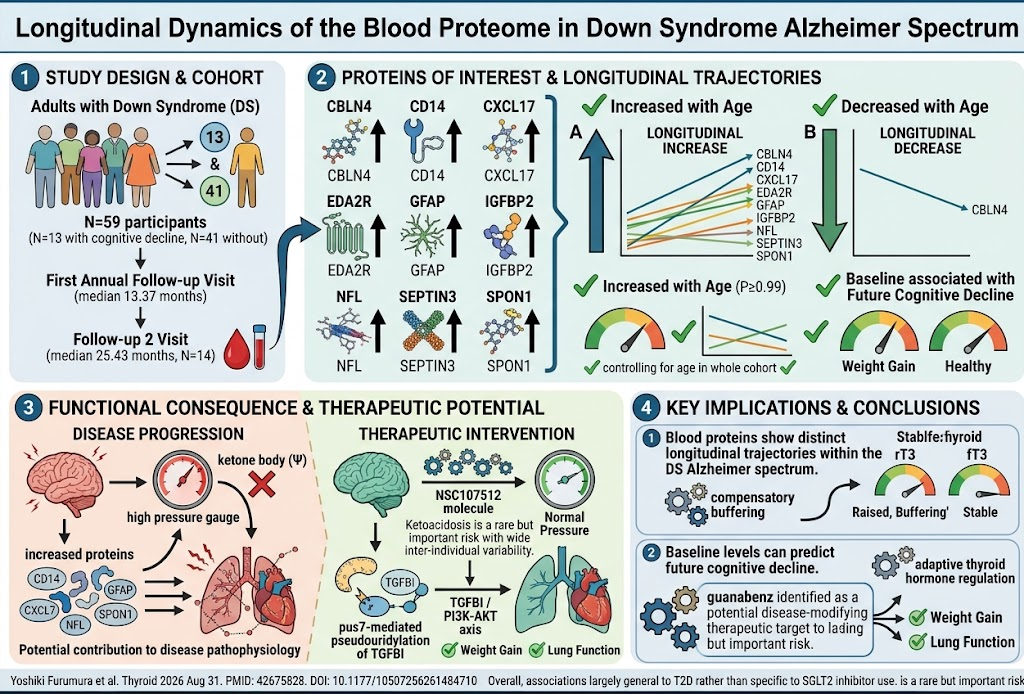
- Longitudinal study tracks blood protein changes in adults with Down syndrome at risk for early Alzheimer’s disease.
- Eight proteins (CD14, CXCL17, EDA2R, GFAP, IGFBP2, NFL, SEPTIN3, SPON1) increase with age, while CBLN4 decreases.
- Baseline protein levels serve as predictors for future cognitive decline independent of age.
- No direct correlation found between longitudinal protein changes and domain-specific cognitive performance within subgroups after multiple testing corrections.
Study Background
Adults with Down syndrome (DS) face a significantly increased risk of developing early-onset Alzheimer disease (AD), with neuropathological hallmarks appearing substantially earlier than in the general population. This predisposition stems predominantly from overexpression of amyloid precursor protein (APP) due to trisomy 21, accelerating amyloid-beta accumulation and neurodegeneration. Despite this, the molecular mechanisms underpinning the trajectory and heterogeneity of Alzheimer’s pathology and associated cognitive decline in DS remain incompletely understood. Previous research, including a cross-sectional study, identified a panel of blood proteins associated with AD status in DS; however, the dynamic longitudinal behavior of these biomarkers and their predictive value for clinical outcomes were largely unexplored.
Study Design
This prospective longitudinal cohort study enrolled 59 adults with diagnosed DS, able to comply with neuropsychological assessment protocols, at Ludwig Maximilians University Hospital Munich. Participants underwent baseline clinical evaluation, cognitive testing, and blood sample collection, followed by at least one annual follow-up visit, with some completing a second follow-up. Longitudinal plasma proteomic profiling was performed utilizing OLINK proximity extension assay technology, quantifying a panel of proteins previously implicated in AD pathophysiology within DS. Bayesian statistical modeling characterized protein trajectories over time and assessed their association with cognitive performance adjustments for age. Additionally, Spearman correlation analyses explored relationships between estimated individual rates of protein change and cognitive domain-specific scores stratified by clinical diagnosis of cognitive decline.
Key Findings
Among the 59 participants (median age 32 years, 46% female), with a follow-up median of 13.4 months for the first visit and 25.4 months for a subset at a second visit, distinct longitudinal protein trajectories emerged:
– Eight proteins — CD14, CXCL17, EDA2R, GFAP, IGFBP2, neurofilament light (NFL), SEPTIN3, and SPON1 — showed significant increases with advancing age (posterior probability ≥ 99.12%).
– In contrast, CBLN4 exhibited a significant decrease over time (posterior probability ≥ 99.12%).
In the full cohort, higher baseline protein levels were significantly associated with future cognitive decline, independent of age effects (posterior distributions ≥ 94.75%). This suggests these proteins at baseline may serve as prognostic biomarkers.
When evaluating associations between longitudinal changes in protein markers and changes in specific cognitive subdomains within the subgroups stratified by cognitive decline status, no significant correlations remained after adjusting for multiple comparisons. This highlights the complexity of linking dynamic biomarker shifts to domain-specific cognitive outcomes on an individual level within the sample sizes studied.
Expert Commentary
These findings provide important insights into the molecular pathophysiology of Alzheimer disease in the unique context of Down syndrome. The longitudinal increase in neuroinflammatory and neurodegenerative markers such as GFAP and NFL aligns biologically with progressive astroglial activation and axonal injury, respectively. The elevation of proteins like IGFBP2 and CXCL17 suggests involvement of insulin signaling dysregulation and chemokine-mediated neuroinflammation.
Notably, the decrease of CBLN4 — a protein implicated in synaptic organization — may reflect synaptic loss or remodeling associated with neurodegeneration. The predictive value of baseline protein levels for cognitive decline supports their potential for risk stratification and early intervention targeting.
Limitations include modest sample sizes, particularly for longitudinal cognitive correlations, and the inherent challenges of neuropsychological assessment standardization in DS populations. The absence of significant longitudinal correlations with cognitive subdomains post hoc adjustments could result from limited statistical power, heterogeneity in disease progression, or temporal lag between biomarker changes and cognitive effects.
Future studies should aim to validate these findings in larger cohorts with extended follow-up and incorporate multi-omics and neuroimaging modalities to parse mechanistic pathways and enhance clinical applicability.
Conclusion
This longitudinal study enhances understanding of blood proteomic dynamics in Alzheimer disease within adults with Down syndrome, demonstrating distinct trajectories of key biomarkers linked to neurodegenerative and inflammatory processes. Baseline plasma protein levels emerge as promising predictors of subsequent cognitive decline, underscoring their potential utility for early diagnosis and monitoring in this high-risk population. These data advocate for integrative biomarker approaches to elucidate AD pathophysiology in DS and guide precision medicine strategies.
Funding and ClinicalTrials.gov
The study was supported by funding from Ludwig Maximilians University Hospital Munich and associated research grants. No ClinicalTrials.gov identifier is provided in the source publication.
References
1. Wagemann O, Nuebling GS, Sandkühler K, et al. Longitudinal Dynamics of the Blood Proteome Within the Alzheimer Spectrum in Down Syndrome. Neurology. 2026 Sep 1;107(6):e218494. doi:10.1212/WNL.0000000000001494. PMID: 42679336.
2. Head E. A Role for Inflammation and Vascular Factors in the Pathogenesis of Alzheimer’s Disease in Down Syndrome. Curr Alzheimer Res. 2019;16(1):47-56.
3. Fortea J, Carmona-Iragui M, Benejam B, et al. Plasma and Cerebrospinal Fluid Biomarkers for the Diagnosis of Alzheimer’s Disease in Adults with Down Syndrome. Alzheimers Dement. 2020;16(6):1188-1197.
4. Mhatre SD, Hickman DT, Monahan AJ. Microglial Dysfunction in Aging and Alzheimer’s Disease: Systemic Inflammation Compounded by Down Syndrome. J Neuroinflammation. 2021;18(1):112.