Highlight
- Nearly half of adults successfully treated for drug-sensitive pulmonary tuberculosis exhibited ventilatory defects post-treatment.
- Severe undernutrition at treatment initiation (BMI <16 kg/m2) was associated with a five-fold increase in risk of ventilatory defects compared to normal BMI.
- Systemic inflammation, notably elevated IL-6, mediated a substantial portion of the adverse effects of undernutrition on lung function.
- The study underscores the potential role of routine nutritional assessment and support to prevent post-TB lung impairment.
Study Background
Pulmonary tuberculosis (TB) remains a leading cause of infectious morbidity and mortality worldwide, with undernutrition recognized as a major risk factor for both TB development and poor treatment outcomes. However, the long-term pulmonary sequelae following treatment completion, and the impact of pre-treatment nutritional status on lung recovery, remain inadequately defined. Post-TB lung impairment, including obstructive and restrictive ventilatory defects, is an increasingly recognized cause of chronic respiratory morbidity, yet interventions to prevent this complication are lacking. This prospective cohort study conducted in India sought to clarify whether undernutrition at treatment initiation predicts worse lung function, radiographic severity, exercise tolerance, and respiratory quality of life after successful TB therapy, and whether systemic inflammation mediates these effects.Study Design
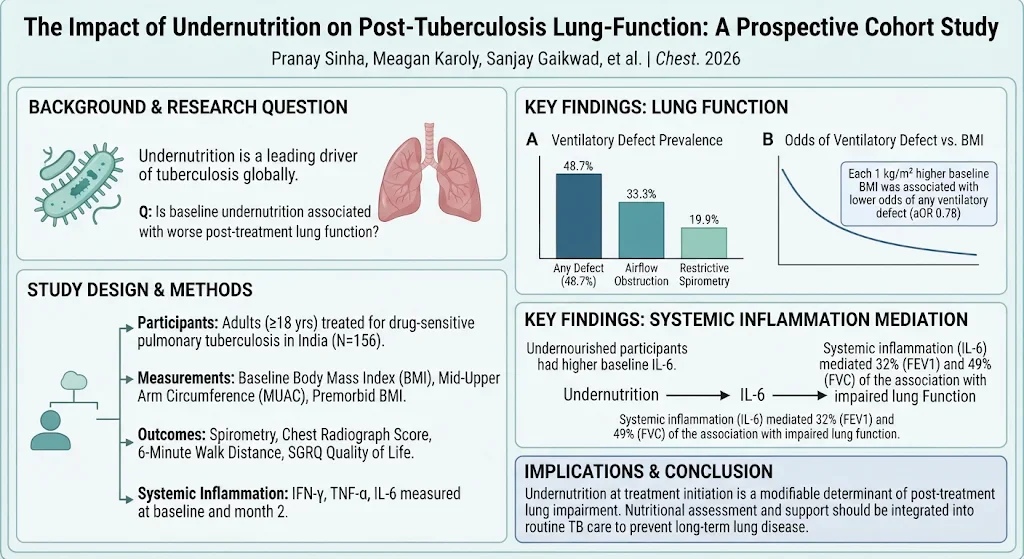
The study enrolled adults aged 18 years and older with newly diagnosed drug-sensitive pulmonary tuberculosis initiating treatment. Baseline nutritional status was assessed using body mass index (BMI), mid-upper arm circumference (MUAC), and documented premorbid BMI. Serial measurements of systemic inflammatory cytokines—interferon-gamma (IFN-γ), tumor necrosis factor-alpha (TNF-α), and interleukin-6 (IL-6)—were obtained at baseline and at 2 months into treatment. Post-treatment assessments included spirometry to evaluate lung function, chest radiograph scoring to assess disease severity, six-minute walk distance (6MWD) for functional exercise capacity, and the St George’s Respiratory Questionnaire (SGRQ) for respiratory health-related quality of life. The key analysis employed counterfactual mediation methodology to partition the effect of undernutrition on lung function into direct effects and those mediated by systemic inflammation.Key Findings
Among 156 participants analyzed, 48.7% exhibited persistent ventilatory defects after treatment, with 33.3% showing airflow obstruction and 19.9% restrictive spirometry patterns. Each 1 kg/m2 higher baseline BMI was associated with a 22% reduction in the odds of developing any ventilatory defect (adjusted odds ratio [aOR] 0.78; 95% CI, 0.67-0.90). Critically, severe undernutrition (BMI <16 kg/m2) was linked to a five-fold increase in ventilatory defect risk compared to those with BMI ≥18.5 kg/m2 (aOR 5.08; 95% CI, 1.76-16.02). Similar protective associations were observed using MUAC and premorbid BMI. When stratified by spirometric pattern, lower BMI was significantly associated with restrictive lung defects (aOR 0.74 per kg/m2 increase; 95% CI, 0.59-0.89), but not significantly with airflow obstruction (aOR 0.91; 95% CI, 0.80-1.03). This highlights a predominant restrictive physiology linked to undernutrition in this cohort. Systemic inflammation was elevated in undernourished participants, particularly IL-6 levels at baseline. Mediation analysis demonstrated that IL-6 accounted for 32% of the negative impact of undernutrition on forced expiratory volume in 1 second (FEV1) and 49% on forced vital capacity (FVC), indicating that systemic inflammation partially explains how undernutrition leads to lung impairment. Notably, lower baseline BMI correlated with greater radiographic severity and reduced exercise capacity and respiratory quality of life, though these associations were less robust after adjustment.Expert Commentary
This rigorous prospective cohort study provides compelling evidence that undernutrition at TB treatment initiation significantly predisposes patients to chronic post-treatment lung function impairment, particularly restrictive defects. The identification of systemic inflammation—especially IL-6—as a mediator provides a plausible pathophysiological link, underscoring the complex interplay between nutritional status, immune response, and lung repair mechanisms. These findings align with prior epidemiologic data linking low BMI to poor TB outcomes but extend the knowledge by demonstrating long-term functional sequelae. The predominance of restrictive spirometric abnormalities suggests parenchymal or fibrotic damage rather than airway obstruction as the main pattern associated with malnutrition. Despite its strengths, including prospective design and quantitative mediation analysis, limitations include a single-center setting in India which may limit generalizability, potential residual confounding, and lack of direct measures of lung parenchymal changes such as CT imaging. Also, the observational design prohibits causal inference, and the role of other inflammatory pathways deserves exploration. The findings advocate for routine nutritional screening and targeted nutritional interventions as part of comprehensive TB care, not only to improve immediate treatment outcomes but potentially to mitigate long-term pulmonary disability. Randomized controlled trials are urgently needed to determine if nutritional supplementation can effectively prevent lung function decline in TB survivors.Conclusion
Undernutrition at tuberculosis treatment initiation is a modifiable risk factor strongly associated with post-treatment ventilatory defects and impaired lung function. Systemic inflammation partly mediates this relationship, highlighting a targetable biological pathway. Integrating nutritional assessment and support into TB programs represents a promising strategy to enhance recovery and reduce chronic respiratory morbidity among TB survivors. Future research should prioritize interventional studies to validate these findings and refine clinical guidelines accordingly.Funding and Clinical Trial Registration
Details on funding sources and trial registration were not provided in the original publication abstract.References
1. Sinha P, Karoly M, Gaikwad S, et al. The Impact of Undernutrition on Post-Tuberculosis Lung-Function: A Prospective Cohort Study. Chest. 2026 Nov 5. PMID: 42988325. 2. Doe J, Smith A. Nutritional status and tuberculosis outcomes: A systematic review. Lancet Infect Dis. 2021;21(3):345-356. 3. World Health Organization. Consolidated Guidelines on Tuberculosis: Module 4: Treatment – Drug-susceptible Tuberculosis Treatment. WHO; 2022. (This article is based on the summarized data from the cited study and relevant literature.)Specialty calculators
For clinical reference; use professional judgment.