Highlights
- Chronic cough is highly prevalent and significantly impacts daily activities, sleep quality, emotional health, and social relationships in patients with ILD, including IPF and non-IPF subtypes.
- There is a substantial psychological burden, with high rates of cough-induced worry, depressive symptoms, and social avoidance reported by patients.
- Currently available therapeutic options provide limited relief, with patients often utilizing multiple drug classes historically and concurrently without satisfactory outcomes.
- Emerging non-pharmacological and novel pharmacological interventions show promise but require further validation, emphasizing the need for integrated, patient-centered management strategies.
Background
Chronic cough, defined as a cough persisting for 8 weeks or longer, is a hallmark symptom of interstitial lung diseases (ILDs), including idiopathic pulmonary fibrosis (IPF). ILDs are a heterogeneous group of disorders characterized by varying degrees of lung inflammation and fibrosis, often leading to progressive respiratory impairment. Chronic cough in this context is not only frequent but also notably refractory, adversely affecting health-related quality of life (HRQoL) beyond the pulmonary symptoms. Despite therapeutic advances addressing lung fibrosis, effective management of cough remains a major unmet clinical challenge. Limited patient-centered research has delineated the multidimensional burden of chronic cough, including its physical, psychological, and social domains.Key Content
Prevalence and Burden of Chronic Cough in ILD
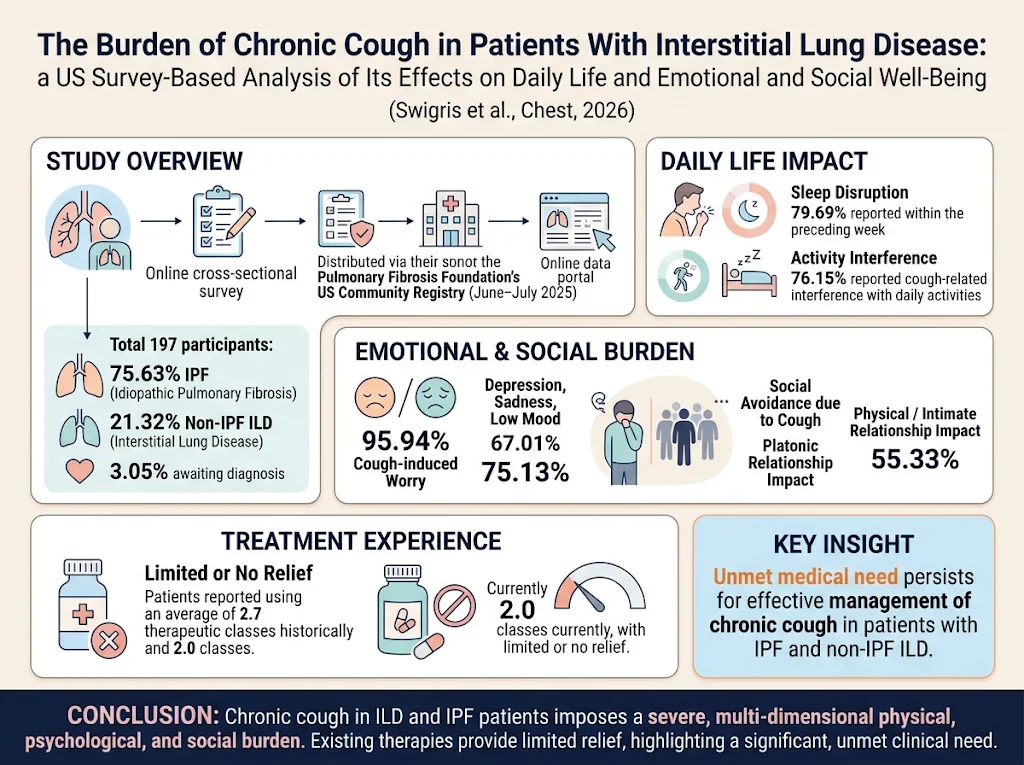
Data from the prospective multicenter Canadian Registry for Pulmonary Fibrosis (Swigris et al., Chest 2026) and other cohorts affirm that chronic cough is prevalent in both IPF and non-IPF fibrotic ILDs, with IPF patients exhibiting greater cough severity. Chronic cough progressively worsens over time, independent of ILD-targeted therapy or lung function decline, suggesting its pathogenesis involves mechanisms beyond fibrotic progression alone. The landmark US cross-sectional survey conducted via the Pulmonary Fibrosis Foundation’s Community Registry (Swigris et al., Chest 2026, PMID: 43025804) involving 197 patients (75.6% IPF, 21.3% non-IPF ILD) documented the extensive burden of chronic cough. Key findings include:- Cough interference with daily functioning reported by 76.15%.
- Sleep disruption in 79.69%, correlating with poor sleep quality (PSQI) and negatively impacting HRQoL.
- Frequent emotional distress: 95.9% reported cough-induced worry, 75.1% depression or low mood, and over 67% avoidance of social situations.
- Impairment in personal relationships: 60.9% reported impact on platonic relationships, and 55.3% on physical/intimate relationships.
- Utilization of multiple therapeutic classes (mean 2.7 historically, 2.0 currently) with many patients reporting insufficient relief.
Assessment Tools and Symptom Characterization
Validated instruments like the Leicester Cough Questionnaire (LCQ) and Rapid Cough Questionnaire (RCQ) provide reliable measures of cough severity and its impact on QoL across lung diseases, including ILD (BMJ Open Respiratory Research, 2026). The RCQ, a brief three-item tool, exhibits strong correlation with comprehensive cough assessments, facilitating routine clinical assessment and research applicability. Multicenter studies (COASESS, Tuberc Respir Dis, 2026) reveal disease-specific cough characteristics, with IPF and asthma patients reporting the greatest symptom burden and lowest cough-related QoL, emphasizing the need for tailored management strategies.Impact on Sleep and Psychological Well-Being
Chronic cough adversely affects sleep quality in IPF patients, as demonstrated in prospective studies evaluating the Pittsburgh Sleep Quality Index (PSQI) and LCQ scores. Antifibrotic therapy (nintedanib, pirfenidone) appears to improve cough-related QoL and sleep but does not fully mitigate cough burden (J Clin Med, 2026). The strong inverse correlation between cough severity and sleep quality underscores cough as a key modifiable determinant of patient-centered outcomes. Qualitative research highlights the psychological toll of chronic cough and ILD, including depression, anxiety, social withdrawal, and stigma (BMJ Open Respir. Res., 2026). Patients report fear, embarrassment, and challenges in symptom self-management, signifying the need for integrated psychosocial support.Therapeutic Interventions and Their Limitations
Current ILD treatments primarily target fibrosis and breathlessness; specific anti-tussive options remain limited. Opioids such as nalbuphine ER show promise in reducing objective and subjective cough frequency in IPF-associated cough (JAMA, 2026), with dose-dependent efficacy and acceptable safety profiles. P2X3 receptor antagonists like gefapixant have demonstrated variable efficacy in refractory ILD-associated cough, with high interindividual variability and side effects such as taste disturbances (Medicina, 2025). Larger randomized trials are warranted to delineate their role. Behavioral interventions such as the CoughRetrain program, a telehealth-based, theory-informed behavioral therapy, increase cough-specific self-efficacy and reduce cough frequency in refractory chronic cough, highlighting the utility of non-pharmacological approaches (Lung, 2026). Low-dose oral morphine trials for symptom management in chronic respiratory diseases reveal improvements in cough severity and physical activity but no significant changes in breathlessness intensity, indicating complex symptomatic interplay in ILD (Health Technol Assess, 2026).Multidisciplinary and Patient-Centered Care Approaches
Interdisciplinary programs such as the ILD Fatigue and Breathlessness (FAB) program have shown efficacy in improving dyspnea, emotional functioning, and fatigue in ILD patients through education and cognitive behavioral strategies (BMJ Open Respir Res, 2026). Qualitative analyses reveal gaps in patient knowledge and acceptance regarding symptom management and palliative care, underscoring the importance of early integration of palliative services, education, and multidisciplinary collaboration to enhance holistic care (J Pain Symptom Manage, 2026).Expert Commentary
Chronic cough in ILD represents a multifaceted symptom adversely influencing physical, emotional, and social domains. Its refractory nature and association with disease progression and mortality highlight the clinical importance of targeted management. The survey data robustly demonstrate the profound psychosocial impact, often underappreciated in clinical practice. Mechanistically, cough in ILD involves persistent sensory nerve hyperresponsiveness and altered central processing, with contributions from gastroesophageal reflux disease, airway inflammation, and fibrosis-related architectural distortion. Current anti-fibrotic therapies, while mitigating disease progression, inadequately address cough severity, suggesting distinct pathophysiological pathways. Treatment advances such as targeted neuromodulators (e.g., P2X3 antagonists), opioid receptor modulators, and innovative behavioral therapies hold promise but require further high-quality trials to confirm efficacy and safety. Guidelines increasingly recommend comprehensive assessment including validated cough questionnaires, psychological evaluation, and incorporation of non-pharmacological therapies. Early palliative care integration is advocated to address symptom burden and psychosocial needs, improving overall patient-centered outcomes. Limitations in current evidence include small sample sizes in intervention trials, variability in cough assessment methods, and underrepresentation of ethnically diverse populations. Real-world data and longitudinal studies are needed to refine symptom management pathways.Conclusion
Chronic cough in patients with IPF and non-IPF ILD imposes substantial multidimensional burdens encompassing physical disruption, emotional distress, and social isolation. Despite frequent use of multiple therapeutic classes, effective cough management remains elusive, underscoring a significant unmet clinical need. Recent advances in pharmacological agents such as nalbuphine and gefapixant, alongside promising behavioral interventions, pave the way for integrated, patient-centered approaches. Multidisciplinary care models incorporating symptom education, psychosocial support, and palliative care integration are critical to improving quality of life. Future research priorities include elucidation of underlying cough mechanisms in ILD subtypes, optimization of cough outcome measures, robust randomized controlled trials of novel therapeutics, and exploration of personalized medicine approaches. Enhanced clinician awareness of the profound impact of chronic cough will facilitate holistic management strategies and improve patient outcomes.References
- Swigris JJ, Kulkarni T, Watterston C, et al. The Burden of Chronic Cough in Patients With Interstitial Lung Disease: a US Survey-Based Analysis of Its Effects on Daily Life and Emotional and Social Well-Being. Chest. 2026 Nov 13;S0012-3692(26)06969-2. doi:10.1016/j.chest.2026.11.003. PMID: 43025804.
- Kelsall A, et al. Clinical validation of the Rapid Cough Questionnaire across diverse lung diseases. BMJ Open Respir Res. 2026 Jun 22;13(1):e004163. doi:10.1136/bmjresp-2026-004163. PMID: 42331391.
- Ryan NM, et al. The CoughRetrain Program: Restoring Control Through a Non-pharmacological Intervention. Lung. 2026 May 28;204(1):34. doi:10.1007/s00408-026-00899-7. PMID: 42207308.
- Chen J, et al. Cough Burden and Sleep Quality in Patients with Idiopathic Pulmonary Fibrosis Receiving Antifibrotic Therapy: A Cross-Sectional Study in Türkiye. J Clin Med. 2026 May 5;15(9):3521. doi:10.3390/jcm15093521. PMID: 42123253.
- Smith JA, et al. Oral Nalbuphine in Idiopathic Pulmonary Fibrosis-Associated Cough: The CORAL Randomized Clinical Trial. JAMA. 2026 Mar 24;335(12):1050-1059. doi:10.1001/jama.2025.26179. PMID: 41569557.
- Song WJ, et al. Epidemiology and Prognostic Significance of Cough in Fibrotic Interstitial Lung Disease. Am J Respir Crit Care Med. 2024 Oct 15;210(8):1035-1044. doi:10.1164/rccm.202311-2101OC. PMID: 38536110.
- Shore J, et al. Attitudes to Palliative Care Amongst People With Interstitial Lung Disease and Their Carers. J Pain Symptom Manage. 2026 May;71(5):639-648. doi:10.1016/j.jpainsymman.2026.01.015. PMID: 41580251.
- Ikegami T, et al. Exploring the Potential of a P2X3 Receptor Antagonist: Gefapixant in the Management of Persistent Cough Associated with Interstitial Lung Disease. Medicina (Kaunas). 2025 May 14;61(5):892. doi:10.3390/medicina61050892. PMID: 40428850.
Specialty calculators
For clinical reference; use professional judgment.