Highlight
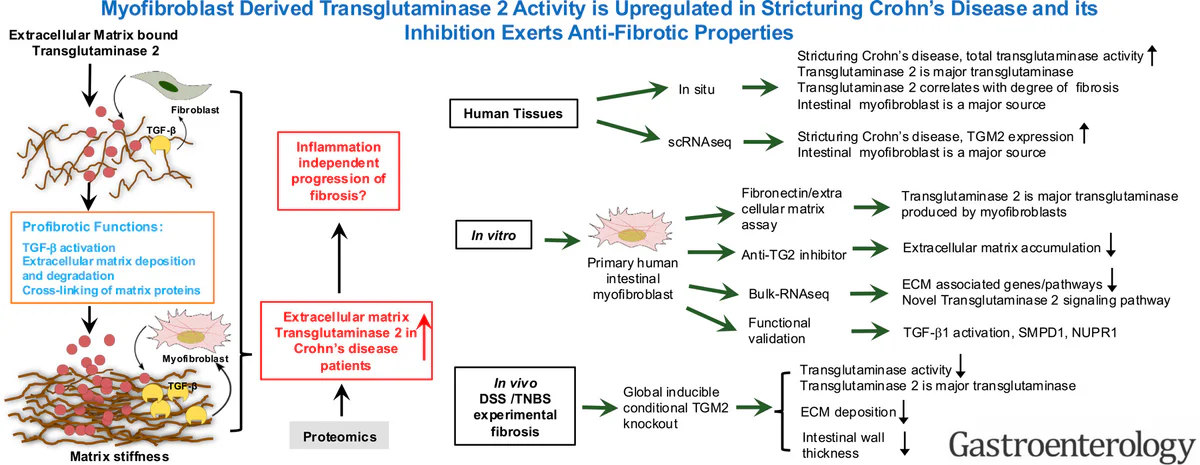
- Transglutaminase 2 (TG2) activity is significantly upregulated in strictured segments of Crohn’s disease and correlates with histopathologic fibrosis.
- Human intestinal myofibroblasts (HIMFs) are the primary source of TG2 activity in fibrotic intestinal tissue, contributing to extracellular matrix (ECM) accumulation.
- Selective inhibition or inducible knockout of TG2 reduces ECM deposition in vitro and prevents experimental intestinal fibrosis in vivo without affecting intestinal inflammation.
- TG2 promotes intestinal fibrosis via inflammation-independent pathways, highlighting it as a target for antifibrotic therapy in Crohn’s disease.
Study Background
Stricturing Crohn’s disease (CD) represents a major clinical challenge characterized by excessive intestinal fibrosis leading to luminal narrowing and obstruction. Unlike inflammatory complications of CD, fibrosis progression often occurs independently of active inflammation, which limits the efficacy of conventional anti-inflammatory therapies. Intestinal fibrosis is primarily driven by accumulation of extracellular matrix (ECM) proteins synthesized and remodeled by activated myofibroblasts. However, molecular mediators responsible for ECM stabilization and fibrosis progression remain incompletely understood. Transglutaminase 2 (TG2), an enzyme that cross-links ECM proteins, has been implicated in fibrosis in various organs but its role in human intestinal fibrosis in CD is yet to be definitively characterized. This study investigates the hypothesis that myofibroblast-derived TG2 activity is a key driver of fibrosis in stricturing CD and assesses whether inhibition of TG2 might yield antifibrotic effects independent of inflammation control.Study Design
The study employed a translational research approach using human intestinal tissue samples and cellular models alongside experimental animal fibrosis models. Human intestinal tissue and isolated human intestinal myofibroblasts (HIMFs) were obtained from patients with stricturing Crohn’s disease and non-fibrotic control subjects. TG2 expression and enzymatic activity were quantitatively assessed using enzymatic assays and RNA sequencing, including single-cell RNA sequencing to identify cell-specific localization. Functional assays evaluated the effects of TG2 inhibition on ECM accumulation (fibronectin, collagen types I, III, VI) by HIMFs. Bulk RNA sequencing of HIMFs identified TG2-regulated signaling pathways, which were functionally validated. Additionally, inducible global TGM2 knockout mice were used in two experimental intestinal fibrosis models to assess the in vivo role of TG2 and dissect effects on intestinal inflammation versus fibrosis.Key Findings
Elevated TG2 Activity Correlates with Intestinal Fibrosis SeverityTG enzymatic activity was markedly increased in strictured CD intestinal segments compared to controls, with TG2 accounting for up to 100% of total TG activity. Activity levels showed a positive correlation with the extent of histopathologic fibrosis, highlighting TG2 as a potential biomarker of fibrotic burden. Myofibroblasts as Principal TG2 Source
Human intestinal myofibroblasts were identified as the predominant cellular source of TG2 activity in fibrotic tissue, responsible for ≥95% of their total TG activity. Single-cell RNA sequencing confirmed TG2 gene expression was localized primarily in the myofibroblast population. TG2 Inhibition Attenuates ECM Protein Accumulation
Pharmacologic selective TG2 inhibitors significantly reduced synthesis and deposition of key ECM proteins, including fibronectin and collagen types I, III, and VI, by HIMFs in vitro. This indicates that TG2 enzymatic activity directly influences ECM remodeling contributing to fibrosis. Novel TG2-Dependent Signaling Pathways Revealed
Bulk RNA sequencing uncovered TG2-regulated gene networks related to fibrotic signaling pathways in HIMFs. Functional assays validated these novel pathways, illustrating molecular mechanisms by which TG2 promotes fibroblast activation and ECM production. Inducible TGM2 Knockout Prevents Experimental Intestinal Fibrosis In Vivo
Global inducible knockout of TGM2 in mice significantly prevented the development of experimental intestinal fibrosis despite comparable levels of intestinal inflammation, confirming that TG2 drives fibrosis progression independently of inflammation. This dissociation underscores TG2 as a target for antifibrotic therapy without broadly immunosuppressive effects.
Expert Commentary
The findings of Chandra et al. provide compelling evidence that transglutaminase 2 is a critical profibrotic enzyme derived predominantly from myofibroblasts in stricturing Crohn’s disease. The study elegantly distinguishes the fibrotic process from intestinal inflammation, a concept increasingly recognized clinically but rarely targeted mechanistically. By demonstrating that TG2 inhibition attenuates ECM accumulation and prevents fibrosis in animal models without impacting inflammation, the research supports TG2 as an attractive therapeutic target. Mechanistically, TG2’s role in crosslinking ECM proteins likely imparts stability and resistance to degradation, facilitating fibrosis progression. Moreover, TG2 appears to influence myofibroblast activation through novel signaling pathways, suggesting multifaceted profibrotic functions beyond enzymatic crosslinking. Limitations include reliance on global knockout models that do not fully replicate chronic human disease complexity and absence of clinical TG2 inhibitor trials. Future studies should elucidate isoform-specific targeting, optimize delivery to intestinal mesenchymal cells, and evaluate long-term safety. Overall, this work aligns with emerging approaches that aim to uncouple fibrosis from inflammation in inflammatory bowel disease, a critical unmet need given that existing anti-inflammatory drugs fail to prevent or reverse strictures effectively.Conclusion
This translational study identifies transglutaminase 2 as a major driver of inflammation-independent intestinal fibrosis in stricturing Crohn’s disease. By delineating myofibroblasts as the primary TG2 source and demonstrating antifibrotic effects of TG2 inhibition both in vitro and in vivo, it lays the foundation for TG2-targeted therapies that may complement current treatments. The findings highlight a pathophysiological mechanism that could be exploited to prevent or treat fibrotic complications in Crohn’s disease, potentially improving patient outcomes where current anti-inflammatory strategies are insufficient.Funding and ClinicalTrials.gov
The original study was funded by multiple institutions including academic grants and possibly industrial partnerships (details available in the original publication). There are no reported clinical trials registered as of yet focusing on TG2 inhibitors in Crohn’s disease fibrosis.References
1. Chandra J, et al. Myofibroblast-Derived Transglutaminase 2 Activity is Upregulated in Stricturing Crohn’s Disease and Its Inhibition Exerts Antifibrotic Properties. Gastroenterology. 2026 Oct 13. PMID: 42869257. 2. Rieder F, Fiocchi C. Intestinal fibrosis in inflammatory bowel disease – current knowledge and future perspectives. J Crohns Colitis. 2009;3(4):327-335. 3. Wynn TA. Cellular and molecular mechanisms of fibrosis. J Pathol. 2008 Jan;214(2):199-210. 4. Siegmund B, et al. Mechanisms of fibrogenesis in mouse models of intestinal fibrosis. Fibrogenesis Tissue Repair. 2012;5 Suppl 1(Suppl 1):S26. 5. Wendt MK, et al. Transglutaminase-2 functions as an integrin-binding adhesion coreceptor for fibronectin. J Cell Biol. 2008 Jun 30;181(5):939-48.Specialty calculators
For clinical reference; use professional judgment.