Highlight
- Dupilumab demonstrated greater clinical improvement in moderate-to-severe pediatric atopic dermatitis (AD) than methotrexate or cyclosporine, regardless of skin color.
- Both White and non-White children showed significant improvements in eczema severity and quality of life with dupilumab treatment.
- Itch reduction was most notable with dupilumab; cyclosporine was the least effective in symptom relief.
- Adverse event rates were higher in White children, particularly with cyclosporine, although dupilumab had a favorable safety profile across groups.
Study Background
Atopic dermatitis is a chronic, relapsing inflammatory skin disease predominantly affecting children, characterized by pruritus, xerosis, and eczematous lesions. The disease severity and phenotypic expression can differ substantially across ethnic groups due to genetic, immunological, and environmental factors. Prior research has suggested variable disease burden and treatment responses linked to race and ethnicity, underscoring the importance of evaluating systemic therapies in diverse populations.
Systemic treatment options for moderate-to-severe pediatric AD include biologics such as dupilumab—an IL-4 receptor alpha antagonist targeting type 2 inflammation—and traditional immunosuppressants like methotrexate and cyclosporine. Real-world data comparing effectiveness and safety outcomes across different racial subgroups remain limited.
Study Design and Methods
The Pediatric Eczema Disease Registry (PEDISTAD) is an international, multicenter, observational registry capturing longitudinal real-world data on children under 12 years with moderate-to-severe AD receiving systemic treatments. This analysis stratified participants into White and non-White groups; the non-White cohort included Black/African American, Asian, American Indian or Alaskan Native, and multiracial children.
Clinical outcomes included changes in the Eczema Area and Severity Index (EASI), patient-reported itch severity, and quality-of-life measures. Safety was assessed by exposure-adjusted adverse event rates per 100 person-years. The main systemic interventions compared were dupilumab, methotrexate, and cyclosporine, reflecting contemporary and traditional therapies.
Key Findings
Participant Characteristics
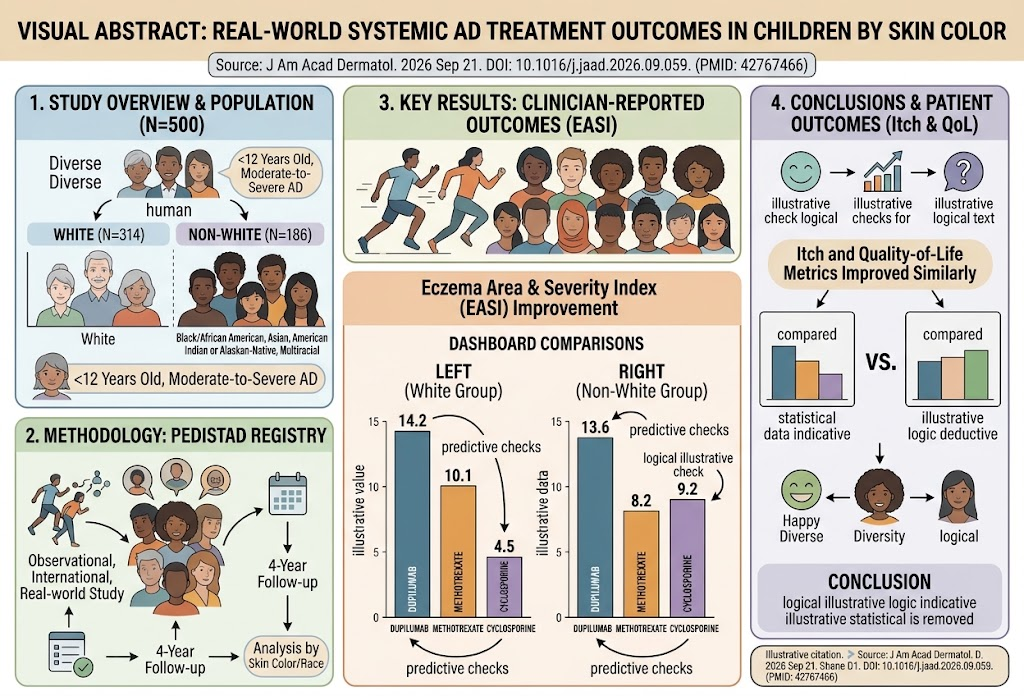
A total of 500 children were included: 314 White and 186 non-White, all younger than 12 years with moderate-to-severe AD requiring systemic therapy.
Effectiveness Outcomes
All treatments achieved statistically significant improvements in EASI scores across racial groups. In non-White patients, mean improvements were 13.6 points with dupilumab, 8.2 with methotrexate, and 9.2 with cyclosporine; in White patients, improvements were 14.2, 10.1, and 4.5 points, respectively. Dupilumab consistently yielded the highest magnitude of improvement, with clinically meaningful gains across both populations.
Itch severity reduction mirrored these trends: dupilumab demonstrated significant itch alleviation in both groups, whereas cyclosporine showed the least benefit. Improvements in quality-of-life metrics paralleled EASI and itch findings, with dupilumab recipients reporting greater enhancements than those on methotrexate or cyclosporine, independent of skin color.
Safety Profile
Exposure-adjusted adverse event rates varied by treatment and race. White children exhibited higher adverse event rates per 100 person-years (33.33 for dupilumab, 33.24 for methotrexate, 58.33 for cyclosporine) compared to non-White children (28.28, 20.86, and 28.72 respectively). Despite this, dupilumab maintained a favorable safety and tolerability profile across all groups, with comparatively fewer adverse events than cyclosporine.
Expert Commentary
The PEDISTAD registry provides robust real-world evidence supporting dupilumab as an effective and well-tolerated systemic therapy for pediatric moderate-to-severe AD across diverse racial backgrounds. The consistent benefits observed in both White and non-White children underscore the broad applicability of dupilumab in heterogeneous populations, a critical consideration given the variable disease pathogenesis and phenotypes in different ethnic groups.
Cyclopsorine’s lower efficacy in itch reduction and higher adverse event rates, especially among White children, highlight the need for careful patient selection and monitoring when using this agent. Methotrexate demonstrated intermediate effectiveness but with fewer adverse events relative to cyclosporine. These findings align with evolving clinical guidelines advocating for biologics as preferred systemic agents in pediatric AD due to their targeted mechanism and safety advantages.
Limitations of this observational study include potential confounding by indication, variability in treatment regimens, and the heterogeneous non-White subgroup, which may mask ethnic-specific nuances. Nevertheless, the data fill critical gaps in understanding real-world treatment outcomes beyond clinical trial populations often underrepresenting minorities.
Conclusion
The PEDISTAD registry analysis confirms that dupilumab is superior in improving clinician- and patient-reported outcomes compared to methotrexate and cyclosporine in children with moderate-to-severe AD, with comparable efficacy across White and non-White racial groups. These findings support dupilumab as a front-line systemic therapy option regardless of skin color, addressing an unmet need for effective and safe treatments in diverse pediatric patients.
Future research should explore tailored therapeutic strategies considering genetic and immunologic differences contributing to heterogeneous treatment responses, alongside longer-term safety and health economics evaluations in real-world cohorts.
Funding and Clinical Trials
This study was supported by the PEDISTAD registry funding sources as detailed in the original publication. No additional clinical trial registration information was provided in the abstract.
References
- Paller AS, Eichenfield LF, Lee LW, Ramien M, Ma L, López Carrera YI, Joyce JC, Gonzalez ME, Capozza K, Hamad S, Ardeleanu M, Zhang A. Real-World Systemic Treatment Outcomes for Moderate-to-Severe Atopic Dermatitis in Children by Skin Color: 4-Year Results from the observational, international, real-world PEDISTAD Registry. J Am Acad Dermatol. 2026 Sep 21. PMID: 42767466.
- Silverberg JI. Atopic dermatitis in diverse racial and ethnic groups—variations in epidemiology, genetics, clinical presentation and treatment. Exp Dermatol. 2017;26(5):356-362.
- Beck LA, Thaçi D, Hamilton JD, et al. Dupilumab treatment in adults with moderate-to-severe atopic dermatitis. N Engl J Med. 2014;371:130-139.
- Eichenfield LF, Tom WL, Chamlin SL, et al. Guidelines of care for the management of atopic dermatitis: Section 2. Management and treatment of atopic dermatitis with topical therapies. J Am Acad Dermatol. 2014 May;71(1):116-32.