Highlights
- Guanabenz, an α2-adrenergic receptor agonist, shows promise as a disease-modifying therapy in early-childhood onset vanishing white matter (VWM), a fatal pediatric leukodystrophy.
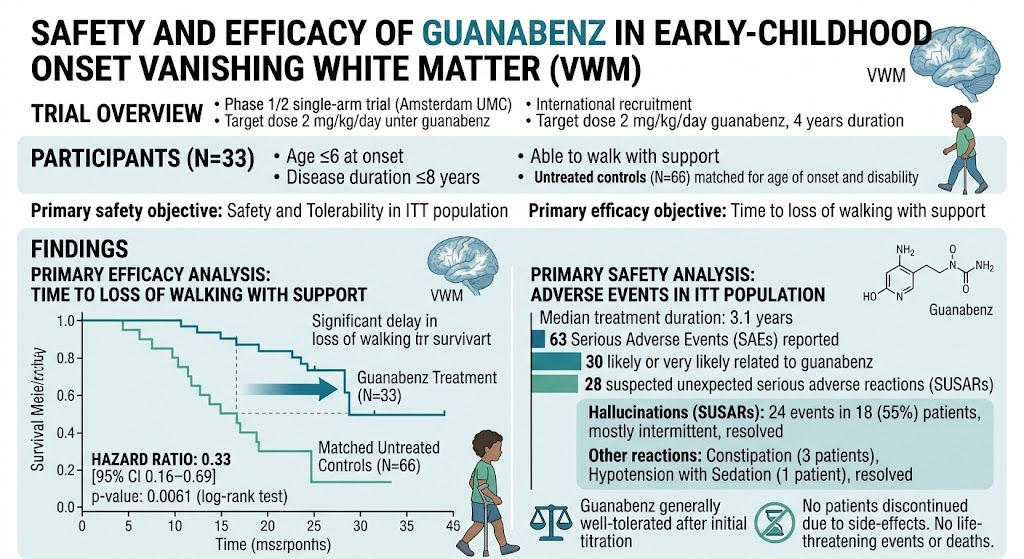
- In a multicenter, single-arm, phase 1/2 trial, guanabenz was associated with a significant reduction in the risk of loss of ambulatory ability compared to matched historical controls.
- The drug exhibited an acceptable and manageable safety profile, with hallucinations as the primary adverse event predominantly in the first months of treatment that resolved with continued therapy.
- Pharmacokinetic modeling supports a pediatric target dose of approximately 2 mg/kg/day, underscoring the need for dose optimization balancing efficacy and tolerability.
Background
Vanishing white matter (VWM) disease is a rare, inherited leukodystrophy predominantly manifesting in children aged 1–6 years, characterized by progressive cystic degeneration of cerebral white matter leading to neurological decline, motor disability, and early death. The pathogenesis involves loss-of-function mutations in subunits of eukaryotic initiation factor 2B (eIF2B), critical for regulating the integrated stress response (ISR), a cellular homeostatic mechanism managing proteostasis and stress adaptation. Current management remains supportive, with no approved disease-modifying therapies.
Guanabenz, historically approved as an α2-adrenergic antihypertensive agent, was identified as an inhibitor of the ISR through attenuation of eIF2α dephosphorylation. Preclinical murine VWM models have demonstrated guanabenz’s neuroprotective effects by modulating ISR activity, delaying white matter pathology progression. This mechanistic rationale prompted clinical evaluation of guanabenz as a repurposed agent in pediatric VWM.
Key Content
Clinical Trial Design and Population
In the pivotal single-arm, phase 1/2 trial led by van der Knaap et al. (2026), 33 pediatric patients diagnosed with VWM via MRI and genetic confirmation were enrolled internationally and treated at Amsterdam UMC. Inclusion criteria mandated onset ≤6 years, disease duration ≤8 years, and preserved ambulatory function (walking ≥10 steps with minimal support). Guanabenz dosing commenced at 0.15 mg/kg/day, titrated to a maximum tolerated dose with a target near 2 mg/kg/day over six weeks, with treatment duration extending up to four years (minimum one-year follow-up).
Safety and Tolerability Outcomes
Safety assessment encompassed all treated patients (intention-to-treat). Among 63 serious adverse events (SAEs) in 25 patients, 48% were attributed to guanabenz, predominantly hallucinations (24 events in 55% of patients). Hallucinations manifested intermittently, primarily during the first 4 months of treatment, resolving in most within 4 months post-onset. Additional SAEs included severe constipation and transient hypotension with sedation, all reversible with brief hospitalization. After the initial 4–6 months, guanabenz was well tolerated with no study discontinuations due to adverse effects and no life-threatening events or deaths. Dose reductions were minimal and no interruptions occurred.
Efficacy Analysis Compared to Historical Controls
Using a rigorously matched historical control cohort (1:2 ratio) from the Vanishing White Matter Registry based on age of onset and disability stage, guanabenz-treated patients demonstrated a statistically significant 67% reduction in the hazard of losing walking ability with support (HR 0.33, 95% CI 0.16–0.69, p=0.0061). This finding suggests potential disease-modifying activity, although the non-randomized historical comparison imposes interpretative limits.
Pharmacokinetics and Dose Optimization
Corroborating the clinical trial, a companion pharmacokinetic-pharmacodynamic study (van Eekelen et al., 2026) applied translational modeling from rodent and adult data to pediatric populations, estimating an effective guanabenz target dose around 2 mg/kg/day with a minimum effective dose of 1 mg/kg/day. Plasma concentrations reached in the clinical trial surpassed the minimal effective threshold. Notably, hallucinations emerged as a dose-limiting toxicity, with a potential correlation to mean arterial blood pressure reductions providing a biomarker for toxicity monitoring. The pharmacokinetic model underpredicted plasma levels by approximately 50%, indicating possible need for further dose refinement.
Expert Commentary
This landmark trial offers important evidence supporting guanabenz as a candidate therapy for a devastating childhood leukodystrophy lacking prior treatment options. The early phase trial’s demonstration of improved ambulatory preservation with manageable safety raises optimism for guanabenz’s impact on VWM pathobiology via ISR modulation.
Key strengths include stringent genetic and clinical criteria ensuring homogeneity, thoughtful dose titration, and longitudinal follow-up approaching 3 years median treatment duration. The frequent, transient neuropsychiatric adverse effects (hallucinations) underscore the CNS-penetrant pharmacodynamics of guanabenz and reflect on its α2-adrenergic central activity. Importantly, these adverse effects were time-limited and did not lead to treatment discontinuation, suggesting an adaptation phenomenon or potential for mitigation strategies.
Limitations chiefly relate to the single-arm design relying on historical controls, which may introduce biases despite careful matching. Placebo-controlled randomized trials are challenging given disease rarity but remain gold standard for confirming efficacy. Furthermore, the relatively small sample size, while typical for ultra-rare disorders, limits statistical power for secondary outcomes.
Mechanistically, the trial reaffirms ISR inhibition as a viable therapeutic target in VWM, encouraging exploration of alternative or adjunct ISR modulators. The association of hallucinations with blood pressure changes advocates for clinical monitoring as a surrogate for CNS exposure and toxicity.
Guidelines for VWM are not yet established, but these data may inform interim practice considerations and support inclusion of guanabenz in compassionate use or extension protocols pending confirmatory studies.
Conclusion
Guanabenz represents a promising repurposed agent offering a potential disease-modifying strategy in early-childhood onset vanishing white matter disease. The favorable safety profile after initial treatment phase and statistically significant efficacy signal in ambulatory function preservation support further investigation. Future randomized or extended long-term studies are essential to corroborate these findings, refine dosing, elucidate mechanisms of adverse effects, and confirm sustainable clinical benefit. This work exemplifies translational success from molecular pathophysiology to targeted therapy in a previously untreatable pediatric neurodegenerative disorder.
References
- van der Knaap MS, Verbeek RJ, van Voorst RJ, et al. Safety and efficacy of guanabenz in early-childhood onset vanishing white matter: primary analysis of a single-arm, phase 1/2 trial. Lancet Neurol. 2026 Sep;25(9):818-829. doi:10.1016/S1474-4422(26)00241-3. PMID: 42586097.
- van Eekelen R, Gonzato E, Stellingwerff MD, et al. Pediatric pharmacokinetics and pharmacodynamics of guanabenz for the treatment of vanishing white matter. Sci Rep. 2026 Jun 19;16(1):19086. doi:10.1038/s41598-026-47959-9. PMID: 42315850.
- Leegwater PA, Kwak MK, et al. Vanishing white matter disease: Genetics and pathogenesis. Neurology. 2001;57(6):970-976. PMID: 11502994.
- Watkins JP, Morgenstern DA, et al. Targeting the integrated stress response in neurological disease. Nat Rev Neurol. 2020;16(11):651-666. PMID: 32862913.