Highlight
This comprehensive study of 585 RAS-positive thyroid nodules with surgical outcomes identifies key molecular and clinical predictors that define malignancy risk and recurrence potential.
Notably, isolated KRAS mutations confer significantly lower malignancy risk compared to NRAS or HRAS mutations.
Copy number alterations, nodule size, and Bethesda cytology categories independently predict malignant or NIFTP outcomes.
Isolated RAS-mutant nodules demonstrate low rates of persistent/recurrent disease, supporting consideration for less extensive surgery or, in select cases, non-surgical management.
Study Background
Thyroid nodules harboring mutations in the RAS gene family (HRAS, NRAS, KRAS) span a broad histologic spectrum from benign lesions to malignancies. RAS mutations disrupt cell signaling pathways, contributing variably to oncogenesis in thyroid tissue. Fine needle aspiration (FNA) biopsy molecular testing often detects these mutations, triggering surgical intervention chiefly due to concerns around malignancy and the potential for follicular variant papillary thyroid carcinoma or follicular thyroid carcinoma.
However, the heterogeneous nature of RAS-positive nodules complicates risk stratification, often leading to diagnostic surgery whose necessity remains debated. Clarifying clinical and molecular predictors that accurately identify malignancy and aggressive behavior among RAS-mutant nodules is imperative to optimize management, minimize overtreatment, and improve patient outcomes.
Study Design
This retrospective single-institution study analyzed a consecutive series of thyroid nodules positive for RAS mutations determined by ThyroSeq v3 molecular testing between 2018 and 2024. Inclusion criteria comprised nodules with either histopathologic surgical diagnosis or at least one year of post-biopsy ultrasound follow-up if non-resected. The study comprised 585 surgically resected RAS-positive nodules and 55 nodules managed non-surgically with follow-up imaging.
Comprehensive clinical data included nodule ultrasound size and Bethesda cytology class, while molecular profiling integrated RAS mutation subtype and presence of copy number alterations (CNAs). Outcomes assessed were final histopathologic diagnoses categorized as benign, non-invasive follicular thyroid neoplasm with papillary-like nuclear features (NIFTP), or carcinoma, as well as disease recurrence or persistence during a median 2.5-year follow-up.
Key Findings
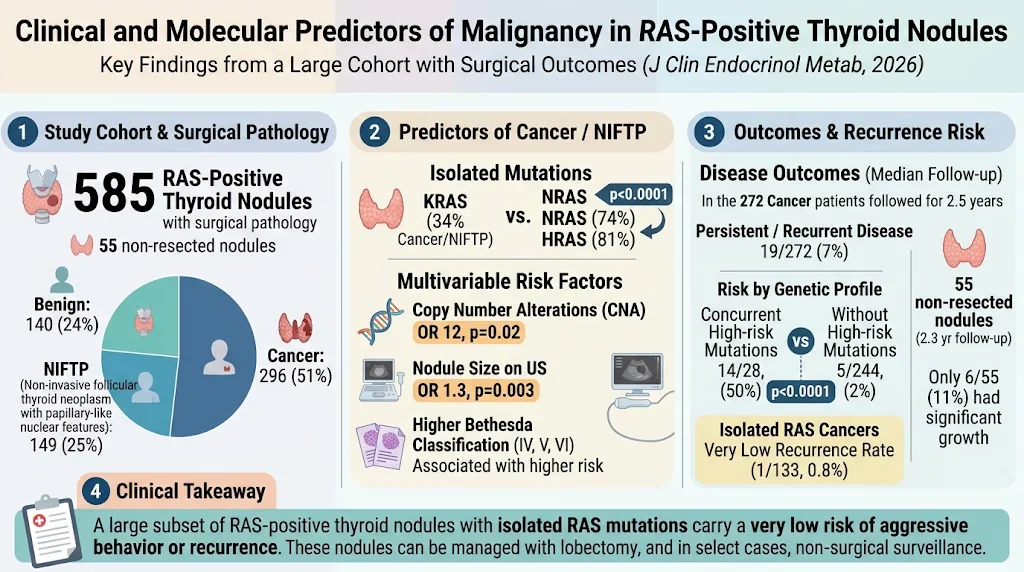
Among the 585 surgically treated nodules, 24% were benign, 25% NIFTP, and 51% malignant. Cancer/NIFTP rates varied significantly by RAS mutation type: isolated KRAS mutations had only a 34% probability of malignancy/NIFTP, substantially lower than NRAS (74%) or HRAS (81%) (p<0.0001), underscoring important biological heterogeneity.
Multivariable logistic regression revealed that presence of CNAs conferred a 12-fold increased odds of malignancy/NIFTP (p=0.02). Larger nodule size on ultrasound (odds ratio [OR] 1.3 per cm, p=0.003) and higher Bethesda categories IV, V, or VI were also independent predictors of cancer/NIFTP, suggesting that integrated clinical and genetic assessment enhances diagnostic precision.
Among 272 patients with thyroid cancer, persistent or recurrent disease during follow-up was noted in only 7% overall. However, the risk was markedly higher in tumors harboring concurrent high-risk mutations (50%) compared to those with RAS mutations alone (2%) (p<0.0001). Isolated RAS-positive cancers demonstrated exceptionally low recurrence (0.8%).
The 55 non-resected nodules showed low rates (11%) of significant volumetric growth over a median 2.3 years, supporting the feasibility of active surveillance in select patients.
Expert Commentary
This robust study advances precision oncology in thyroid nodules by delineating mutational subtype-specific risk profiles within RAS-positive nodules. The differential malignancy risks linked to KRAS versus NRAS/HRAS mutations have biological plausibility given variable downstream signaling pathway activation and tumorigenic potential. The demonstration that CNAs and Bethesda cytology improve malignancy prediction aligns with the heterogeneity of follicular-patterned lesions and their molecular complexity.
Importantly, the extremely low recurrence in isolated RAS-mutant cancers underscores a potential paradigm shift favoring conservative surgical approaches, such as lobectomy, or cautious non-operative monitoring for select low-risk nodules. This aligns with current trends toward individualized care emphasizing morbidity reduction without compromising oncologic safety.
Limitations include retrospective design and relatively short follow-up duration. Longer surveillance is needed to confirm durability of low recurrence risk, and prospective validation in diverse clinical settings would enhance generalizability.
Conclusion
This large, methodologically sound study highlights that clinical parameters combined with detailed molecular profiling—including RAS isoform and CNAs—significantly refine malignancy risk stratification among RAS-positive thyroid nodules.
Isolated KRAS mutations correspond to a substantially lower likelihood of cancer or NIFTP than NRAS or HRAS, suggesting a potential for personalized surgical planning. For isolated RAS nodules, minimal risk of disease persistence or recurrence supports lobectomy or, in selected cases, conservative surveillance, potentially reducing unnecessary total thyroidectomies and related complications.
These insights advance the precision management of thyroid nodules and may influence future guideline recommendations, underscoring the value of integrated molecular diagnostics in tailoring patient-centric care.
Funding and Clinical Trials
No specific funding sources were specified in the original publication. The study appears to be an institutional retrospective analysis without registered prospective clinical trial identifiers.
References
1. Doerfler WR, Argueta AS, Nikitski AV, et al. Clinical and Molecular Predictors of Malignancy in a Series of 585 RAS-positive Thyroid Nodules with Surgical Outcome. J Clin Endocrinol Metab. 2026 Nov 7. PMID: 42995246.
2. Nikiforov YE, et al. Molecular diagnostics in thyroid nodules: Current status and perspectives. Endocr Relat Cancer. 2018.
3. Haugen BR, et al. 2015 American Thyroid Association Management Guidelines for Adult Patients with Thyroid Nodules and Differentiated Thyroid Cancer. Thyroid. 2016.
4. Steward DL, et al. Molecular testing for mutations in thyroid nodules: A path to precision medicine. Expert Rev Mol Diagn. 2020.
Specialty calculators
For clinical reference; use professional judgment.