Highlight
- Eliminating the mandatory 6-month sobriety period increased transplant access for patients with alcohol-associated liver disease (ALD).
- Waitlist mortality and deterioration decreased significantly among ALD patients after policy liberalization.
- Long-term post-transplant survival improved in the era without the sobriety requirement, primarily driven by ALD recipients.
- Shorter pre-transplant sobriety (<6 months) did not worsen adjusted survival or post-transplant complications compared to longer sobriety.
Study Background
Alcohol-associated liver disease (ALD) remains a leading indication for liver transplantation (LT) worldwide, reflecting the substantial morbidity and mortality associated with chronic and acute alcohol-related liver injury. Conventionally, many transplant programs have enforced a mandatory 6-month sobriety period prior to listing ALD patients, intending to reduce relapse risk post-transplant and improve outcomes. However, this requirement has been increasingly questioned for its potential to delay transplantation, thereby increasing waitlist mortality and limiting access for patients who may urgently benefit from LT. Recent shifts towards individualized assessment without a fixed sobriety duration seek to balance timely access with post-transplant risk mitigation. This study evaluates the clinical impacts of removing the mandatory sobriety period, comparing waitlist and post-transplant outcomes in ALD and non-ALD cohorts within a single center over a 13-year period.Study Design
This retrospective cohort study analyzed adult patients listed for liver transplantation at a single center from 2010 through 2023, with follow-up extending to 2025. Two distinct eras were defined: Era 1 (<2018), enforcing a ≥6-month sobriety period before listing ALD patients; and Era 2 (≥2018), in which no formal sobriety duration was mandated. Data collected included patient demographics, liver disease etiology, waitlist outcomes (likelihood of transplant, death/deterioration, waiting times), post-LT survival at 1, 3, and 5 years, and measures of graft rejection, recidivism, and adherence. A subgroup analysis within Era 2 stratified ALD transplant recipients by pre-LT sobriety duration (<6 months vs ≥6 months). Competing risk analyses and survival modeling accounted for confounding variables such as Model of End-stage Liver Disease (MELD) score.Key Findings
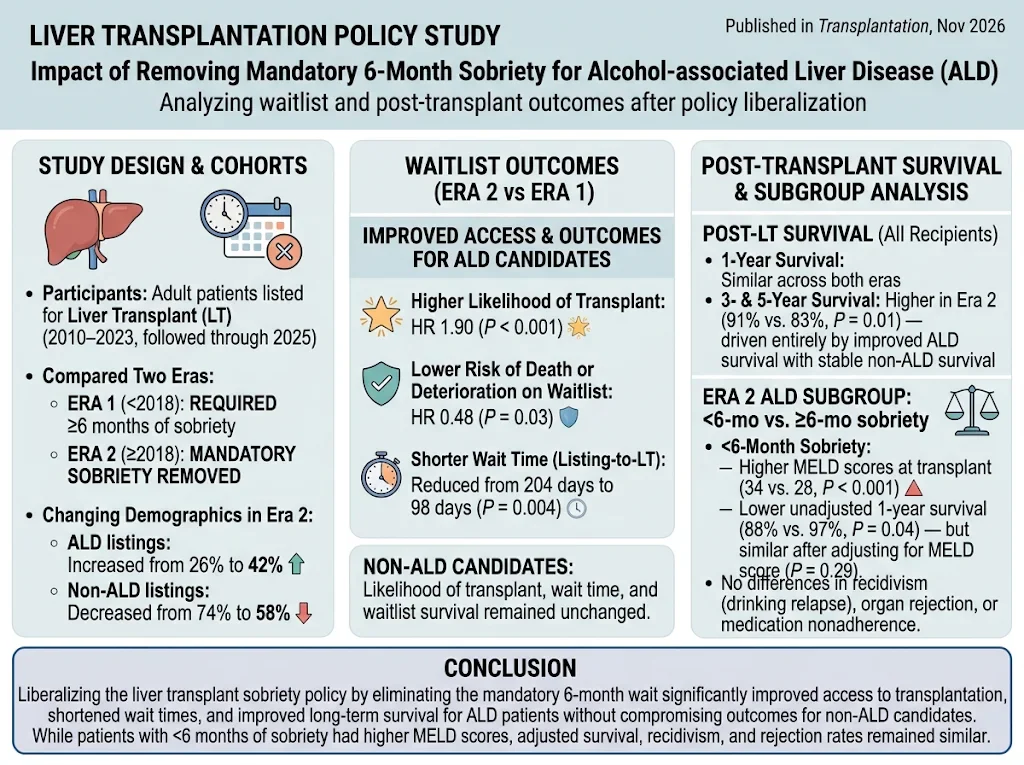
The prevalence of ALD listings significantly increased from 26% in Era 1 to 42% in Era 2, while non-ALD listings correspondingly decreased. This shift reflects broader acceptance and prioritization of ALD candidates following policy liberalization.Waitlist Outcomes:
- ALD candidates in Era 2 had a markedly higher likelihood of receiving LT (hazard ratio [HR] 1.90; P < 0.001) and a lower risk of death or clinical deterioration on the waitlist (HR 0.48; P = 0.03) compared to Era 1.
- Median waiting time from listing to transplant was reduced by more than half for ALD patients (204 days in Era 1 to 98 days in Era 2; P = 0.004).
- Non-ALD patients’ likelihood of transplant, waitlist mortality/deterioration, and waiting times remained stable between eras.
Post-Transplant Survival:
- One-year post-LT survival rates were comparable across both eras.
- However, 3- and 5-year survival improved in Era 2 (83% vs 91%; P = 0.01), driven primarily by better outcomes among ALD recipients; survival for non-ALD recipients did not change significantly.
Subgroup Analysis of Era 2 ALD Recipients:
- Patients transplanted with <6 months sobriety presented with higher median MELD scores (34 versus 28; P < 0.001), indicating more advanced liver disease at listing.
- Unadjusted 1-year survival was lower in the <6 months sobriety group (88% versus 97%; P = 0.04), but adjustment for MELD score eliminated this difference (P = 0.29).
- Rates of alcohol relapse (recidivism), graft rejection, and post-transplant treatment nonadherence were statistically similar between the groups regardless of sobriety duration.
Expert Commentary
This study provides compelling evidence that rigidly enforced sobriety periods may unnecessarily restrict timely liver transplantation for patients with ALD without improving long-term post-transplant outcomes. The significant increase in transplantation rates and reduced waitlist mortality following policy relaxation highlights a critical opportunity to improve access to lifesaving LT. The comparable post-LT outcomes, including relapse and adherence, suggest that individualized psychosocial assessments and support programs may be sufficient to mitigate risks traditionally attributed to early transplantation post-alcohol use. Nonetheless, limitations include the single-center design and potential unmeasured confounding variables, such as evolving transplant listing practices or selection biases. External validation in multicenter cohorts and inclusion of robust addiction medicine interventions would further inform policy refinements. Current guidelines increasingly advocate for a patient-centered approach rather than arbitrary sobriety durations, aligning with these findings and emphasizing comprehensive multidisciplinary evaluation.Conclusion
Removing the mandatory 6-month sobriety requirement in liver transplantation candidacy for ALD patients substantially improved access to transplantation and enhanced long-term survival without detrimental effects on patients with other liver disease etiologies. These results support continued reassessment of restrictive sobriety mandates and endorse tailored evaluation strategies to optimize transplant timing and outcomes in ALD. Future research should integrate addiction support mechanisms and investigate long-term psychosocial outcomes to further refine transplantation policies.Funding and ClinicalTrials.gov
The study did not report specific funding sources or clinical trial registration.References
1. Shivega WG, Hack MA, Chang CC, et al. Impact of Removing the Mandatory Sobriety Period on Waitlist and Posttransplant Outcomes of Patients With and Without Alcohol-associated Liver Disease. Transplantation. 2026 Nov 10; PMID: 43008122. 2. Lee BP, Mehta N, Platt L, et al. The benefit of early liver transplantation for patients with severe alcoholic hepatitis: a multicenter study. J Hepatol. 2018;69(2):439-45. 3. European Association for the Study of the Liver. EASL Clinical Practice Guidelines on the management of alcohol-related liver disease. J Hepatol. 2018;69(1):154-181. 4. Mathurin P, Moreno C, Samuel D, et al. Early liver transplantation for severe alcoholic hepatitis. N Engl J Med. 2011 May 19;364(19): 1795-806.Specialty calculators
For clinical reference; use professional judgment.