Introduction
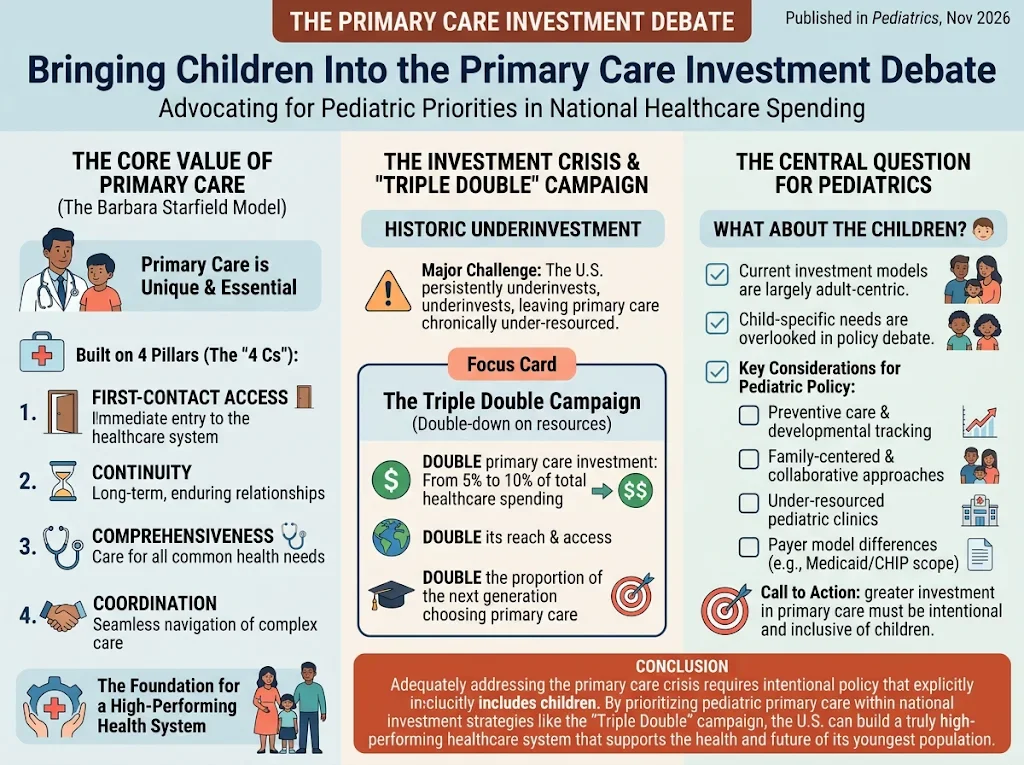
Primary care forms the backbone of effective, efficient, and equitable healthcare delivery. Pediatrician Barbara Starfield’s seminal work underscored primary care’s unique attributes—first-contact access, continuity, comprehensiveness, and coordination—and how these pillars are delivered through persistent patient-family-provider relationships. Despite this foundation, the United States has chronically underinvested in primary care, resulting in under-resourced practices and compromised care quality. This underinvestment is concerning not only for adults but critically for children, whose developmental trajectories rely heavily on continuous, comprehensive care early in life.
The Current Landscape of Primary Care Investment
In the U.S., primary care receives an estimated 5% of total healthcare spending. National and state initiatives have emerged to address this imbalance by setting explicit investment targets and demanding intentional financial commitments rather than reliance on market forces. One notable initiative, the Triple Double campaign, aims to double primary care investment to 10% of healthcare spending, expand the reach of primary care services, and increase the proportion of future clinicians choosing this specialty. While these efforts represent a shift towards strengthening primary care, they predominantly address the adult population, leaving pediatric inclusion largely unarticulated.
Why Children’s Inclusion Matters in Primary Care Investment
Pediatric primary care differs fundamentally from adult care in scope and impact. Children require services that prioritize growth, development, and preventive care, which have lifelong health implications. Early intervention in childhood is often cost-saving and improves long-term outcomes by preventing chronic conditions that manifest later in life. Therefore, comprehensive investment strategies must explicitly include children to ensure the development of a robust pediatric primary care infrastructure that can support families through each stage of childhood and adolescence.
Challenges in Pediatric Primary Care Investment
Pediatric primary care faces unique hurdles compared to adult care. These include:
- Reimbursement Issues: Pediatric services are often undervalued in payment models, especially when compared to adult specialty care, causing financial strain on pediatric practices.
- Workforce Shortages: There is a concerning decline in medical trainees choosing pediatrics and primary care fields, threatening future access for children.
- Complex Care Coordination: Children with chronic and special healthcare needs require integrated, multi-disciplinary approaches that demand additional resources.
Insights from Perrin et al.’s Contribution
In their pivotal article discussed in the November 2026 issue of Pediatrics, Perrin et al. articulate the gap in primary care investment debates: the omission of child health considerations. They argue for policies that explicitly define pediatric primary care spending, workforce development initiatives that encourage new generations to enter pediatric primary care, and measurement frameworks to track impact on child health outcomes. Their work calls on policymakers, payers, and health system leaders to acknowledge that optimal population health hinges on children’s health and that primary care investments should reflect this reality.
Implications for Health Policy and Practice
Incorporating children into primary care investment strategies requires a multipronged approach:
- Revised Payment Models: Design pediatric-specific value-based payment schemes that recognize the holistic needs of children and their families.
- Investment in Workforce Development: Expand training programs, loan repayment, and incentives for careers in pediatric primary care.
- Enhanced Data Infrastructure: Develop metrics specific to pediatric primary care effectiveness and equity to guide policy adjustments.
- Family-Centered Care Models: Support care coordination and integration services that address social determinants of health and developmental factors unique to children.
Expert Commentary
Experts emphasize that strengthening pediatric primary care aligns with the broader public health goals of reducing healthcare costs and improving quality. Notably, Dr. Barbara Starfield’s legacy continues to inspire calls for a shift from reactive specialty-focused care to proactive, continuous primary care grounded in strong relational foundations beginning in childhood. Some limitations include the need for granular cost-effectiveness data specific to pediatric investment, which remains an area for further research. Additionally, generalizing investment models from adult settings to pediatric care may overlook substantive differences in care delivery and outcomes measurement.
Conclusion
Bringing children into the primary care investment debate is not merely an enhancement but an imperative. Comprehensive policies that intentionally allocate resources to pediatric primary care will build resilient health systems capable of delivering equitable, high-quality care from the earliest stages of life. Future research should focus on quantifying the returns on pediatric primary care investment, refining payment models, and sustaining workforce pipelines to support these goals. Ultimately, a healthcare system that invests robustly in children’s primary care will reap benefits across the lifespan and generations.
Funding and ClinicalTrials.gov
No specific funding declared. No clinical trials referenced.
References
- Starfield B. Primary care and health. A cross-national comparison. JAMA. 1991;266(16):2268-2271.
- Westfall JM, et al. The Triple Double Campaign: Transforming the Future of Primary Care. Ann Fam Med. 2024;22(2):123-125.
- Perrin JM, et al. What Should Primary Care Investment Policy Mean for Children? Pediatrics. 2026; Current issue.
- Rittenhouse DR, Zickafoose JS, Chamberlain LJ. Bringing Children Into the Primary Care Investment Debate. Pediatrics. 2026 Nov 11; PMID: 43010162.
Specialty calculators
For clinical reference; use professional judgment.