Highlight
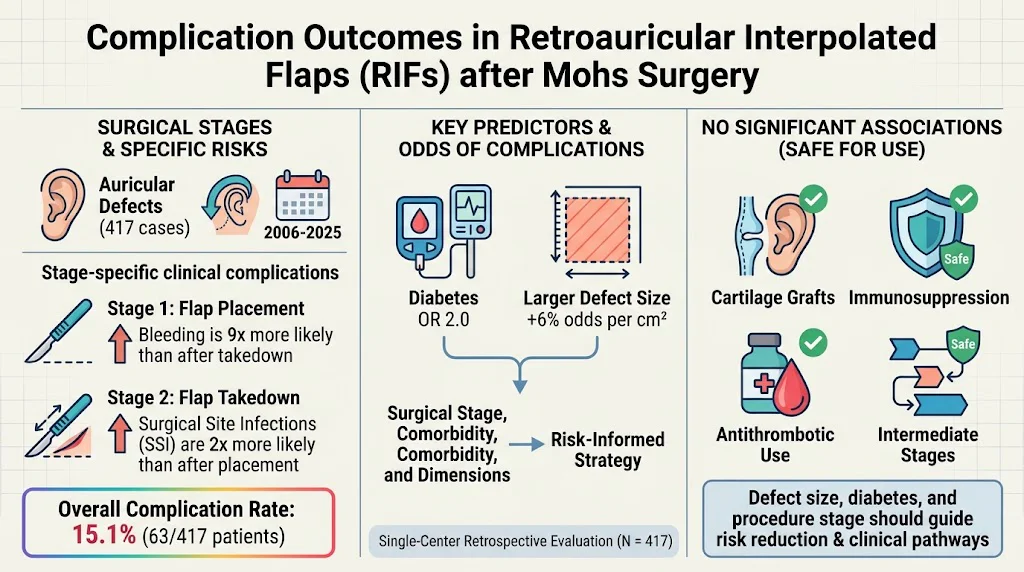
This single-center retrospective cohort study of 417 cases evaluates complication rates associated with retroauricular interpolated flaps (RIFs) after Mohs micrographic surgery on the auricle. Key findings reveal a 15.1% overall complication rate, differential risks of bleeding and infections between flap placement and takedown stages, and significant associations of diabetes and larger defect size with increased complication odds. Notably, cartilage graft use, immunosuppression, and antithrombotic therapy did not increase complication risk.
Study Background
Mohs micrographic surgery is the gold standard for treating cutaneous malignancies of the head and neck, including auricular skin cancers. Given the auricle’s complex three-dimensional anatomy, reconstruction often necessitates local flaps to achieve optimal cosmetic and functional outcomes. Retroauricular interpolated flaps (RIFs) utilize adjacent postauricular skin to reconstruct anterior ear defects, preserving contour and color match. Despite the established surgical utility of RIFs, granular data on stage-specific postoperative complications and patient- or procedure-related risk factors have been sparse. Understanding these factors is crucial in preoperative counseling, surgical planning, and risk mitigation strategies, especially given the delicate vascularity and exposed location of auricular flaps.
Study Design
This retrospective analysis included 417 consecutive RIF reconstructions performed between January 2006 and March 2025 at a single high-volume tertiary center specializing in Mohs surgery. Data were extracted from a prospectively maintained Mohs surgery database. The study cohort comprised adult patients undergoing RIF repair for auricular defects following tumor extirpation. The primary endpoint was the overall postoperative complication rate encompassing bleeding, infection, and flap necrosis or dehiscence. Secondary analyses contrasted complication rates between different surgical stages—flap placement and flap takedown. Multivariate logistic regression identified patient-specific (age, diabetes status, immunosuppression, antithrombotic use) and procedure-specific (defect size, cartilage graft use, intermediate surgical stages) predictors of complication risk.
Key Findings
Aggregate Complication Rate: Of 417 patients, 63 experienced postoperative complications, rendering a total incidence of 15.1%. This rate aligns with expected outcomes for complex auricular reconstructions but underscores the need for vigilance given the anatomic challenges.
Stage-Specific Complications: Bleeding complications were significantly more frequent following the initial flap placement stage, with a ninefold higher odds compared to after flap takedown, suggesting increased vascular insult or hemostatic challenges during flap elevation and inset. Conversely, surgical site infections occurred twice as often after flap takedown, potentially due to factors such as extended operative time, wound exposure, or flap ischemia during final inset.
Patient-Related Risk Factors: Diabetes mellitus doubled the odds of experiencing complications (OR approximately 2.0), reflecting its known impairments on wound healing, microvascular circulation, and infection susceptibility. Immunosuppression did not significantly modify complication risks, which may reflect heterogeneity in immunosuppressive regimens or preoperative optimization.
Procedure-Related Risk Factors: Each incremental 1 cm2 increase in postoperative defect size was associated with a 6% increased odds of complications, highlighting the challenge of larger defect reconstructions. Contrary to potential concerns, cartilage graft usage did not increase complication risk, indicating that harvesting and integration of cartilage in RIF repair can be safely performed. Intermediate surgical stages and antithrombotic medication use also showed no statistically significant association with adverse outcomes.
Limitations: The retrospective study design and single-center setting may limit external generalizability and introduce selection or reporting bias. Variations in surgical technique, operator experience, and perioperative protocols over nearly two decades could also affect complication rates. Nonetheless, the large sample size and detailed stage-specific analysis provide valuable insights.
Expert Commentary
Retroauricular interpolated flaps remain a cornerstone of auricular reconstruction post-Mohs surgery, prized for their robust vascularity and aesthetic match. This comprehensive evaluation reinforces the importance of patient comorbidity assessment—particularly diabetes—as a modifiable risk factor for postoperative complications. Surgeons should consider preoperative glycemic optimization and individualized risk counseling. The distinct temporal pattern of bleeding following flap placement versus infection post-takedown suggests opportunities for stage-specific perioperative management, including meticulous hemostasis at flap elevation and wound care vigilance post-flap inset. The reassuring finding that cartilage grafts do not elevate complication risk supports their judicious use to restore framework integrity. Future prospective studies examining perioperative interventions, including antibiotic protocols and hemostatic techniques, may further refine outcomes.
Conclusion
This large retrospective study identifies key predictors of complications following retroauricular interpolated flap reconstruction after Mohs surgery: the surgical stage, diabetes status, and defect size. Tailoring perioperative management to these risk factors can improve surgical outcomes and patient satisfaction. While bleeding and infection risks differ by operative stage, cartilage graft use and routine immunosuppression do not confer additional risk. These findings contribute to evidence-based risk stratification and underscore the importance of comprehensive preoperative evaluation and multidisciplinary care in complex auricular reconstructions.
Funding and Clinical Trials
The article does not report specific funding sources or clinical trial registrations related to this study.
References
Tran VA, Myrdal CN, Wang S, et al. Complication outcomes in retroauricular interpolated flaps after Mohs surgery: A single-center retrospective study. J Am Acad Dermatol. 2026;95(4):1061-1066. PMID: 42229808.
Broader literature addressing outcomes of auricular reconstruction with interpolated flaps and factors influencing flap complications can be found in standard reconstructive surgery and dermatologic surgery texts.
Specialty calculators
For clinical reference; use professional judgment.