Highlights
- Introduction of the Texas Children’s Hospital classification system quantifies regional anatomical fusion via a composite score, enhancing evaluation of separation feasibility in conjoined twins.
- Tissue expansion and hepatic artery embolization emerge as pivotal preparatory techniques facilitating safe separation and reconstruction.
- Lower composite fusion scores correlate significantly with elective separation candidacy, reinforcing the system’s utility in preoperative risk stratification.
- Postoperative complications include tissue expander device and sternal hardware issues, tracheostomy, gastrostomy, infections, and seroma, underscoring the complexity of conjoined twin reconstruction.
Background
Conjoined twins represent a rare congenital anomaly characterised by physical connection and sharing of anatomical structures resulting from incomplete embryonic division after day 13 of gestation. The incidence approximates 1 in 50,000 to 1 in 200,000 live births, with high perinatal mortality and intricate surgical challenges. Outcomes depend fundamentally on the extent and nature of shared organs and tissues, making detailed anatomical classification integral to operative planning and prognostication. Traditional classifications focus on external morphology (e.g., thoracopagus, craniopagus) but lack granularity regarding internal structural sharing — a key determinant for feasibility and surgical approach.Key Content
Evolution of Anatomical Classification Systems
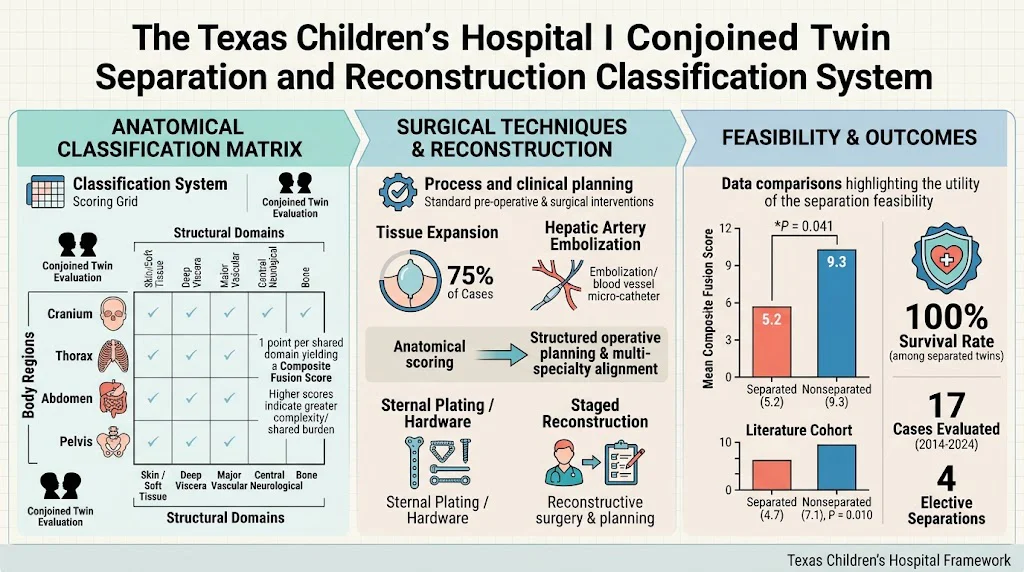
Early conjoined twin taxonomies primarily described shared body surface areas without systematic quantification of deeper organ and vascular involvement. This limitation hindered objective assessment to guide multidisciplinary teams in operative decision-making. King et al. (2026) introduce the Texas Children’s Hospital (TCH) classification system, assigning point scores across five tissue domains (skin/soft tissue, deep viscera, major vascular, central neurological structures, bone) within four anatomical regions (cranium, thorax, abdomen, pelvis). This numeric composite score reflects the burden of fusion, facilitating comparison and stratification.Institutional Experience and Outcomes
In a retrospective review spanning 2014-2024 at TCH, 17 conjoined twin pairs were identified with detailed anatomical evaluation. Viability at birth was confirmed in 12 pairs (70.6%), with elective separation attempted in 4 pairs (33.3% of viable; 23.5% overall). Tissue expansion was employed preoperatively in 75% of separated pairs, optimizing soft tissue coverage and facilitating reconstruction. One separation utilized hepatic artery embolization to minimize intraoperative hepatic perfusion shared between twins. Device-related complications emerged, including issues with tissue expanders in 2 out of 3 cases and sternal plating difficulties in 2 of 3 patients undergoing skeletal stabilization. Common postoperative complications included infections and seromas (each 25%). Airway and nutrition management challenges necessitated tracheostomy and gastrostomy in 37.5% of separated patients respectively. Importantly, all separated twins survived, with follow-up ranging from 9 to 117 months, underscoring excellent medium-term outcomes in selected cases.Comparative Analysis with Literature Cases
A literature review encompassing published cases with sufficient anatomical detail validated the utility of the TCH classification score. Lower fusion scores were consistently associated with successful elective separation. Mean composite scores for separated versus nonseparated twins were significantly different both institutionally (5.2 ± 2.8 vs 9.3 ± 3.2, P=0.041) and in the published cohort (4.7 ± 1.9 vs 7.1 ± 1.8, P=0.010). This reproducible pattern highlights the system’s role in operational decision-making.Techniques and Reconstruction Strategies
Surgical approaches are multifaceted, tailored to the spectrum of shared anatomy. Tissue expansion prior to separation serves as a critical adjunct, promoting adequate skin and soft tissue coverage essential in extensive reconstructions. Hepatic artery embolization assists in diminishing blood flow through shared liver parenchyma, reducing bleeding risk. Skeletal stabilization with plating may be necessary for thoracic and pelvic defects but carries risk of hardware complications. Airway management post-separation often requires tracheostomy to secure airway patency. Nutritional rehabilitation is supported through gastrostomy placement when oral intake is compromised.Expert Commentary
The TCH classification system addresses a pivotal gap in conjoined twin management by providing an intuitive, anatomy-driven quantitative framework to assess fusion burden beyond surface morphology. This refinement aids multidisciplinary teams in aligning surgical strategies, conducting informed family counseling, and appropriately triaging separation candidacy. The demonstrated association between fusion burden and separation feasibility offers objective support to clinical judgment. Nevertheless, the classification is not inherently predictive of outcomes or mortality and should be considered as complementary to comprehensive clinical evaluation including cardiopulmonary status, neurological function, and ethical considerations. Surgical morbidity remains considerable, emphasizing the necessity for meticulous perioperative planning, infection control, and rehabilitation support. Complications related to devices and reconstructive hardware underscore the importance of vigilant postoperative monitoring and contingency planning. Future directions entail prospective validation of the fusion score’s predictive utility across diverse populations and integration with advanced imaging modalities like 3D reconstruction and virtual surgical planning. The system may also inform translational research on tissue engineering approaches for optimal reconstruction.Conclusion
The Texas Children’s Hospital classification system represents an innovative adjunctive tool that captures the anatomic burden of shared structures in conjoined twins, correlates with separation feasibility, and facilitates standardized communication across care teams. Multimodal preparatory techniques such as tissue expansion and embolization are integral to surgical success. Despite inherent complexities and postoperative challenges, survival outcomes from this tertiary center experience are favorable. This structured anatomical framework and evidence-informed surgical strategies advance the field of conjoined twin separation, supporting precision planning and patient-centered care.References
- King BW, Pham KT, Xue E, Hollier LH, Buchanan EP. Conjoined Twin Separation and Reconstruction: An Anatomical Classification System, Techniques, and Outcomes at a Tertiary Pediatric Care Center. Plast Reconstr Surg. 2026 Mar 11;158(5):833e-841e. PMID: 42950259.
- Anthony B, Spencer R. Conjoined twins: Summary of an international registry. J Pediatr Surg. 2015;50(11):1946-1950. doi:10.1016/j.jpedsurg.2015.05.017
- Spencer R. Anatomic description of conjoined twins: key principles and classification. J Pediatr Surg. 2018;53(7):1374-1379. doi:10.1016/j.jpedsurg.2017.11.060
- Gonzalez D, et al. Advances and challenges in the surgical separation of conjoined twins. Pediatr Surg Int. 2019;35(5):567-578. doi:10.1007/s00383-019-04403-x
- Simpson LL, et al. Preoperative planning strategies in complex conjoined twin separation. Semin Pediatr Surg. 2021;30(4):151108. doi:10.1016/j.sempedsurg.2021.151108
Specialty calculators
For clinical reference; use professional judgment.