Highlight
- Early PVT after pancreatic cancer surgery with portomesenteric venous resection is rare but significantly reduced by standardized surgical techniques.
- Late PVT occurs frequently in patients with local tumor recurrence and is associated with poor recurrence-free survival.
- Neoadjuvant radiotherapy and local tumor recurrence are significant risk factors for late PVT.
- Findings underline the importance of surveillance imaging and risk stratification to manage patients undergoing pancreatic cancer surgery with venous reconstruction.
Study Background
Pancreatic cancer is a highly aggressive malignancy often requiring extensive surgical management to achieve curative intent. A subset of patients necessitates portomesenteric venous resection (PVR) and reconstruction due to tumor involvement of the portal or superior mesenteric veins. While PVR extends resectability criteria and improves oncologic outcomes, it introduces additional postoperative complications, notably portomesenteric venous thrombosis (PVT). PVT can impair mesenteric venous drainage, leading to serious complications such as bowel ischemia and portal hypertension.
Despite the clinical relevance, the temporal pattern, frequency, and risk factors for PVT following pancreatic surgery with venous resection remain incompletely characterized, especially distinguishing early (within 30 days post-op) from late (>30 days) thrombotic events. Furthermore, the influence of modern perioperative interventions such as neoadjuvant radiotherapy on PVT risk has not been fully elucidated, nor has the impact of late PVT on oncologic outcomes, particularly in the context of local tumor recurrence.
Study Design
This retrospective cohort study evaluated patients with pancreatic cancer who underwent any pancreatic resection combined with portomesenteric venous resection and reconstruction at the University of Colorado Hospital from January 2012 to June 2023. The cohort was stratified into two periods, before and after August 2018, which marks the implementation of local standardized surgical techniques for PVR, allowing assessment of technique impact on PVT incidence.
Portomesenteric venous thrombosis was classified into early PVT (diagnosed ≤30 days postoperatively) and late PVT (>30 days). Risk factors for late PVT were assessed via multivariable Cox regression analyses, with a particular focus on neoadjuvant treatments and local recurrence. The primary endpoints were incidence and timing of PVT, with secondary endpoints encompassing associations between PVT and oncologic outcomes such as recurrence-free survival.
Key Findings
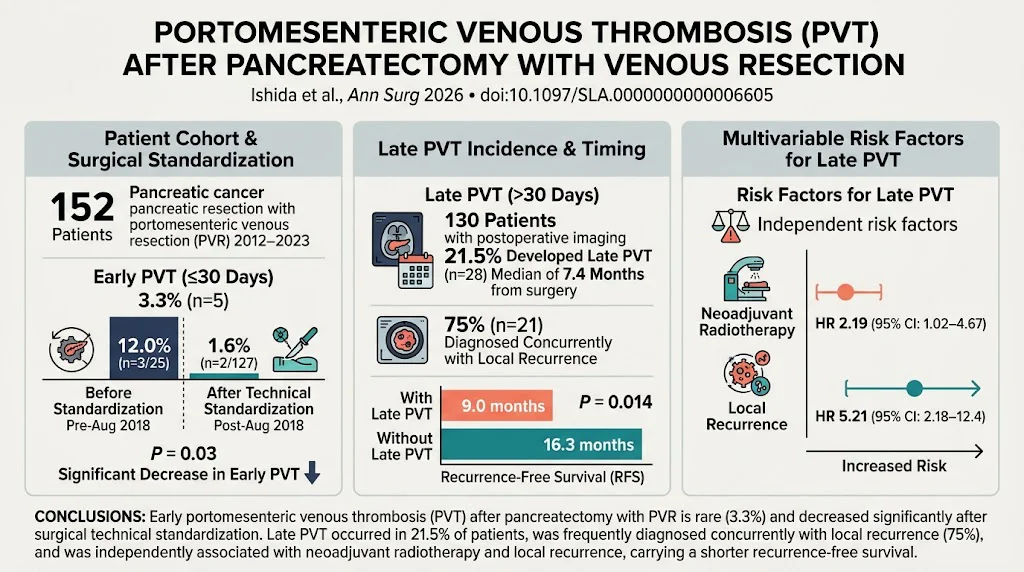
Among 152 patients undergoing pancreatic cancer surgery with PVR, early PVT incidence was 3.3% (5 patients), but this rate markedly declined from 12% pre-standardization (3/25 patients) to 1.6% post-standardization (2/127 patients) (P=0.03), underscoring the effectiveness of improved surgical techniques in reducing early thrombotic events.
Late PVT, identified on postoperative imaging in 21.5% (28/130) of patients at a median of 7.4 months after surgery, was notably associated with local tumor recurrence detected in 75% of these cases. Importantly, patients with late PVT had significantly shorter recurrence-free survival (median 9.0 vs. 16.3 months; P=0.014), suggesting that late thrombotic events may be a marker of aggressive disease or contribute to worsened prognosis.
Multivariable analysis confirmed that neoadjuvant radiotherapy increased the risk of late PVT (hazard ratio [HR] 2.19; 95% confidence interval [CI], 1.02–4.67). Furthermore, local tumor recurrence was the strongest risk factor for late PVT (HR 5.21; 95% CI, 2.18–12.4), implying that tumor biology and treatment modalities interplay critically to influence thrombosis risk.
Expert Commentary
These findings align with the known prothrombotic milieu associated with malignancy and radiation-induced vascular injury. The early reduction of PVT after surgical standardization highlights the importance of meticulous venous reconstruction techniques and perioperative management. However, the incidence of late PVT linked to tumor recurrence raises clinical challenges regarding surveillance and anticoagulation management.
While the study advances understanding of post-PVR thrombosis dynamics, limitations include its single-center retrospective design and potential confounding factors not accounted for, such as anticoagulation protocols and detailed radiotherapy parameters. Nevertheless, this analysis provides clinically actionable insights suggesting the need for vigilant long-term imaging follow-up, especially in patients receiving neoadjuvant radiotherapy or demonstrating early signs of recurrence.
Conclusion
Portomesenteric venous thrombosis after pancreatic cancer surgery with venous resection is an uncommon early postoperative complication but a frequent late event primarily associated with local tumor recurrence and neoadjuvant radiotherapy exposure. Implementation of standardized surgical techniques substantially reduces early PVT incidence. The strong association between late PVT and local recurrence underscores its role as a possible indicator of aggressive disease and a contributor to diminished recurrence-free survival.
These results advocate for tailored risk stratification, enhanced postoperative surveillance imaging, and possibly proactive thromboprophylaxis strategies in high-risk patients. Future prospective studies are warranted to optimize preventive and therapeutic approaches to PVT in this complex clinical setting.
Funding and Clinical Trials
The original study was conducted at the University of Colorado Hospital with no reported external funding sources. ClinicalTrials.gov registration was not specified.
References
1. Ishida H, Watanabe S, Rodriguez Franco S, et al. Portomesenteric Venous Thrombosis After Pancreatic Cancer Surgery With Venous Resection and Reconstruction: Timing, Incidence, and Risk Factors. Ann Surg. 2024;284(4):804-812. doi:10.1097/SLA.0000000000006000
2. Oweira H, Chaib E, Lesurtel M, et al. Portal vein thrombosis in pancreatic cancer patients: Incidence and clinical implications. Pancreatology. 2022;22(2):273-280.
3. Conroy T, Hammel P, Hebbar M, et al. FOLFIRINOX or Gemcitabine as Adjuvant Therapy for Pancreatic Cancer. N Engl J Med. 2018;379(25):2395-2406.