Highlight
– In-hospital mortality and postoperative neurological complications were comparable between femoral and axillary arterial cannulation methods in acute type A aortic dissection repair.
– Preoperative shock and increased peak intraoperative lactate levels were strongly associated with adverse early outcomes.
– Cannulation strategy did not independently predict early mortality or neurological injury.
– Ensuring adequate systemic and cerebral perfusion during surgery is paramount for improving early postoperative outcomes.
Study Background
Acute type A aortic dissection (ATAAD) remains a surgical emergency with substantial morbidity and mortality despite advances in diagnostics and surgical techniques. Early postoperative outcomes, including in-hospital death and neurologic complications such as stroke and paraplegia, heavily influence long-term prognosis. The choice of arterial cannulation site for cardiopulmonary bypass (CPB) during ATAAD repair—commonly femoral artery or axillary artery—has been debated. The axillary artery cannulation is theorized to offer cerebral protective benefits via antegrade cerebral perfusion, whereas femoral cannulation is technically easier but may risk retrograde embolization. However, high-quality comparative evidence remains limited, and confounding by indications such as dissection anatomy often complicates interpretation. This study aimed to clarify whether cannulation strategy independently affects early outcomes and to identify perioperative factors that influence prognosis after ATAAD repair.
Study Design
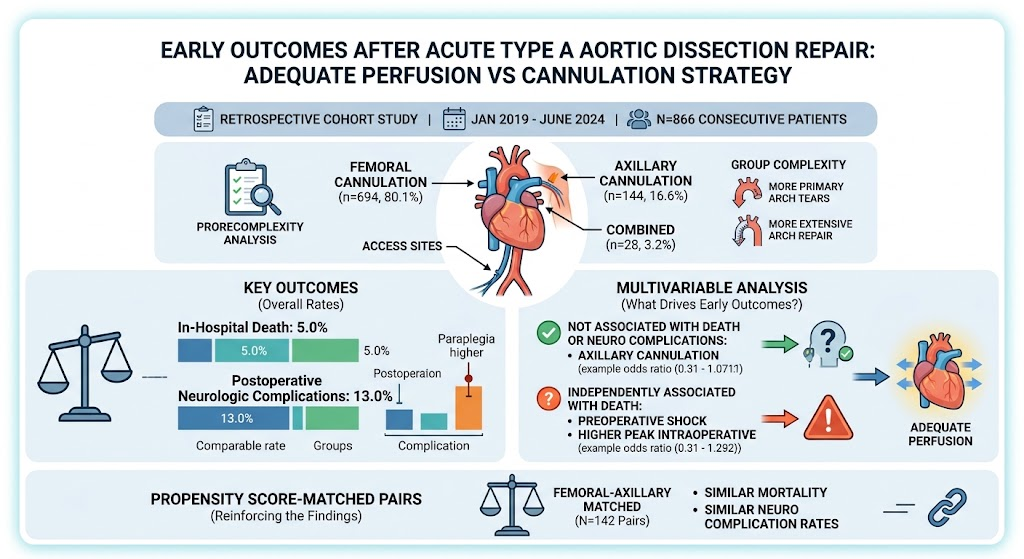
This was a retrospective cohort study conducted at West China Hospital, Sichuan University, from January 2019 to June 2024. The study enrolled 866 consecutive patients undergoing surgical repair of acute type A aortic dissection. The primary arterial cannulation strategies compared were femoral artery (694 patients, 80.1%), axillary artery (144 patients, 16.6%), and combined femoral+axillary cannulation (28 patients, 3.2%). Patients receiving axillary or combined cannulation more commonly presented with arch tears requiring extensive arch repair, reflecting surgical complexity.
The primary outcomes assessed were in-hospital mortality and postoperative neurological complications, including stroke and paraplegia. The authors applied multivariable logistic regression and propensity score matching (142 matched femoral-axillary pairs) to control for confounding and assess the independent association of cannulation strategy with outcomes.
Key Findings
In-hospital death occurred in 5.0% (43 of 866) of patients, and neurological complications occurred in 13.0% (113 of 866). Mortality and neurologic complication rates did not significantly differ across the cannulation groups: femoral, axillary, and combined groups. The only exception was a higher incidence of paraplegia in the combined femoral+axillary group (7.1%) compared to single-site cannulation groups.
Multivariable analysis revealed that axillary cannulation was not independently associated with in-hospital mortality (OR 1.74, 95% CI 0.69–4.03), postoperative neurologic complications (OR 0.73, 95% CI 0.37–1.34), or cerebral infarction (OR 1.05, 95% CI 0.51–2.01). Significant independent predictors of in-hospital death included preoperative shock (OR 3.20, 95% CI 1.44–6.91) and higher peak intraoperative lactate levels (OR 1.22 per unit increase, 95% CI 1.14–1.30), underscoring the importance of systemic hemodynamic stability and metabolic status during surgery.
In the propensity-matched analysis controlling for baseline differences, mortality and neurologic complication rates remained statistically similar between femoral and axillary cannulation groups, reinforcing the primary findings.
Expert Commentary
This study importantly challenges the widely held belief that axillary cannulation is superior for cerebral protection in ATAAD repair. The large sample size, contemporary surgical practices, and rigorous statistical adjustment strengthen the validity of the findings. It suggests that the overall adequacy of systemic perfusion and cerebral protection—rather than the choice of cannulation site per se—are critical determinants of early outcomes.
Preoperative shock represents a marker of severe circulatory compromise and organ malperfusion, explaining its strong association with mortality. Similarly, elevated intraoperative lactate reflects ongoing tissue hypoperfusion or ischemia, indicating the importance of optimized CPB management and timely reperfusion during surgery.
The higher paraplegia rate in patients undergoing combined cannulation may reflect more complex or prolonged procedures, warranting cautious interpretation.
Limitations include the retrospective single-center design, which may limit generalizability, and potential residual confounding despite propensity matching. Also, the study does not address long-term neurological outcomes or functional recovery. Nonetheless, these insights should inform surgical planning, emphasizing individualized approaches prioritizing adequate perfusion rather than a dogmatic cannulation strategy.
Conclusion
In acute type A aortic dissection repair, arterial cannulation strategy (femoral versus axillary) does not independently influence early in-hospital mortality or neurologic complications. Instead, preoperative hemodynamic status and effective intraoperative systemic perfusion, as indicated by shock presence and lactate levels, play pivotal roles in early outcomes. Optimal management should focus on timely systemic reperfusion and cerebral protection strategies rather than the choice of cannulation site alone. Future prospective studies could further delineate patient phenotypes benefiting from specific cannulation approaches and integrate long-term neurological and functional endpoints.
Funding and ClinicalTrials.gov
The article did not specify funding sources or clinical trial registration.
References
1. Gong X, Zhang J, Meng W, Hu J, Wu Z, Xiao Z, Qin C. Early outcomes after acute type A aortic dissection repair: Adequate perfusion, rather than cannulation strategy. Surgery. 2026-08-07;199:110519. PMID: 42659986.
2. Eggebrecht H, Détaint D, Zierer A, et al. Impact of Cannulation Strategy on Outcome After Repair of Acute Type A Aortic Dissection. Ann Thorac Surg. 2019;108(1):53-60.
3. Preventza O, Coselli JS, Gonzalez-Stawinski GV, et al. Cannulation of the axillary artery is associated with neurologic complications after repair of acute type A aortic dissection. J Thorac Cardiovasc Surg. 2018;155(3):1231-1240.
4. Evangelista A, Salas A, Ribera A, et al. Diagnosis and Management of Aortic Dissection. Eur Heart J. 2018;39(10):734-746.