Highlight
– Oliceridine demonstrated non-inferior analgesic efficacy compared to remifentanil in adults receiving invasive mechanical ventilation (IMV) in ICU settings.
– Patients treated with oliceridine had significantly fewer mild-to-moderate adverse drug reactions and respiratory depression events.
– Oliceridine use was associated with lower post-extubation respiratory depression and reduced analgesic-sedation costs.
– No differences were observed in duration of mechanical ventilation, ICU length of stay, or 28-day mortality between treatment arms.
Study Background
Effective analgesia is a cornerstone of critical care management for patients undergoing invasive mechanical ventilation (IMV). Remifentanil, a potent μ-opioid receptor agonist with rapid onset and short duration, is widely used but is associated with opioid-related adverse events (AEs), including respiratory depression, sedation, and potential prolonged ICU stay. Such adverse effects complicate clinical management and may impact patient outcomes.
Oliceridine, a novel G protein-biased μ-opioid receptor agonist, selectively activates analgesic pathways while theoretically limiting the β-arrestin-mediated adverse effects common to traditional opioids. Preclinical and limited clinical data suggest it could provide effective analgesia with a better safety profile. However, there is a lack of rigorous evidence assessing oliceridine’s efficacy and safety in critically ill, mechanically ventilated patients.
Study Design
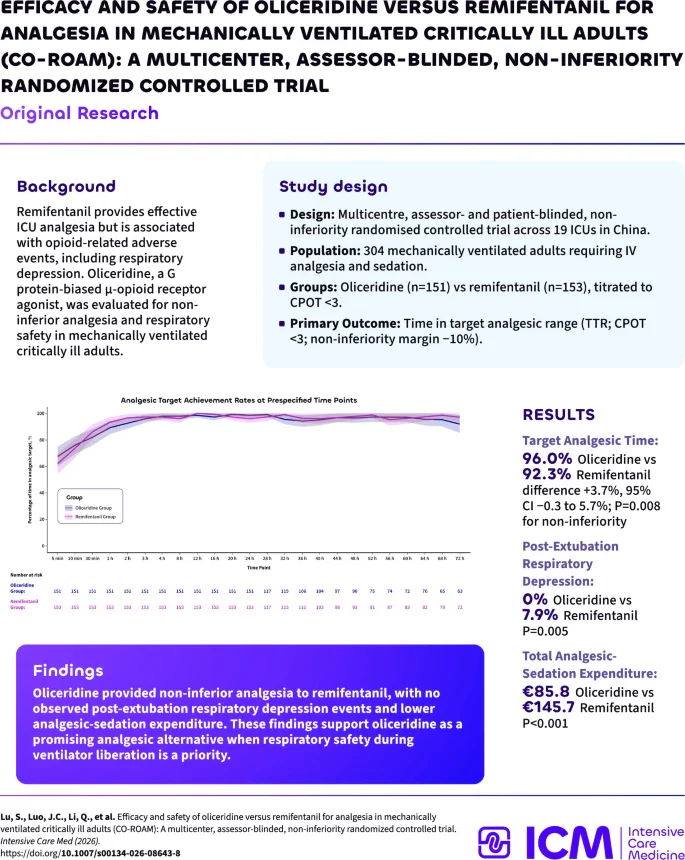
The CO-ROAM trial was a prospective, multicenter, randomized, assessor- and patient-blinded, non-inferiority study conducted across 19 intensive care units (ICUs) in China. The target population included critically ill adults requiring IMV who were randomized 1:1 to receive either oliceridine or remifentanil analgesia.
Study intervention involved titration of both agents to achieve a Critical-Care Pain Observation Tool (CPOT) score below 3, indicating adequate analgesia. The primary endpoint was the proportion of time patients remained within the target analgesic range (time-in-target range, TTR), with a predefined non-inferiority margin of -10%.
Secondary endpoints included incidence rates of adverse drug reactions (ADRs), especially respiratory depression during and after ventilation, duration of IMV, ICU length of stay, 28-day mortality, and analgesic-sedation associated costs. Subgroup analyses examined efficacy and safety across severity strata using the Acute Physiology and Chronic Health Evaluation II (APACHE II) score and presence of acute respiratory distress syndrome (ARDS).
Key Findings
A total of 307 patients were randomized, and the modified intention-to-treat population included 304 patients (151 in the oliceridine arm and 153 in the remifentanil arm). The primary outcome showed that median TTR was 96.0% in the oliceridine group versus 92.3% in the remifentanil group; the absolute difference was 3.7% (95% CI -0.3 to 5.7%), establishing non-inferiority of oliceridine.
Importantly, oliceridine was associated with a safety advantage. Mild-to-moderate ADRs occurred at 15.9 events per 100 patient-days compared to 22.2 events per 100 patient-days with remifentanil (incidence rate ratio [IRR] 0.72, 95% CI 0.52 to 1.00, P = 0.049). Notably, respiratory depression events during the study period were absent in the oliceridine group (0%) versus 4.6% in the remifentanil group (P = 0.015). Post-extubation respiratory depression was similarly reduced (0% vs. 7.9%, P = 0.005).
The subgroup analyses suggested that the ADR benefit with oliceridine was more pronounced in patients with APACHE II scores greater than 17, indicating higher severity of illness. Additionally, patients without ARDS showed a larger nominal difference favoring oliceridine in TTR.
There were no statistically significant differences between groups regarding duration of invasive mechanical ventilation, ICU stay length, or 28-day mortality. However, analgesic and sedation costs were lower in the oliceridine group, underscoring potential economic advantages.
Expert Commentary
The CO-ROAM trial provides the first large-scale evidence supporting the use of oliceridine in critically ill mechanically ventilated patients. Its demonstration of non-inferior analgesia combined with improved respiratory safety addresses a critical unmet need in ICU opioid management. Opioid-induced respiratory depression is a major concern in ventilated patients, and the lower incidence with oliceridine is clinically significant.
While remifentanil remains a standard agent for ICU analgesia, its well-known adverse effects necessitate alternatives. Oliceridine’s G protein-biased mechanism offers a plausible biological rationale for the observed reduction in respiratory adverse events, reflecting a potential paradigm shift toward safer opioid options in critical care contexts.
Limitations of the study include its conduct within a single country, which may affect generalizability across different healthcare settings. Also, the trial did not assess long-term outcomes beyond 28 days or examine opioid-related phenomena such as tolerance or withdrawal. Further, the subgroup findings are nominal and require confirmation.
Future research should explore oliceridine’s role in diverse ICU populations, optimal dosing strategies, and head-to-head comparisons with other analgesics. Integration of multimodal analgesia protocols including non-opioid adjuncts would be a valuable avenue as well.
Conclusion
In summary, the CO-ROAM trial establishes that oliceridine provides effective analgesia comparable to remifentanil in mechanically ventilated critically ill adults, with a favorable respiratory safety profile and reduced analgesic-related costs. These results support oliceridine as a promising alternative to conventional opioids in ICU pain management, potentially improving patient safety and resource utilization.
Clinicians should consider emerging evidence on G protein-biased opioids when selecting analgesic regimens for mechanically ventilated patients, balancing efficacy, safety, and cost. Ongoing evaluation in broader patient populations and longer-term follow-up will further define oliceridine’s clinical niche.
Funding and Trial Registration
This study was registered with ClinicalTrials.gov (NCT06454292) on June 11, 2024. Funding sources were not detailed in the publication.
References
1. Lu S, Luo JC, Li Q, et al. Efficacy and safety of oliceridine versus remifentanil for analgesia in mechanically ventilated critically ill adults (CO-ROAM): a multicenter, assessor-blinded, non-inferiority randomized controlled trial. Intensive Care Med. 2026 Nov 10. PMID: 43007421.
2. DeWire SM, Yamashita DS, Rominger DH, et al. A G protein-biased ligand at the μ-opioid receptor is potently analgesic with reduced gastrointestinal and respiratory dysfunction compared with morphine. J Pharmacol Exp Ther. 2013.
3. Barr J, Fraser GL, Puntillo K, et al. Clinical practice guidelines for the management of pain, agitation, and delirium in adult patients in the intensive care unit. Crit Care Med. 2013.
4. Wunsch H. Opioids and critical illness: minimizing harm in the ICU. Crit Care. 2018.
Specialty calculators
For clinical reference; use professional judgment.