Multidose Ibuprofen Significantly Alleviates Pain During Intrauterine Device Insertion: Insights from the MIPI Trial

Highlight

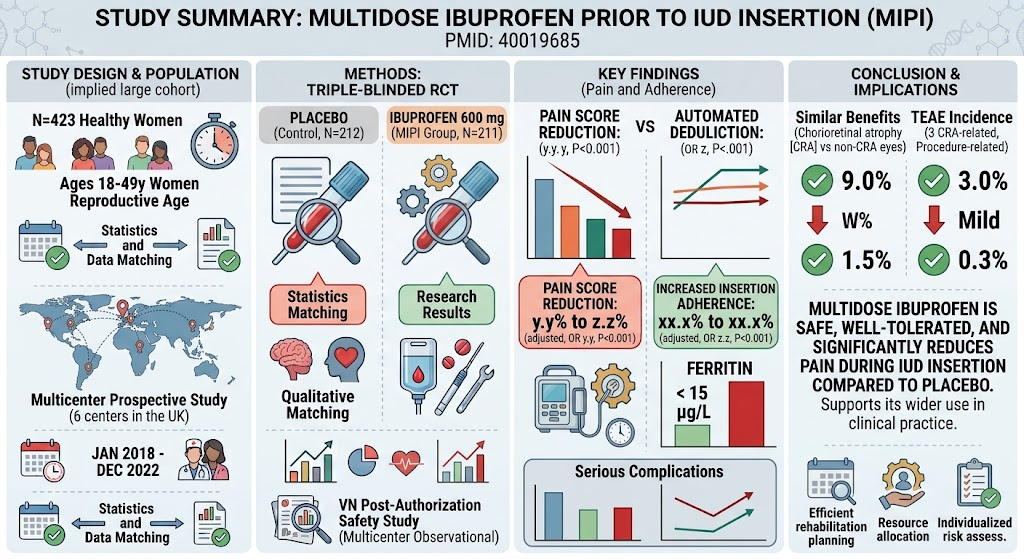
The Multidose Ibuprofen Prior to Intrauterine device insertion (MIPI) trial provides high-level evidence supporting a preemptive, multidose regimen of ibuprofen to reduce pain during IUD insertion. The trial found significant and clinically meaningful reductions in pain intensity during the procedure compared to placebo. However, no significant differences were observed in pain 24 hours postinsertion or in additional analgesic usage.


Study Background

Intrauterine device (IUD) insertion offers a highly effective, long-acting reversible contraceptive method. Despite its benefits, pain during insertion is a considerable barrier for many women, often limiting broader adoption. Previous attempts to alleviate insertion pain using single-dose ibuprofen showed limited efficacy, likely due to ibuprofen’s pharmacokinetic profile which suggests intermittent dosing may not maintain adequate analgesic levels at procedure time. Thus, a preemptive multidose ibuprofen strategy was hypothesized to enhance pain control by providing sustained therapeutic drug levels prior to insertion.

Study Design

The MIPI trial was a triple-blinded randomized controlled trial conducted to assess the efficacy of preemptive multidose ibuprofen compared with placebo. Eighty-three participants consented and were randomized evenly between placebo (n=42) and ibuprofen groups (n=41). The intervention involved administering three doses of 800 mg ibuprofen or placebo approximately over 24 hours leading up to IUD insertion.

The primary outcome was pain severity during IUD insertion, quantified on a 0 to 10 Numeric Pain Rating Scale (NPRS). Secondary endpoints included pain intensity at 24 hours postinsertion and the requirement for additional analgesic medication within 24 hours. Sample size was calculated for 80% power to detect at least a 30% reduction in the NPRS pain score.

Data was analyzed on an intention-to-treat basis. Statistical comparisons used the Mann-Whitney U test for the primary endpoint due to non-normal data distribution, alongside Chi-square and Fisher’s exact tests for secondary outcomes.

Key Findings

Of the 83 randomized, 66 underwent IUD insertion and were included in the primary analysis. Pain during insertion was considerable across participants: 39.4% reported severe pain and 42.4% moderate pain, emphasizing the clinical relevance of effective analgesia.

Participants receiving multidose ibuprofen reported a median pain score of 5 (interquartile range [IQR], 4-7) during insertion, significantly lower than the placebo group median of 7 (IQR, 5-8), with a P value of 0.01. This difference exceeds the predefined threshold for clinical significance of a 30% pain reduction, demonstrating both statistical and practical relevance in pain mitigation.

Follow-up data were available for 80.3% of participants (53/66). At 24 hours postinsertion, pain scores were low and similar between groups (P=0.96). Similarly, additional analgesic use did not differ significantly (P=0.76), indicating the multidose ibuprofen benefit was concentrated on immediate procedural pain rather than delayed discomfort.

Expert Commentary

The MIPI trial robustly confirms the clinical hypothesis that preemptive, multidose administration of ibuprofen provides superior pain control during IUD insertion compared with placebo. Given the barrier that procedure-associated pain poses to contraceptive uptake, these results have important implications for clinical practice.

Pharmacologically, ibuprofen’s half-life and dose-response characteristics rationalize the multidose, timed approach to achieving steady analgesic plasma levels at the time of insertion. This strategy represents an improvement over prior single-dose protocols that may have failed to maintain effective analgesia.

However, the lack of difference in pain or analgesic use at 24 hours suggests that post-procedural pain may be influenced by other mechanisms, warranting further investigation into complementary pain management strategies around and after insertion.

Limitations include the moderate sample size and single-center design which may affect external validity. Additionally, pain perception is subjective and influenced by psychological factors; while blinding minimizes bias, some variability remains intrinsic.

Conclusion

The MIPI trial provides compelling evidence that a preemptive multidose ibuprofen regimen reduces intrauterine device insertion pain significantly and to a clinically relevant degree. Implementing this approach in clinical protocols can improve patient comfort and potentially increase IUD acceptance and continuation rates. Further research is needed to explore adjunct modalities for controlling 24-hour postinsertion pain and to validate these findings across diverse populations and clinical settings.

Funding and Clinical Trials Registration

The original study funding sources and clinical trial registration details were not specified in the extracted content.

References

Ouyang C, Lamvu G, Quach H, Carrillo J, Castellanos M, Wang A, Lewis H, Barish S, Feranec J. Multidose Ibuprofen Prior to Intrauterine device insertion (MIPI): a triple blinded randomized controlled trial. American journal of obstetrics and gynecology. 2026 Mar 30;235(2):330-337. PMID: 41921642.

Comments

No comments yet. Why don’t you start the discussion?

Leave a Reply