Introduction and Context
Chronic pancreatitis (CP) is a progressive inflammatory disease of the pancreas whose dominant clinical burden is unrelenting pain, together with endocrine and exocrine insufficiency and reduced quality of life. Surgical management remains a cornerstone for patients with pain refractory to medical and endoscopic therapies. Over the last three decades, the discipline has shifted from an “one-size-fits-all” resectional mindset toward morphology-based decision-making: identifying anatomic patterns — dilated main pancreatic duct (MPD), an enlarged pancreatic head (PH), combined ductal and head disease, or small-duct disease — and tailoring surgery to preserve pancreatic parenchyma whenever possible.
Two major guideline families have codified this approach: European morphology-based recommendations (HaPanEU-based documents) and international combined statements (IAP-APA-JPS-EPC). Until now, there has been limited prospective, multicenter evidence on how those guidelines are applied in real-world practice across Europe, and whether guideline-concordant procedures produce better short-term outcomes.
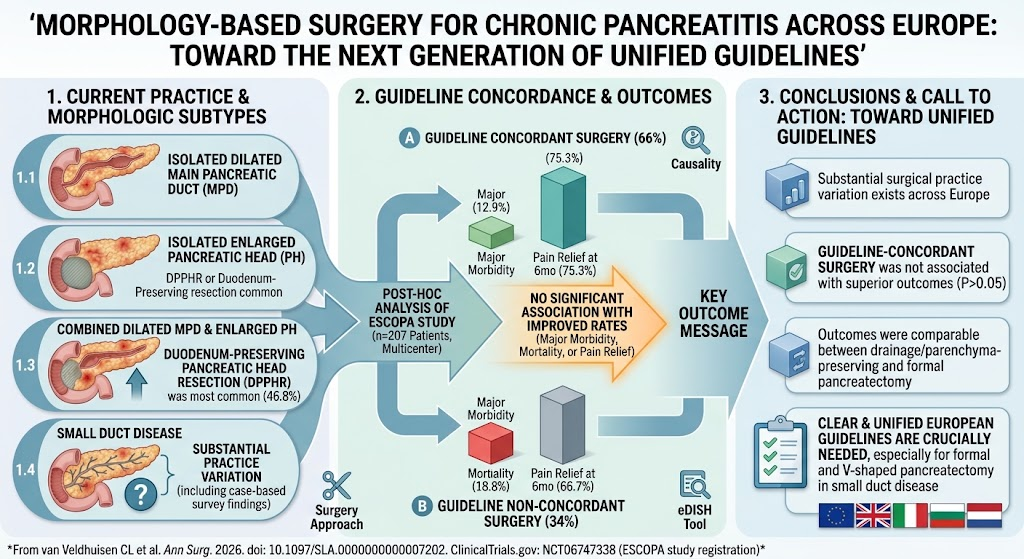
The recent multicenter prospective ESCOPA study (Van Veldhuisen et al., Annals of Surgery, 2026) — reporting 207 patients across 22 centers in 13 countries with 6-month follow-up — fills that gap. The study evaluated use and impact of morphology-based surgery for CP, examined center and surgeon practice variation, and used an embedded case-based survey to capture decision-making patterns. Its findings are timely: they document substantial variation in practice and raise specific questions about recommendations for formal pancreatectomy and V-shaped resections in small-duct disease. The paper calls for a new generation of unified European guidelines with clearer, more actionable recommendations.
This article summarizes the ESCOPA findings, places them in the context of existing morphology-based guidance, highlights remaining controversies, and outlines practical, evidence-informed directions for next-generation unified guidelines.
New Guideline Highlights (Why guidance needs updating)
– ESCOPA shows large intercenter and intersurgeon variation in the choice of operation for identical morphologic subtypes of CP — especially for small-duct disease and isolated dilated MPD. Many centers still perform formal pancreatectomies or V-shaped resections where parenchyma-preserving or drainage procedures might be expected.
– Despite the variation, short-term outcomes were comparable across many approaches: overall 90-day major morbidity 14.5%, 90-day mortality 1.4%, and 6-month pain relief 72.6%. Guideline-concordant surgery (as defined using HaPanEU and international statements) occurred in about two-thirds of patients but did not correlate with superior short-term morbidity, mortality, or pain relief.
– These observations expose two critical gaps: 1) existing guideline recommendations leave room for divergent interpretation, especially for small-duct disease and formal resection indications; and 2) guideline concordance as presently defined may not adequately capture nuanced decision-making (e.g., patient preference, prior endotherapy, center expertise).
Key takeaways for clinicians:
– Tailor operation choice to the morphologic subtype but be explicit in documenting the rationale when deviating from guideline-preferred procedures.
– Recognize that available evidence supports parenchyma-preserving approaches (DPPHR variants) for head-dominant disease; however, evidence on small-duct disease remains limited and practice varies.
– There is urgent need for harmonized guidance that 1) tightens recommendations where evidence is strong, 2) clarifies acceptable alternatives where evidence is weak, and 3) integrates timing of surgery, indications for total pancreatectomy with islet autotransplantation (TPIAT), and the role of repeated endotherapy.
Updated Recommendations and Key Changes: What a unified guideline should address
The ESCOPA study highlights specific areas a next-generation unified guideline must address. Below we propose a concise comparison of existing guidance themes and suggested clarifications driven by ESCOPA findings. (Note: proposed clarifications are synthesized from the ESCOPA multicenter data and established morphology-based recommendations; they are intended to guide development of formal guideline wording.)
Proposed update themes and rationale:
– Explicit operative recommendations by morphologic subtype with hierarchy of preferred options.
– Clear stance on the role of formal (completion) pancreatectomy and V-shaped resections for small-duct disease.
– Structured pathway for “timing of surgery” (early vs after failed endotherapy) based on symptom duration, narcotic dependence, exocrine/endocrine insufficiency status, and imaging morphology.
– Position statements on TPIAT candidacy and referral criteria.
– Minimum data reporting standards for centers (to enable future prospective benchmarking): morphological classification, prior endotherapy, pain scores, opioid use, and short-term surgical outcomes.
Suggested side-by-side summary (simplified):
– Isolated dilated MPD (dominant ductal dilatation): Preferred — longitudinal pancreaticojejunostomy (modified Puestow) ± resectional component if head mass; Acceptable — parenchyma-sparing drainage with removal of intraductal stones. ESCOPA finding: many centers still perform formal pancreatectomy here; guidelines should restrict formal pancreatectomy to clear resectional indications (neoplasm suspicion, irreversible head destruction) and require documented rationale.
– Isolated enlarged PH (head-dominant disease): Preferred — duodenum-preserving pancreatic head resection (DPPHR; Beger/Frey variants); Acceptable — limited pancreatic head resection with preservation of parenchyma; Formal pancreaticoduodenectomy (PD) only for suspected neoplasm or unresectable disease. ESCOPA: DPPHR was used commonly but not uniformly.
– Combined dilated MPD + enlarged PH: Preferred — DPPHR combined with longitudinal pancreaticojejunostomy (Frey procedure) or other hybrid procedures; ESCOPA: DPPHR most common (46.8%).
– Small-duct disease (MPD <3 mm, no dominant head mass): Historically the most controversial. Preferred — tailored approach: consider partial pancreatic head resection (parenchyma-preserving) if a discrete inflammatory mass exists; consider TPIAT in selected refractory patients (young, debilitating pain, preserved islet function candidate); Avoid routine formal pancreatectomy or V-shaped resections unless clear structural rationale. ESCOPA: high use of formal and V-shaped pancreatectomy for small-duct disease suggests need to clarify indications and caution against routine use.
Topic-by-Topic Recommendations
Below are practical, morphology-centered recommendations a unified guideline should include. Each point is formulated to be directly actionable for surgeons, gastroenterologists, and multidisciplinary pancreas teams.
1) Diagnostic criteria and morphological classification
– Use multiphase contrast-enhanced CT and MRI/MRCP as first-line morphological imaging to classify CP into: dilated MPD, enlarged pancreatic head, combined, or small-duct disease. Endoscopic ultrasound (EUS) is for parenchymal/focal lesion assessment and tissue sampling when malignancy is suspected.
– Define dilated MPD quantitatively (commonly ≥6 mm in body/tail) and small duct <3–4 mm; guidelines should standardize cutoffs.
2) Indications for surgery
– Absolute indications: suspicion of malignancy not amenable to conclusive diagnosis through nonoperative means; complications such as intractable pain despite optimized analgesia and endoscopic therapy; local complications (e.g., bile duct obstruction, duodenal obstruction) attributable to inflammatory mass.
– When possible, surgery should be discussed in a multidisciplinary setting (surgeon, gastroenterologist, radiologist, pain specialist, endocrinologist), with shared decision-making regarding risks/benefits.
3) Choice of operation by morphology (practical algorithm)
– Isolated dilated MPD: Offer drainage (lateral pancreaticojejunostomy/Puestow or variations) as first-line surgical option after failed endoscopic drainage or when stones/ductal strictures are not amenable to endoscopic management.
– Head-dominant disease: Prefer DPPHR (Beger, Frey, or Beger-Frey hybrids) to preserve duodenum and pancreatic parenchyma and to address the inflammatory head mass.
– Combined disease: Favor hybrid procedures (Frey) that combine anterior decompression and head coring.
– Small-duct disease: Exhaust nonoperative options; consider limited head resection or denervation procedures in case of focal inflammatory mass; evaluate for TPIAT in centers with experience and for patients meeting strict criteria (young, severe refractory pain, limited prior pancreatic resections, preserved islet potential).
4) Role of formal pancreatectomy and V-shaped pancreatectomy
– Restrict formal pancreatoduodenectomy or distal pancreatectomy to patients with a clear resectional indication (suspicion of malignancy, irreversible ductal destruction/complication) and, where possible, avoid them solely for pain control in CP.
– V-shaped pancreatectomy (a more aggressive resectional approach for small-duct disease used in some centers) should not be a routine first- or second-line operation for small-duct CP; its use should be confined to registered trials or as part of institutional protocols with long-term follow-up.
5) Timing of surgery
– Consider early surgery for patients with persistent pain despite optimized medical care and when endoscopic interventions are unlikely to be durable (e.g., large obstructing stones, extensive ductal stricturing). Emerging evidence suggests earlier definitive surgery may reduce opiate dependence and improve pain control for some subsets.
6) Endoscopic vs surgical algorithms
– Endoscopic therapy remains an important step, especially for ductal stones and localized strictures; however, endoscopic therapy should not be repeated indefinitely when pain control is inadequate. A time- or failure-based threshold for referral to surgery (e.g., two failed endoscopic attempts or persistent severe symptoms over 3–6 months) is useful.
7) TPIAT (Total pancreatectomy with islet autotransplantation)
– TPIAT is an option for selected patients (typically younger, refractory pain, small-duct disease) at specialized centers; criteria should be standardized, and patients counseled regarding the high likelihood of insulin dependence despite islet autotransplantation and the potential for improved pain control.
8) Follow-up and outcomes reporting
– Standardize short-term (90-day) and midterm (6–12 months) outcome measures: major complications (Clavien-Dindo grade ≥III), 90-day mortality, pain scores (e.g., visual analog scale or Izbicki), opioid use, weight, endocrine and exocrine function, and quality-of-life metrics. ESCOPA suggests such harmonized data capture.
Expert Commentary and Insights
ESCOPA authors and members of European surgical and gastroenterological communities have emphasized several points in responses to the study:
– “Variation is not always bad” — clinicians point out that anatomic nuance, prior therapy, comorbidity, and patient preference legitimately influence surgical decisions. Yet, variation that stems from ambiguous guideline wording rather than patient-centered reasons is problematic.
– High-volume pancreas centers tend to favor parenchyma-preserving operations and trans-disciplinary decision-making; the study highlights the persisting influence of individual surgeon training and regional tradition on operation choice.
– Small-duct disease is the principal area of disagreement. Many centers continue to offer formal pancreatectomy or V-shaped resections — practices that some experts question because of the risk of exocrine/endocrine insufficiency and mixed evidence for pain benefit.
– There is a call for registries and randomized trials: ESCOPA demonstrates feasibility of multicenter data collection and underscores the need for trials comparing parenchyma-preserving vs resectional strategies in select morphologic subsets.
Areas of consensus and controversy:
– Consensus: Use morphology to guide operative choice; prioritize parenchyma-preserving approaches for head-dominant disease; prefer drainage procedures for duct-dilated disease when appropriate.
– Controversy: Indications and timing for formal pancreatectomy and V-shaped resections in small-duct disease; ideal thresholds for transitioning from endoscopic to surgical management; role and selection criteria for TPIAT.
Practical Implications for Clinical Practice
What should individual clinicians and centers take away now?
– Audit your practice: document morphologic subtype, prior endoscopic therapy, rationale for operation selected, and short-term outcomes. Compare with peers and published multicenter benchmarks (e.g., ESCOPA proportions and outcomes).
– Standardize MDT (multidisciplinary team) discussions before major pancreatic operations and use clear documentation when deviating from guideline-preferred options.
– For small-duct disease, adopt a conservative default stance: (1) exhaust nonoperative measures, (2) consider limited parenchyma-preserving resections for focal inflammatory masses, and (3) refer for TPIAT only in centers with established expertise according to standardized criteria.
– Contribute to registries and trials. ESCOPA shows that pan-European collaborative data collection is feasible and crucial for refining recommendations.
Practical algorithm (brief):
– Step 1: Morphologic classification via CT/MRCP ± EUS.
– Step 2: Multidisciplinary review: consider prior therapies, pain trajectory, opioid dependence, and patient goals.
– Step 3: Choose operation by morphology, preferring drainage for dilated duct, DPPHR variants for head disease, hybrid procedures for combined disease, and cautious, individualized approaches for small-duct disease.
– Step 4: Document decision-making and follow standardized outcome measures.
Future directions and research priorities
– Randomized and pragmatic trials comparing parenchyma-preserving versus resectional surgeries in defined morphologic subgroups, particularly small-duct disease.
– Prospective studies on timing of surgery vs prolonged endoscopic therapy and the impact on opioid use and quality of life.
– Standardized definitions and imaging cutoffs to harmonize morphology classification across centers.
– International registries with core data sets (including modern patient-reported outcomes and metabolic endpoints) to enable benchmarking.
Conclusion
The ESCOPA multicenter prospective study provides the first broad European picture of how morphology-based surgical guidelines for chronic pancreatitis are implemented in practice. While overall short-term outcomes were acceptable, the substantial practice variation — especially the frequent use of formal and V-shaped pancreatectomy in small-duct disease — highlights an urgent need for unified, tightly worded guidelines. Next-generation guidance should codify morphology-specific recommendations, define indications and contraindications for formal resections and TPIAT, standardize imaging cutoffs and outcome metrics, and promote multicenter trials and registries. For clinicians today, the study reinforces the value of multidisciplinary decision-making, careful documentation when deviating from morphology-based defaults, and participation in collaborative data collection to accelerate evidence generation.
References
– Van Veldhuisen CL, Leseman CA, De Rijk FEM, et al. Morphology-Based Surgery for Chronic Pancreatitis Across Europe: Toward the Next Generation of Unified Guidelines. Ann Surg. 2026 Sep 4. PMID: 42693506. https://pubmed.ncbi.nlm.nih.gov/42693506/
– Existing morphology-based guideline families referenced in the ESCOPA study: European HaPanEU guidance and the international IAP–APA–JPS–EPC collaborative recommendations (as cited within Van Veldhuisen et al.).
(Clinicians and guideline developers should consult the full Van Veldhuisen et al. paper and the original HaPanEU and IAP-family documents for specific guideline text and evidence tables.)