Highlight
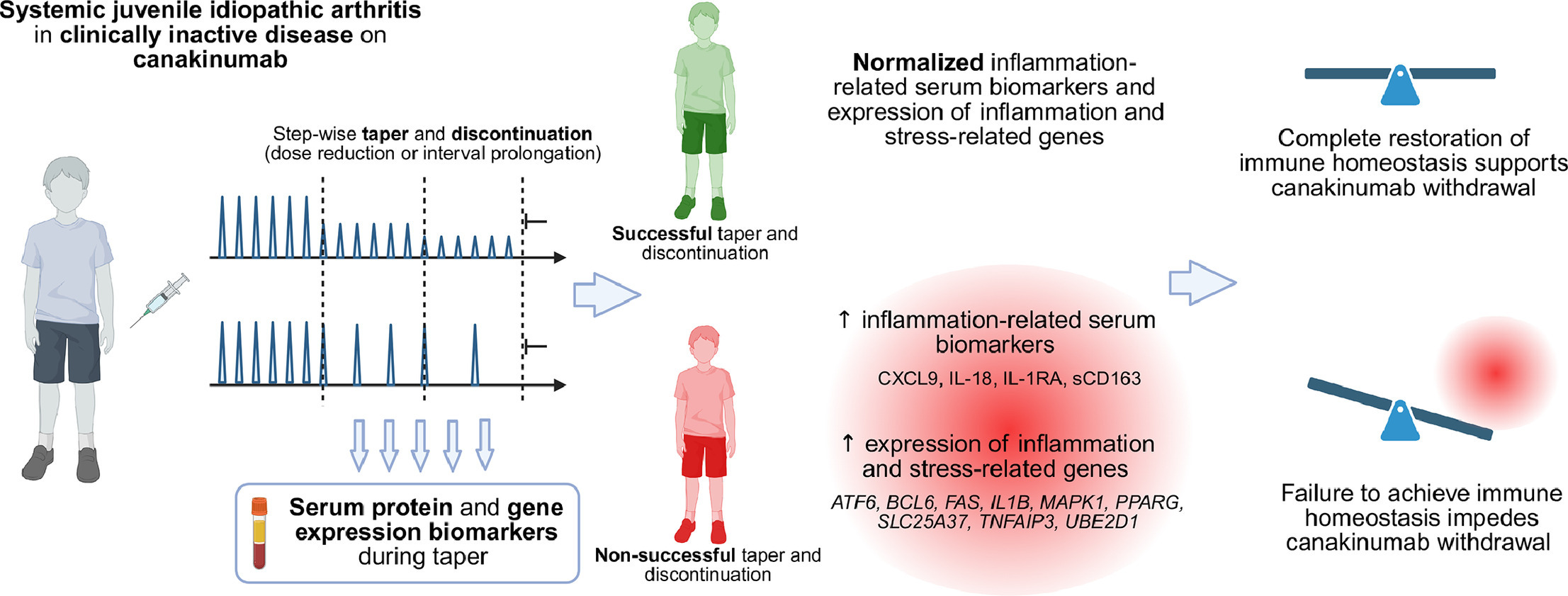
- Lower serum levels of sCD163, CXCL9, IL-1RA, and IL-18 associate with successful canakinumab tapering in sJIA patients.
- Distinct transcriptomic profiles differentiate patients who flare upon canakinumab withdrawal from those who maintain remission.
- A nine-gene signature reflects persistent inflammation and cellular stress, accurately predicting tapering outcomes (AUC 0.71).
- Integrative molecular profiling may individualize tapering regimens, advancing precision medicine in Still’s disease.
Study Background
Systemic juvenile idiopathic arthritis (sJIA) is a severe autoinflammatory condition characterized by systemic inflammation and arthritis, primarily affecting children. The proinflammatory cytokine interleukin-1 (IL-1) plays a central role in its pathogenesis. Canakinumab, a monoclonal antibody targeting IL-1β, induces remission in many patients. However, sustained remission often requires indefinite treatment, and tapering or withdrawal can lead to disease flare in a substantial subset. There is a critical unmet need to identify biomarkers that predict which patients can safely taper off canakinumab without relapse, thus minimizing exposure to immunosuppressants and their associated adverse effects.
Study Design
This analysis included 79 patients with sJIA in clinical remission on canakinumab enrolled in a randomized withdrawal trial. Of these, 71 had peripheral blood samples available for detailed gene expression profiling. Serum concentrations of inflammatory biomarkers were measured using multiplex Luminex assays. Whole-blood RNA underwent both unbiased RNA sequencing (RNA-Seq) and targeted profiling via a 67-gene NanoString panel derived from exploratory transcriptomic data. Investigators compared biomarker levels and gene expression signatures between patients who successfully discontinued canakinumab and those who experienced disease flare after tapering. Hierarchical clustering and pathway enrichment analyses were performed to elucidate biological differences linked to tapering outcomes.
Key Findings
The study found that lower serum levels of soluble CD163 (sCD163), CXCL9, interleukin-1 receptor antagonist (IL-1RA), and IL-18 were significantly associated with successful tapering of canakinumab. These molecules are involved in macrophage activation and systemic inflammation, suggesting that lower residual immune activation portends remission stability.
RNA-Seq revealed distinct transcriptomic landscapes. Patients destined to flare after tapering had reduced expression of type I interferon (IFN)-induced genes and elevated expression of erythropoiesis-related genes, indicating altered immune regulation and hematopoietic activity during remission. The targeted NanoString panel identified nine genes—ATF6, BCL6, FAS, IL1B, MAPK1, PPARG, SLC25A37, TNFAIP3, and UBE2D1—overexpressed in patients with unsuccessful tapering. These genes collectively reflect ongoing subclinical inflammation, cellular stress responses, and dysregulated apoptosis.
A composite gene expression score based on this nine-gene signature differentiated patients likely to flare from those maintaining remission with an area under the receiver operating characteristic curve (AUC) of 0.71. This moderate predictive accuracy supports potential clinical utility but suggests room for refinement.
Expert Commentary
This study advances understanding of the molecular underpinnings that govern sJIA flare risk during biologic tapering. The identified biomarkers provide a rationale for incorporating molecular profiling into routine clinical decision-making to tailor canakinumab withdrawal strategies. However, the findings should be interpreted considering the moderate predictive performance and the complexity of sJIA pathophysiology. The sample size, while substantial for this rare disease, limits validation scope, and future prospective studies are needed to confirm these biomarkers’ predictive value and integrate them into clinical algorithms.
Mechanistically, decreased type I IFN signature in future nonresponders contrasts with findings in other inflammatory diseases, possibly reflecting distinct immune pathways active in sJIA remission. The persistent elevation of inflammation and stress-related genes suggests that even clinically quiescent sJIA harbors molecular signals that predispose to relapse, highlighting the importance of sensitive molecular surveillance.
Conclusion
The integration of serum inflammatory markers and targeted transcriptomic analysis identifies a subset of sJIA patients at increased risk of flare upon canakinumab tapering. These molecular signatures pave the way for personalized tapering protocols, aiming to optimize long-term disease control while minimizing medication exposure. Incorporating such biomarkers into clinical practice could improve patient outcomes and quality of life by reducing unnecessary prolonged immunosuppression.
Future research should focus on validating these biomarkers in larger cohorts, exploring their dynamics during tapering, and integrating other omics data to enhance predictive accuracy. Ultimately, such personalized approaches have the potential to transform management paradigms for Still’s disease and other systemic autoinflammatory conditions.
Funding and Trial Registration
The study was supported by institutional and governmental research grants. The randomized withdrawal trial details and registry identifiers were not specified in the abstract. Further information can be found in the original publication: Hinze T et al., Annals of the Rheumatic Diseases, 2026, PMID: 42772990.
References
- Hinze T, Hinze CH, Kessel C, et al. Predictive molecular signatures for successful tapering of canakinumab in systemic juvenile idiopathic arthritis. Ann Rheum Dis. 2026 Sep 22. PMID: 42772990.
- De Benedetti F, Gattorno M. Systemic juvenile idiopathic arthritis. In: Firestein GS, Budd RC, Gabriel SE, McInnes IB, O’Dell JR, eds. Kelley’s Textbook of Rheumatology. 10th ed. Elsevier; 2017.
- Ruperto N, Brunner HI, Quartier P, et al. Two randomized trials of canakinumab in systemic juvenile idiopathic arthritis. N Engl J Med. 2012 Nov 22;367(25):2396-2406.
- Ravelli A, Martini A. Juvenile idiopathic arthritis. Lancet. 2007 May 5;369(9563):767-78.