Highlight
- Low relative muscle mechanical power is a significant independent predictor of all-cause mortality in patients on hemodialysis.
- This association is particularly strong in patients aged 60 years or older, emphasizing an age-related risk factor.
- No significant association was found between low muscle mechanical power and hospitalization rates in this population.
- The five times sit-to-stand test (5-STSrel) provides a practical, standardized approach to quantify muscle mechanical power in clinical settings.
Study Background
Chronic kidney disease (CKD) patients undergoing hemodialysis suffer from high morbidity and mortality rates due to complex comorbidities, including cardiovascular disease and muscle wasting. Sarcopenia and functional muscle decline have emerged as crucial contributors to poor clinical outcomes in this population. While low muscle mechanical power has been identified as an independent risk factor for adverse events among older adults in the general population, its relevance in hemodialysis patients remained unexplored. Given the burden of muscle dysfunction in CKD, identifying reliable predictors of mortality is crucial for timely intervention and improved patient management.Study Design
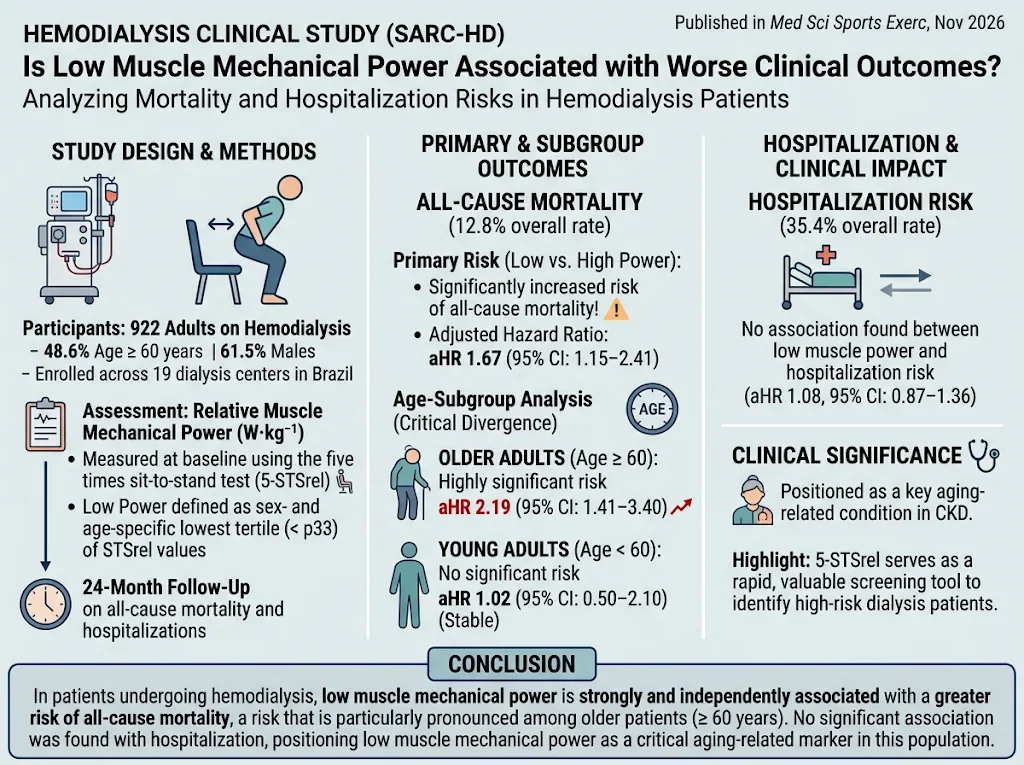
This report is a secondary analysis of the SARC-HD cohort, a prospective longitudinal study enrolling 922 adult patients on maintenance hemodialysis from 19 dialysis centers across Brazil. Baseline assessment included measurement of relative muscle mechanical power using the five times sit-to-stand test (5-STSrel), adjusted for body weight and stratified by sex and age to define low power using the lowest tertile (p33) cutoffs. The primary outcomes were all-cause mortality and hospitalization rates over a 24-month follow-up period. Cox proportional hazards models were employed to estimate hazard ratios (HRs), adjusting for clinically relevant confounders such as age, sex, comorbidities, dialysis adequacy, and nutritional status. Subgroup analysis focused on age categories (≥60 years vs. younger adults) to explore effect modification.Key Findings
Out of 922 participants, 48.6% were aged 60 or older and 61.5% were male. Over two years, there was a 12.8% mortality rate and 35.4% experienced hospitalization. Patients classified with low muscle mechanical power according to 5-STSrel had a significantly increased risk of all-cause mortality with an adjusted HR of 1.67 (95% CI: 1.15–2.41), independent of other variables. Importantly, the risk elevation was pronounced in the older subgroup (≥60 years), with an aHR of 2.19 (95% CI: 1.41–3.40), indicating that low muscle mechanical power substantially contributes to mortality risk in elderly hemodialysis patients. Contrastingly, in younger patients (<60 years), no significant association was found (aHR=1.02, 95% CI: 0.50–2.10). Regarding hospitalizations, there was no statistically significant association observed between low muscle mechanical power and hospitalization risk (aHR =1.08, 95% CI: 0.87–1.36) across the cohort or age subgroups, suggesting that muscle mechanical power may affect longevity rather than short-term acute morbidity.Expert Commentary
This study offers robust evidence that impaired muscle mechanical power is a clinically relevant, independent predictor of mortality in a high-risk population of patients on hemodialysis. By using a practical and validated functional test (5-STSrel), the authors provide a feasible tool for identifying patients at elevated risk. From a mechanistic standpoint, muscle power reflects neuromuscular integrity and functional capacity more comprehensively than mere muscle mass or strength, integrating aspects of contraction speed and force generation. This holistic metric aligns with the multifactorial nature of frailty and aging-related decline seen in CKD. The study’s strengths include a large, multicenter cohort with rigorous adjustment for confounders and a clear operational definition of low muscle mechanical power. However, limitations include lack of direct muscle mass measurements for comparison and absence of cause-specific mortality data, which could elucidate pathways linking muscle power and death. Future research should evaluate interventions such as resistance training or nutritional optimization aimed at improving muscle power and explore if such improvements translate into survival benefits. Integration of muscle mechanical power assessment into routine clinical practice could enhance risk stratification and personalized care for patients receiving dialysis.Conclusion
Low muscle mechanical power, as measured by the relative five times sit-to-stand test, independently predicts higher all-cause mortality risk in patients undergoing hemodialysis, especially among those aged 60 years or older. This finding underscores the significance of muscle function assessment in this vulnerable group and highlights muscle power as a promising target for clinical interventions aimed at improving longevity. Routine evaluation of muscle mechanical power may complement existing prognostic tools, facilitating early identification of patients who may benefit from tailored rehabilitation strategies. Given these findings, clinicians and researchers should prioritize muscle function preservation and enhancement in managing the aging hemodialysis population.Funding and Clinical Trials Registration
The SARC-HD study received funding from national research grants and institutional support in Brazil. No clinical trials registration is indicated as this is a secondary observational cohort analysis.References
1. Disessa HS, Duarte MP, Roure JG, et al. Low Muscle Mechanical Power, Worse Clinical Outcomes? A Cohort of Patients on Hemodialysis. Med Sci Sports Exerc. 2026 Nov 10. PMID: 43008129. 2. Cruz-Jentoft AJ, Bahat G, Bauer J, et al. Sarcopenia: Revised European consensus on definition and diagnosis. Age Ageing. 2019;48(1):16-31. 3. Cheung CL, Nguyen US, Au E, et al. Association of sarcopenia with mortality, cardiovascular events, and hospitalization: A systematic review and meta-analysis. J Am Med Dir Assoc. 2019;20(6):596-607. 4. Roshanravan B, Khatri M, Robinson-Cohen C, et al. Association between physical performance and all-cause mortality among persons with CKD. J Am Soc Nephrol. 2013;24(5):822-830. 5. Beaudart C, Zaaria M, Pasleau F, et al. Health Outcomes of Sarcopenia: A Systematic Review and Meta-Analysis. PLoS One. 2017;12(1):e0169548.Specialty calculators
For clinical reference; use professional judgment.