Highlight
- Documentation of “nonadherence” in the electronic health record (EHR) reduces clinician empathy and increases judgment and patient blame.
- Adding social context to nonadherence documentation mitigates negative clinician attitudes and lowers support for clinic dismissal policies.
- Language used in EHR notes may influence clinical decision-making, highlighting an actionable strategy for improving equity and patient-centeredness.
Study Background
Medication adherence remains a critical determinant of clinical outcomes in chronic disease management. Electronic health records (EHRs) frequently include notes indicating a patient’s adherence status, often using the term “nonadherent” to signify missed or incomplete medication usage. Although this designation is intended to inform care, it can carry implicit bias, potentially affecting clinician perceptions and management decisions. Negative clinician attitudes related to labeling patients as nonadherent may inadvertently promote punitive responses, such as clinic dismissal, thereby exacerbating disparities in healthcare delivery. Understanding the influence of documentation language and the potential mitigating effect of social context explanations is vital to fostering patient-centered care and equity.
Study Design
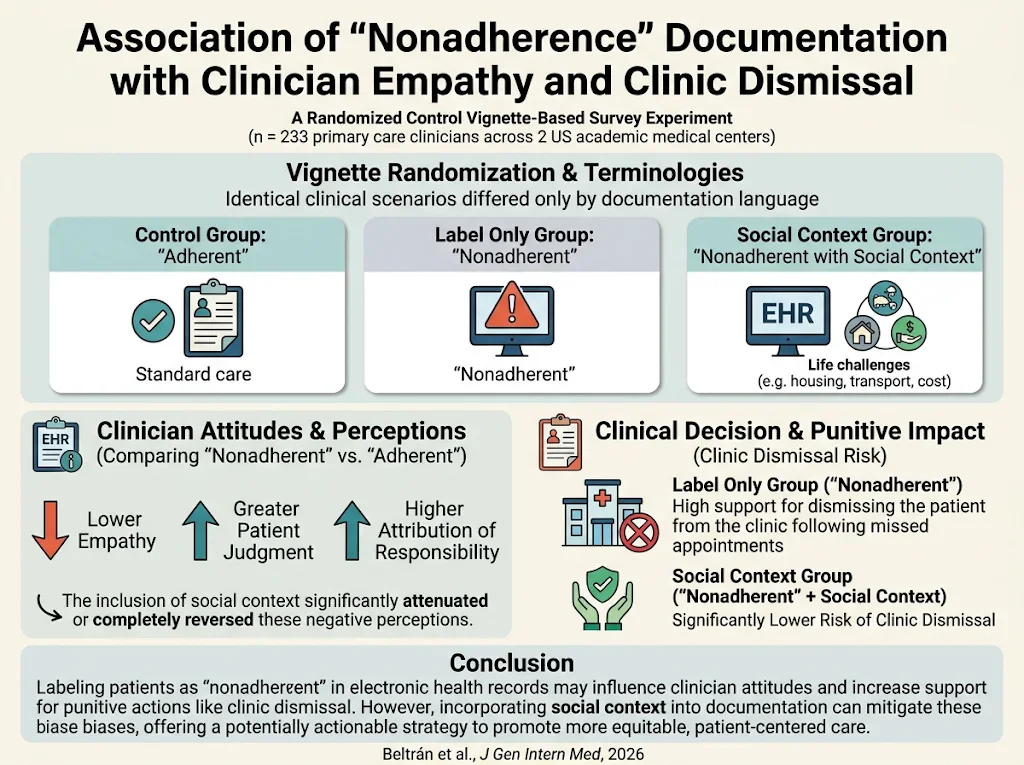
This investigation employed a randomized controlled vignette-based survey experiment conducted across five primary care practices within two US academic medical centers. The study targeted primary care clinicians, including physicians and advanced practice providers, with an invitation sent to 703 individuals. Respondents were randomized to one of three clinical vignettes describing an adverse patient outcome that differed exclusively in the manner adherence was documented in the EHR: (1) adherent (control), (2) nonadherent without additional context, and (3) nonadherent with accompanying social context explaining the patient’s circumstances.
The survey included 15 items assessing clinicians’ self-reported empathy toward the patient, judgment severity, and attribution of personal responsibility. Additionally, clinicians indicated whether they would uphold or challenge a hypothetical policy dismissing patients from the clinic following repeated missed appointments. Statistical comparisons utilized Mann-Whitney U tests and calculated relative risks (RRs) for clinic dismissal decisions.
Key Findings
Out of 703 invited clinicians, 233 responded with 167 providing complete data. Key results were as follows:
- Empathy: The “nonadherent” vignette without social context elicited significantly lower clinician empathy compared with the adherent control group.
- Judgment and Attribution of Responsibility: Clinicians presented with the “nonadherent” label judged the patient more harshly and assigned greater personal responsibility for adverse outcomes.
- Effect of Social Context: Providing social context attenuated or reversed these negative effects. Clinicians reported increased empathy and reduced judgment and blame when social determinants influencing adherence were described.
- Clinic Dismissal Policy: Clinicians exposed to a patient labeled “nonadherent” were more likely to support dismissal from the clinic for missed appointments. However, adding social context significantly lowered the risk of clinicians endorsing dismissal (reduced relative risk), suggesting context sensitizes clinicians to underlying challenges and promotes action less punitive in nature.
These findings indicate that terminology and documentation style in EHRs can shape clinician attitudes and management decisions, potentially affecting the therapeutic alliance and patient retention.
Expert Commentary
Clinical documentation is a powerful tool shaping clinician perceptions and subsequent patient management. The findings align with broader literature documenting the consequences of labeling and implicit bias in healthcare. For example, studies on stigmatizing language associated with patients with substance use disorders or chronic pain highlight similarly detrimental impacts on empathy and care quality (van Boekel et al., 2013; Kelly & Westerhoff, 2010).
Incorporating social context reflects a patient-centered approach that acknowledges barriers such as socioeconomic hardship, transportation issues, or competing life demands that influence adherence. This contextualization supports a shift from blame to understanding and partnership in care planning, consistent with principles of trauma-informed and equitable care (Sweeney & Taggart, 2018).
Limitations of the study include potential selection bias due to voluntary survey participation and the use of vignette-based scenarios that may not capture complex real-world clinical decision-making fully. Nonetheless, the randomized design strengthens causal inference regarding documentation impacts. Future research might explore longitudinal effects of EHR language changes on actual clinical outcomes and patient experiences.
Conclusion
This randomized survey experiment demonstrates that labeling patients as “nonadherent” without contextual information reduces clinician empathy and increases judgment and support for punitive measures like clinic dismissal. Providing social context mitigates these effects, underscoring the importance of careful language use in EHR documentation to foster equitable and patient-centered care.
Healthcare systems and clinicians should consider revising documentation practices to include relevant social determinants and hardship explanations. Such interventions may improve clinician attitudes, preserve the therapeutic relationship, reduce unjustified clinic dismissal, and ultimately enhance patient outcomes.
Funding and Clinical Trials Information
The study was conducted across two US academic medical centers. Specific funding sources and clinical trial registrations were not provided in the abstract.
References
- Beltrán S, Arenas DJ, Bartels SJ, DesRoches CM, Cronholm PF. Association of “Nonadherence” Documentation with Clinician Empathy and Clinic Dismissal: A Randomized Survey Experiment. Journal of General Internal Medicine. 2026 Nov 17. PMID: 43045907.
- van Boekel LC, Brouwers EP, van Weeghel J, Garretsen HF. Stigma among health professionals towards patients with substance use disorders and its consequences for healthcare delivery: systematic review. Drug Alcohol Depend. 2013 Jul 1;131(1-2):23-35.
- Kelly JF, Westerhoff CM. Does it matter how we refer to individuals with substance-related conditions? A randomized study of two commonly used terms. Int J Drug Policy. 2010 Nov;21(3):202-7.
- Sweeney A, Taggart D. The complexity of trauma-informed care. Trauma, Violence, & Abuse. 2018 Jan;19(2):176-190.
Specialty calculators
For clinical reference; use professional judgment.