Highlight
Clinically important upper gastrointestinal (UGI) bleeding in critically ill ventilated patients is associated with prolonged ICU stay and a significantly increased risk of ICU mortality when treated as a time-dependent event. A multistate modeling approach accounting for bleeding timing reveals a 1.56-fold greater hazard of death, underscoring the critical impact of bleeding beyond a simple binary event analysis.
Study Background
Upper gastrointestinal bleeding is a common complication in critically ill patients, especially those receiving invasive mechanical ventilation. It often results from stress-related mucosal disease in the ICU setting. Although prophylaxis strategies exist, bleeding can still occur and has been linked to adverse outcomes such as longer ICU stays and increased mortality. Prior research typically assessed bleeding as a fixed event, ignoring the time-dependent nature of bleeding onset and its dynamic influence on patient outcomes. This limits accurate risk estimation due to immortal time bias and failure to capture transition states during ICU stay. Understanding how clinically important UGI bleeding impacts mortality with time-sensitive statistical methods can better inform prevention and management strategies in critical care.
Study Design
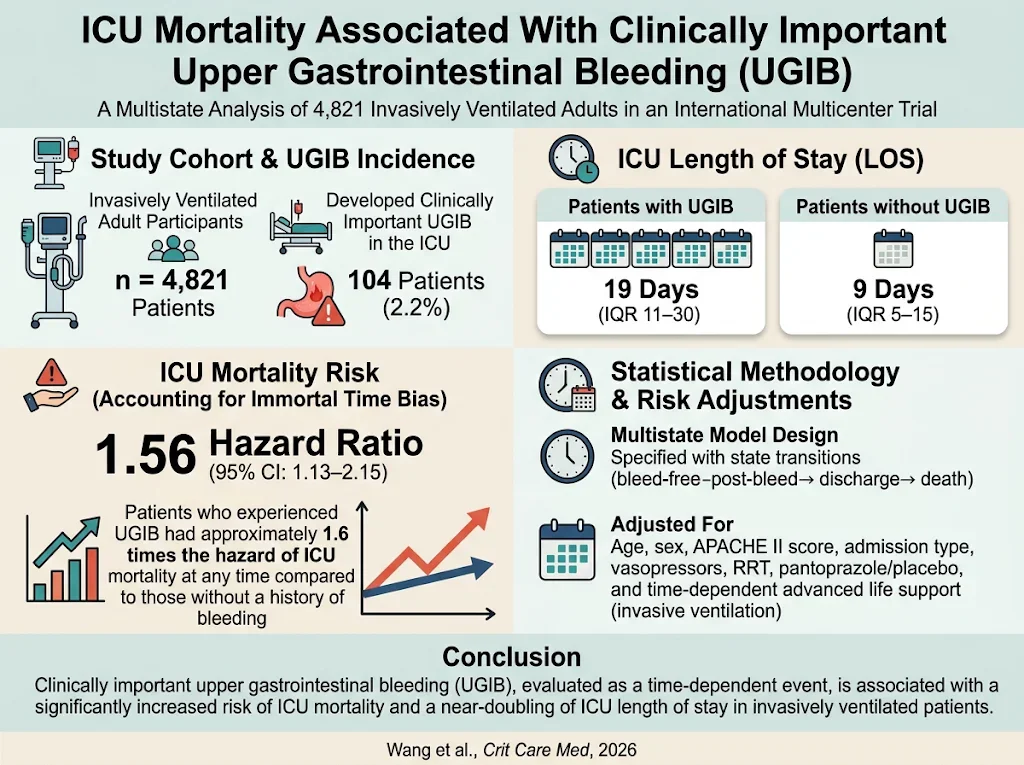
This investigation was a secondary analysis of data from a large international multicenter stress ulcer prophylaxis randomized trial involving 4,821 invasively ventilated adult ICU patients. There were no interventions applied specifically for bleeding within this analysis. Patients were monitored for development of clinically important UGI bleeding during their ICU admission, defined by bleeding requiring clinical intervention or causing hemodynamic compromise. The follow-up was censored at 90 days.
A multistate model was constructed to categorize patients into two transient ICU states—bleed-free and post-bleed—and four absorbing states representing ICU discharge or death with or without bleeding history. The Aalen-Johansen method was employed to estimate state transition probabilities, accounting for timing and competing risks. Two Cox proportional hazards models examined the association between time-dependent bleeding history and ICU mortality. The first adjusted for baseline variables including age, sex, APACHE II score, admission category (medical, surgical, trauma), vasopressor/inotrope use, renal replacement therapy on day 1, and randomization to pantoprazole versus placebo. The second model further controlled for time-dependent exposure to advanced life support interventions during the ICU stay.
Key Findings
Clinically important UGI bleeding occurred in 2.2% (104/4821) of patients. Those who bled had a median ICU stay nearly twice as long as those who did not (19 days vs. 9 days). When accounting for immortal time bias by treating bleeding as a time-dependent covariate, a history of bleeding was associated with a 56% increased hazard of ICU death (hazard ratio 1.56; 95% CI 1.13 to 2.15). The hazard ratio remained consistent after adjustment for time-dependent advanced life support measures.
This indicates that patients who develop clinically important bleeding at any point during ICU admission have approximately 1.6 times the risk of dying in the ICU compared with those who remain bleed-free. The multistate model also highlighted distinct clinical trajectories post-bleeding with alterations in the probabilities of discharge and death, emphasizing bleeding as a pivotal event that influences ICU course rather than a mere binary complication.
Expert Commentary
The study rigorously addresses a key methodological challenge: immortal time bias, which can underestimate the true impact of bleeding on mortality if bleeding is analyzed as a fixed binary event. By leveraging a multistate modeling approach and time-dependent Cox models, the authors provide robust evidence that clinically important upper GI bleeding independently contributes to worse ICU outcomes.
This aligns with current critical care understanding that bleeding complicates management by necessitating transfusions, interrupting anticoagulation, and increasing risks of further organ dysfunction. However, despite prophylaxis, bleeding still occurs, reinforcing the importance of risk stratification and preventative strategies tailored to individual patient profiles.
Limitations include the relatively low bleeding incidence (2.2%) possibly reflecting prophylaxis efficacy or variations in bleeding definitions across centers. The study’s observational design precludes causal inference, and residual confounding by unmeasured variables cannot be completely ruled out. Notably, the cohort was mechanically ventilated adults, so findings may not extend to nonventilated ICU patients or other populations.
Conclusion
Clinically important upper gastrointestinal bleeding during ICU stay is a significant, time-dependent predictor of increased ICU mortality and prolonged length of stay in invasively ventilated adults. This highlights the critical need for robust bleeding prevention and management strategies in the ICU setting. Adoption of time-dependent analytic methods in critical care research offers more accurate risk quantification and better informs clinical decision-making. Future studies should explore targeted interventions to mitigate bleeding risk and evaluate their impact on patient-centered outcomes.
Specialty calculators
For clinical reference; use professional judgment.