Highlight
This prospective observational study demonstrates that adults with diabetes after total pancreatectomy (TP) who transition from multiple daily injections (MDI) to an Advanced Hybrid Closed-Loop (AHCL) insulin delivery system experience a significant increase in time in range (TIR) and favorable glycemic metrics over six months. Notably, reductions in anxiety and fear of hypoglycemia were observed without an increase in hypoglycemic time below range (TBR). These findings suggest AHCL systems may provide meaningful clinical and patient-centered benefits in this challenging population.
Study Background
Total pancreatectomy (TP) results in the complete loss of endogenous insulin and glucagon production, leading to a complex form of diabetes characterized by marked glycemic instability and a high risk of hypoglycemia. Managing such patients with conventional insulin regimens using multiple daily injections (MDI) is challenging given the unpredictable insulin needs and the absence of counterregulatory hormonal responses. The advent of Advanced Hybrid Closed-Loop (AHCL) systems integrates continuous glucose monitoring (CGM) with automated insulin delivery, promising to improve glycemic control and reduce hypoglycemia. However, data on AHCL use specifically after TP remain scarce.
Study Design
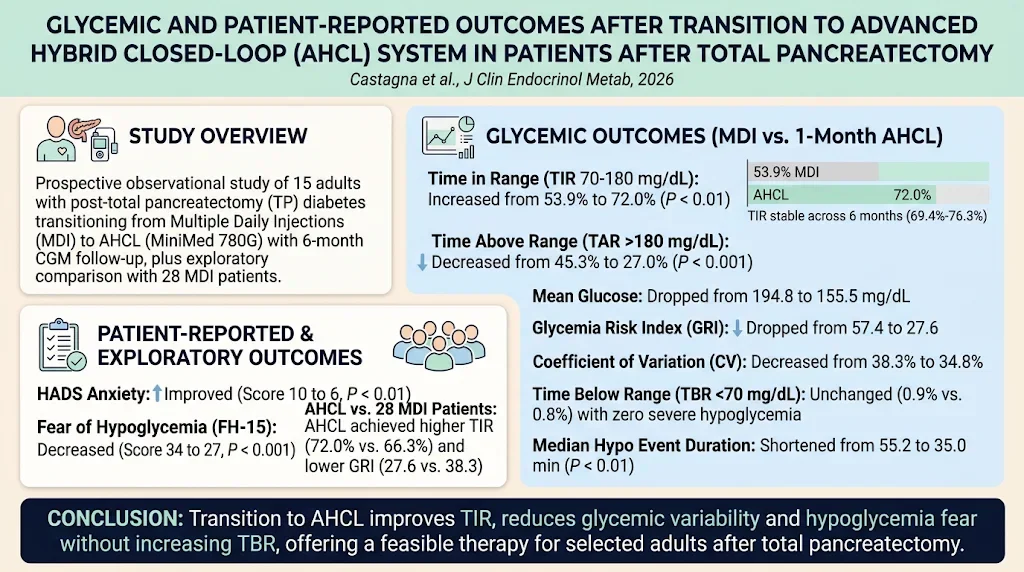
This single-center prospective observational study enrolled 15 adults with diabetes following TP who transitioned from MDI to AHCL therapy. The primary outcome was the change in TIR (70-180 mg/dL) measured by continuous glucose monitoring during the first month after AHCL initiation compared with the final month on MDI. Secondary endpoints included additional CGM-derived metrics such as time above range (TAR), mean glucose, glucose risk index (GRI), coefficient of variation, time below range (TBR), frequency and duration of hypoglycemic events, and patient-reported outcomes related to anxiety and fear of hypoglycemia. CGM outcomes were monitored for six months post-transition. An exploratory comparison was conducted with a matched cohort of 28 TP patients who remained on MDI therapy.
Key Findings
Transitioning to the AHCL system produced a statistically and clinically significant improvement in glycemic control. Median TIR increased markedly from 53.9% under MDI to 72.0% during the initial AHCL month (P < 0.01), with stability maintained throughout the six-month follow-up period. Concurrent reductions were observed in several important metrics: TAR decreased, indicating less hyperglycemia; mean glucose and GRI improved; and glucose variability, as measured by coefficient of variation, lowered significantly (all P < 0.05).
Importantly, time below range (TBR) and the frequency of hypoglycemic events did not increase significantly, addressing a common concern regarding tighter glucose control. Moreover, the median duration of hypoglycemic events shortened substantially—from 55.2 minutes to 35.0 minutes (P < 0.01)—indicating quicker recovery from hypoglycemia episodes.
From a patient perspective, anxiety and fear of hypoglycemia scores decreased post-transition, suggesting that AHCL therapy enhances psychological well-being related to glucose management. Other patient-reported outcomes did not show significant changes.
The exploratory comparative analysis showed that the AHCL cohort had higher TIR and lower GRI relative to the 28 patients continuing on MDI, further supporting the clinical advantages of AHCL therapy in this context.
Expert Commentary
The study addresses a critical unmet need in diabetes management post-TP, where insulin therapy is notoriously difficult due to the absence of endogenous pancreatic hormones and the resulting brittle diabetes phenotype. The use of AHCL systems offers automated adjustments to insulin delivery based on real-time glucose monitoring, thus adapting dynamically to patients’ fluctuating insulin demands.
While the sample size is limited and from a single center, this prospective design with extended follow-up provides valuable insights into the glycemic and patient-reported benefits of AHCL therapy in this population. The maintenance of improved glycemic metrics over six months suggests durability of the benefit, though longer-term studies are warranted.
Limitations include the nonrandomized design and potential selection bias, as patients suitable for AHCL may differ in clinical characteristics from those remaining on MDI. Despite these factors, the improvement in hypoglycemia duration alongside reduced anxiety underscores the clinical relevance of adopting AHCL in specialized centers managing post-TP diabetes.
Conclusion
In adults with diabetes after total pancreatectomy, transitioning from multiple daily injections to an advanced hybrid closed-loop insulin system significantly improves glycemic control metrics including time in range, reduces hypoglycemia duration, and alleviates anxiety related to hypoglycemia without increasing hypoglycemic events. These exploratory findings suggest that AHCL systems are a feasible and promising therapeutic option in this challenging clinical scenario. Larger randomized controlled trials are necessary to confirm long-term efficacy, safety, and sustainability of AHCL in this unique patient population.
Funding and ClinicalTrials.gov
The study was single-center and observational without externally declared funding. No clinical trial registration number was provided in the source publication.
References
Castagna G, Borella ND, Lepore G, Vergani M, Zanchi L, Guizzetti M, Pinelli D, Trevisan R. Glycemic And Patient-Reported Outcomes After Transition To Advanced Hybrid Closed-Loop System In Patients After Total Pancreatectomy. The Journal of Clinical Endocrinology and Metabolism. 2026 Oct 30. PMID: 42960432.
Hinnen D. Advances in Hybrid Closed-Loop Technology in Diabetes Management. Diabetes Technology & Therapeutics. 2020;22(S1):S-140-S-151.
Rubino F, Amiel SA, Zimmet P, et al. New-Onset Diabetes After Pancreatic Surgery: Clinical Perspectives and Management. Diabetes Care. 2021;44(2):237-245.
Specialty calculators
For clinical reference; use professional judgment.