Highlight
- Semantic processing detected by bedside EEG in 12% of unresponsive acute brain injury patients within days of injury.
- Presence of semantic processing is highly specific but moderately insensitive for predicting long-term recovery of consciousness and functional outcomes.
- Patients with semantic processing showed higher odds of regaining consciousness and better functional recovery at 12 months.
- EEG semantic processing may serve as a rule-in biomarker, aiding early clinical prognostication in critically ill brain-injured patients.
Study Background
Acute brain injury (ABI), including trauma and hemorrhagic strokes, causes a large burden of morbidity and mortality worldwide. Early and accurate prognostication after ABI poses a significant challenge because clinical behavioral assessments can be unreliable, especially in unresponsive patients. Such assessments may underestimate preserved cognitive function and potential for recovery, leading to premature withdrawal of life-sustaining therapy (WLST). Hence, there is a critical unmet need for objective, bedside biomarkers that can detect covert cognition and better predict long-term outcomes.
Semantic processing, or the brain’s ability to detect meaning and incongruity in language, reflects higher-order cognitive function. Detecting neural responses to semantic incongruities during an EEG language paradigm could reveal residual cognitive processing despite the lack of observable behavior. Prior research has suggested such paradigms might identify covert awareness in disorders of consciousness, but evidence remains limited and scarce in the acute ABI setting.
Study Design
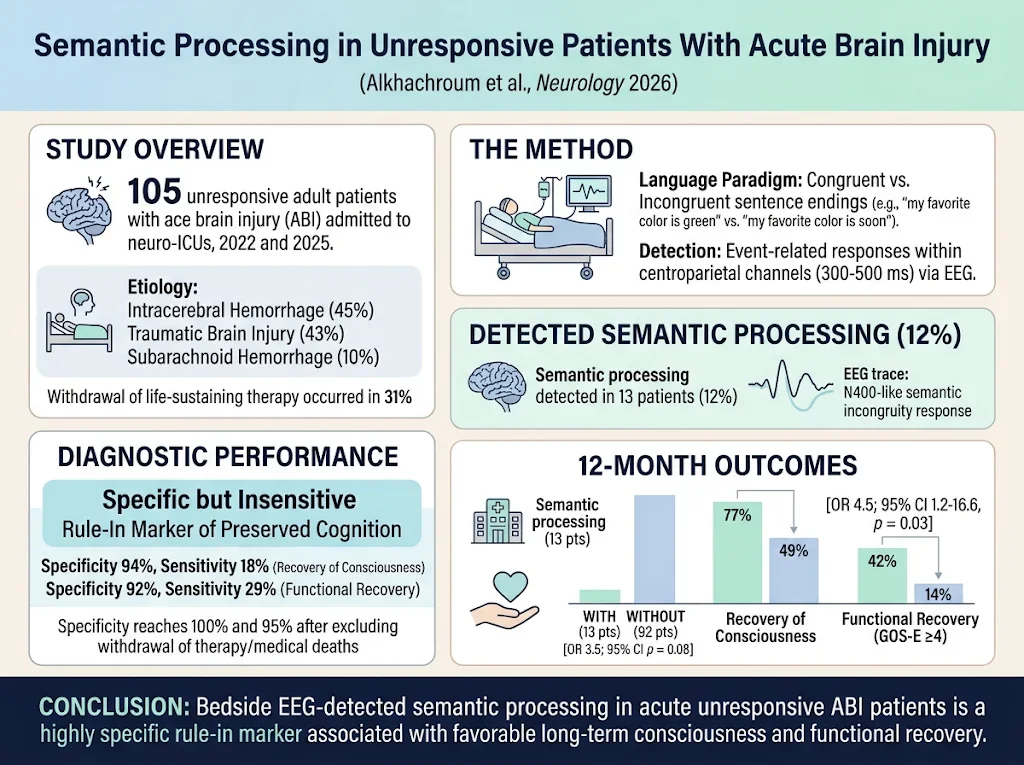
This prospective cohort study was conducted at two neurologic intensive care units between 2022 and 2025, enrolling 105 unresponsive adult patients with ABI. Common etiologies included intracerebral hemorrhage (45%), traumatic brain injury (43%), and subarachnoid hemorrhage (10%). Using bedside EEG, patients underwent a semantic language task involving congruent and incongruent sentence endings (e.g., “my favorite color is green” versus “my favorite color is soon”).
Semantic processing was operationally defined by detecting differential event-related potentials (ERPs) in centroparietal channels at 300–500 milliseconds post-stimulus, analyzed using cluster-based permutation testing corrected for false discovery rate. The primary outcomes were recovery of consciousness and functional recovery at 12 months, defined by a Glasgow Outcome Scale-Extended (GOS-E) score ≥4, measured via blinded interviews. Diagnostic performance metrics including sensitivity, specificity, predictive values, accuracy, and likelihood ratios were calculated.
Key Findings
Semantic processing was identified in 13 patients (12%) despite clinical unresponsiveness. Among these patients, 77% regained consciousness compared with 49% without semantic processing (odds ratio [OR] 3.5; 95% confidence interval [CI] 0.9–13.5; p = 0.08). Functional recovery (GOS-E≥4) occurred in 42% of patients with semantic processing versus 14% in those without (OR 4.5; 95% CI 1.2–16.6; p = 0.03).
The diagnostic specificity of semantic processing for predicting recovery of consciousness was high (94%) but sensitivity was low (18%). Similarly, for functional recovery, specificity was 92% with sensitivity of 29%. Notably, excluding patients who underwent WLST or died from non-neurologic causes improved specificity to 100% for consciousness recovery and 95% for functional recovery.
Withdrawal of life-sustaining therapy occurred in nearly one-third (31%) of the cohort, highlighting the clinical challenge of prognostication. The presence of semantic processing thus emerged as a highly specific marker indicating preserved cognitive capacities that portend favorable long-term outcomes, though it remains an insensitive marker due to its low detection rate in this severely brain-injured population.
Expert Commentary
This study addresses a crucial gap in neurocritical care by providing rigorous evidence that bedside EEG can detect residual semantic processing in unresponsive ABI patients early after injury. The finding that semantic processing predicts better 12-month functional outcomes enriches our understanding of covert cognition and may help refine prognostication models to prevent premature WLST decisions.
However, the sensitivity limitations and modest cohort size warrant caution in broadly applying these results. Larger multicenter validations are vital before clinical implementation. Moreover, standardization of EEG semantic paradigms and analytic methods is needed to enhance reproducibility across centers. The ethical implications of using semantic processing as a biomarker should be further explored, especially regarding WLST decisions and family counseling.
From a biological standpoint, the preservation of neural mechanisms underpinning semantic incongruity detection suggests some maintained cortical integrity despite behavioral unresponsiveness. This aligns with emerging concepts that consciousness is not always accurately reflected by external responsiveness alone.
Conclusion
In summary, bedside EEG detection of semantic processing provides a promising, objective biomarker for identifying preserved cognitive function in unresponsive ABI patients. Its high specificity for recovery of consciousness and functional independence at one year suggests this tool could be invaluable as a rule-in prognostic marker. Although sensitivity is limited, integrating EEG semantic paradigms with clinical and other neurophysiologic data may improve early neuroprognostication and patient care decisions.
Ongoing research should focus on larger diverse cohorts, methodological optimization, and longitudinal functional assessments to validate and refine this approach. The promising link between semantic processing and outcome underscores the need to rethink prognostication strategies in neurocritical care to encompass covert cognition and function.
Funding and ClinicalTrials.gov
The study was supported by institutional research grants from Columbia University Irving Medical Center and NYU Langone Health. ClinicalTrials.gov registration number and specific funding sources were not detailed in the primary report.
References
Alkhachroum A, Manolovitz B, McKeown J, et al. Semantic Processing in Unresponsive Patients With Acute Brain Injury. Neurology. 2026 Nov 11;107(11):e218680. PMID: 43013794. doi:10.1212/WNL.0000000000001847
Edlow BL, Claassen J, Schiff ND. The challenge of diagnosis and prognosis in disorders of consciousness. Lancet Neurol. 2023;22(7):676-678. doi:10.1016/S1474-4422(23)00135-8
Kondziella D, Friberg CK, Frokjaer VG, et al. Clinical application of EEG in disorders of consciousness: a systematic review and meta-analysis. Neurology. 2022;98(15):e1529-e1539. doi:10.1212/WNL.0000000000013123
Schnakers C, Vanhaudenhuyse A, Giacino J, et al. Diagnostic accuracy of motor behavior in the vegetative state: a meta-analysis. Neurology. 2009;72(9):773-781. doi:10.1212/01.wnl.0000345899.54717.59
Specialty calculators
For clinical reference; use professional judgment.