Introduction
Traumatic injury remains a critical public health concern worldwide, not only because of its direct physical consequences but also due to its far-reaching social and economic effects. Social drivers of health—such as housing stability, food security, transportation access, and financial strain—are known to significantly influence health outcomes. However, understanding how these social risks evolve after trauma has been challenging, primarily due to a lack of preinjury baseline data. Leveraging a novel approach using serially measured hospital-administered social drivers of health (SDOH) screening offers a unique opportunity to characterize the impact of trauma on these domains and to identify patients at risk of worsening social vulnerabilities postinjury.
Study Background
At many institutions, trauma patients’ social risks prior to injury are not systematically documented, limiting insight into how injury influences their socioeconomic situation. Since 2019, a screening tool designed to capture key SDOH domains has been implemented at the study institution, enabling repeated measurement preinjury and postinjury during hospitalization. This tool helps interrogate dynamic changes in social risk following trauma and may drive targeted interventions to mitigate adverse socioeconomic impacts.
Study Design and Methods
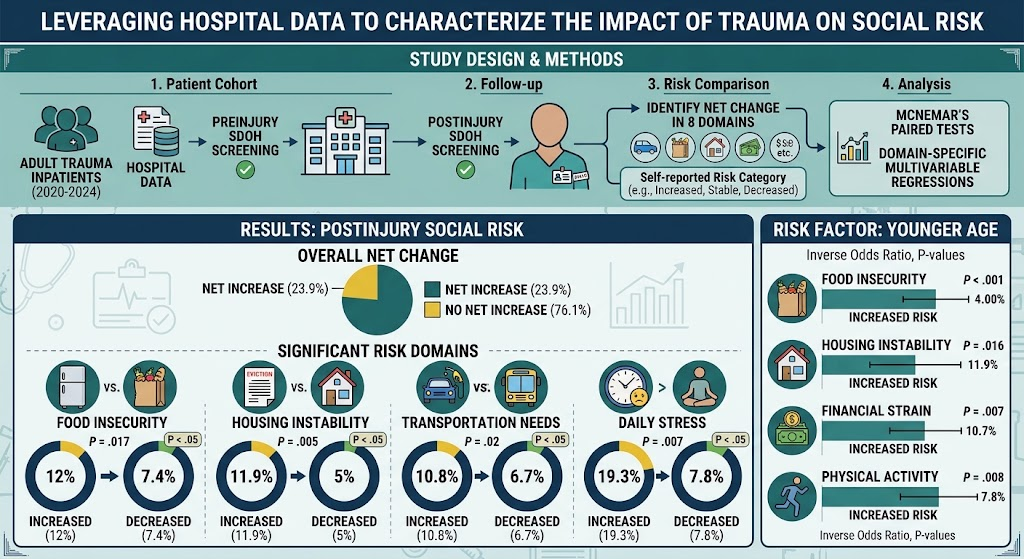
This observational cohort study included adult trauma inpatients treated between 2020 and 2024 who completed hospital-administered social drivers of health screening both preinjury and postinjury. Eight SDOH domains assessed included food insecurity, housing instability, transportation needs, daily stress, financial strain, physical activity, among others. Changes in self-reported risk were categorized as increased, stable, or decreased. Paired McNemar tests determined which domains had significant proportions of patients with increased postinjury risk compared to decreased risk. Additionally, domain-specific multivariable logistic regression models identified factors associated with elevated social risk, with a particular focus on age and other patient characteristics.
Key Findings
Among 1,055 patients studied, nearly one-quarter (23.9%) reported a net increase in social risk following trauma. Four domains emerged as particularly vulnerable: food insecurity increased in 12% versus decreased in 7.4% (P = .017), housing instability increased in 11.9% versus decreased in 5% (P = .005), transportation needs increased in 10.8% versus decreased in 6.7% (P = .02), and daily stress increased in 19.3% versus decreased in 7.8% (P = .007).
Multivariable analyses consistently showed that younger patients were at higher risk of increased social vulnerability across multiple domains. For example, younger age was associated with increased odds of worse food insecurity (inverse odds ratio [OR] 1.04, 95% confidence interval [CI] 1.02-1.06, P < .001), housing instability (inverse OR 1.04, 95% CI 1.01-1.08, P = .016), financial strain (inverse OR 1.04, 95% CI 1.01-1.08, P = .007), and decreased physical activity (inverse OR 0.94, 95% CI 1.02-1.15, P = .008).
These findings highlight that trauma imposes a measurable burden beyond physical injury, disproportionately affecting social determinants pivotal to recovery and long-term health.
Expert Commentary
This study offers valuable insights into the dynamic intersection between trauma and social vulnerabilities, a topic that has garnered growing attention in trauma care and public health. The unique strength lies in the use of serially measured individual-level data that captures preinjury baselines, addressing a critical gap in prior research. The consistent pattern of increased social risk in younger patients warrants further investigation into economic, social support, and healthcare access factors driving this age-related vulnerability.
Limitations include the single-institution design, which may affect generalizability, and reliance on self-reported measures potentially subject to reporting bias. Future studies might explore the longitudinal trajectory beyond hospitalization and evaluate targeted interventions addressing identified social risks. Integration of this screening into trauma care pathways could facilitate early resource allocation and social services referral, potentially improving patient outcomes.
Conclusion
In summary, this study demonstrates that a significant proportion of trauma patients experience increased social risk postinjury, most notably in food insecurity, housing instability, transportation needs, and daily stress domains. Younger adults appear especially vulnerable. These findings underscore the importance of systematic SDOH screening in trauma settings and the development of tailored intervention strategies aimed at mitigating the socioeconomic consequences of traumatic injury. Enhancing postinjury social support and addressing modifiable social risks may ultimately improve clinical recovery and reduce health disparities in this population.
Funding
The study did not specify funding sources.
References
1. Artiga S, Hinton E. Beyond health care: the role of social determinants in promoting health and health equity. Kaiser Family Foundation; 2018.
2. Gottlieb LM, Beagan BL. Assessing social determinants in clinical settings: lessons from the field. Med Care. 2018;56(2):119-125.
3. Haider AH, Scott VK, Rehman KA, et al. Racial disparities in trauma care and outcomes in the United States. J Trauma Acute Care Surg. 2021;90(3):510-517.
4. Gold R, Cottrell E, Bunce A, et al. Developing electronic health record (EHR) strategies to address social determinants of health in primary care. J Am Board Fam Med. 2017;30(4):428-447.
5. Satcher D, Calhoun A, Nicol T, et al. Health disparities and trauma: integrating social risk screening into trauma care pathways. Trauma Surg Acute Care Open. 2022;7(1):e000754.
6.Podugu P, Mahajan A, Mo A, Sweeney S, Ho V. Leveraging serially measured hospital data to characterize the impact of trauma on social risk. Surgery. 2026 Aug;196:110305. doi: 10.1016/j.surg.2026.110305. Epub 2026 May 10. PMID: 42242162.