Highlight
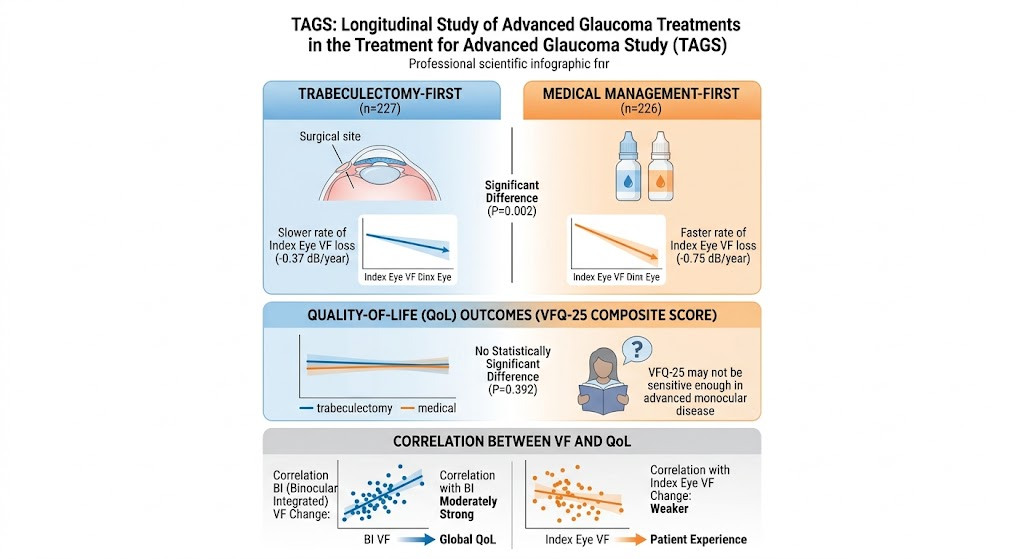
- Trabeculectomy significantly reduces the rate of visual field loss in patients with advanced open-angle glaucoma compared to initial medical management over five years.
- Despite improved visual field outcomes, no statistically significant difference was observed in patient-reported quality of life as measured by the VFQ-25 questionnaire.
- Binocular integrated visual field (BI VF) measures correlate more strongly with quality-of-life changes than monocular index eye visual field, underscoring the importance of assessing binocular function in glaucoma.
- The study suggests current quality-of-life instruments may lack sensitivity to detect monocular intervention benefits in advanced glaucoma treatment.
Study Background and Disease Burden
Glaucoma, particularly advanced open-angle glaucoma, remains a leading cause of irreversible blindness worldwide, characterized by progressive loss of retinal ganglion cells and associated visual field (VF) defects. The disease often leads to compromised vision-related quality of life (QoL), affecting patients’ daily functioning and psychosocial well-being. Therapeutic strategies such as trabeculectomy and medical management are aimed at lowering intraocular pressure (IOP) to preserve visual function and slow VF deterioration. However, the extent to which slowing VF loss impacts QoL, especially in advanced disease stages, remains incompletely understood. Understanding this interplay is critical to optimizing clinical decision-making and patient counseling.
Study Design
The Treatment for Advanced Glaucoma Study (TAGS) is a multicenter randomized clinical trial conducted across 27 secondary care glaucoma departments in the UK. The study enrolled 453 adults with newly diagnosed advanced open-angle glaucoma affecting at least one eye. Participants were randomized to an initial treatment strategy of either trabeculectomy (n=227) or medical management (n=226). One eligible index eye per participant was selected for detailed analysis. The primary endpoints included the rate of change in monocular index eye visual field, binocular integrated visual field (BI VF), and vision-related QoL assessed via the National Eye Institute’s 25-item Visual Function Questionnaire (VFQ-25) composite score over a five-year follow-up period. Data analyses employed a Bayesian longitudinal hierarchical model within an intention-to-treat framework.
Key Findings and Results
Among 442 patients with reliable VF testing (false-positive rate ≤15%) and multiple VFQ-25 timepoints, baseline characteristics were comparable between treatment arms. The main findings were:
- Visual Field Loss Rate: The index eye in the medical management group exhibited a significantly faster VF loss rate at −0.75 dB/year (95% credible interval [CrI], −0.90 to −0.59) compared to −0.37 dB/year (95% CrI, −0.53 to −0.22) in the trabeculectomy group (P=0.002), confirming better structural preservation with surgery.
- Binocular Integrated Visual Field Decline: Although the trabeculectomy group trended toward less BI VF decline than the medical group, the difference did not reach statistical significance (P=0.062), possibly due to compensatory effects from the fellow eye.
- Quality-of-Life Changes: Changes in VFQ-25 composite scores did not differ significantly between groups over five years (P=0.392), suggesting patient-perceived visual function was not markedly improved despite slower VF loss.
- Correlation Analyses: Baseline and longitudinal changes in BI VF demonstrated stronger correlations with VFQ-25 composite scores (baseline correlation 0.41; rate of change correlation 0.56) compared to monocular index eye VF (baseline 0.22; rate of change 0.43), emphasizing the clinical relevance of binocular visual function to QoL.
Expert Commentary
The TAGS study robustly elucidates the differential effects of trabeculectomy versus medical therapy on VF progression in advanced glaucoma, reinforcing trabeculectomy’s role in preserving visual function. However, a notable dissociation exists between objective VF measures and subjective QoL outcomes. This gap raises important considerations about the sensitivity and appropriateness of the VFQ-25 for capturing nuanced monocular improvements and binocular visual adaptations.
Mechanistically, binocular visual function better reflects real-world vision and patients’ daily visual experiences, which may not correlate linearly with monocular VF loss, especially when the fellow eye compensates. Furthermore, QoL instruments may be influenced by psychosocial factors, adaptation, and other comorbidities, which could mask treatment-related benefits. Future research should explore more sensitive and glaucoma-specific patient-reported outcome measures (PROMs) and incorporate assessments of functional vision, such as mobility or obstacle detection, to bridge this translational gap.
Study limitations include the possibility of selection bias toward patients willing to undergo surgery or medical therapy and potential variability in adherence or ancillary treatments. Additionally, the five-year follow-up, although substantial, may be insufficient to detect long-term QoL differences.
Conclusion
This landmark randomized trial confirms that trabeculectomy offers superior preservation of visual field in advanced open-angle glaucoma compared with primary medical management. Nevertheless, the lack of parallel improvement in VFQ-25 derived QoL outcomes underscores the complexity of assessing meaningful patient-centered benefits and questions the sensitivity of existing QoL tools in detecting monocular visual gains. Integrating binocular functional assessments and developing tailored PROMs could enhance clinical evaluation and inform shared decision-making in glaucoma care.
Funding and Registration
The trial received commercial or proprietary support as disclosed in the original publication footnotes. The study was investigator-initiated and conducted across NHS clinical centers in the UK.
References
1. Montesano G, Ometto G, Cheloni R, Garway-Heath DF, Higgins BE, Crabb DP, King AJ; Treatment of Advanced Glaucoma Study (TAGS) Group. Longitudinal Visual Field and Quality-of-Life Change in the Treatment for Advanced Glaucoma Study. Ophthalmology. 2026 Apr 24;133(8):996-1005. doi: 10.1016/j.ophtha.2026.01.003. PMID: 42036075.
2. Garway-Heath DF, Crabb DP. Visual field progression in glaucoma—applying new methodology to personalise clinical care and optimise resource allocation. Expert Rev Ophthalmol. 2019;14(5):353-362.
3. Jampel HD, Friedman DS, Quigley HA. Patient-reported outcomes in glaucoma: review of the literature. Optom Vis Sci. 2009;86(8):591-602.
4. Nelson P, Aspinall P, Papasouliotis O, Worton B, O’Brien C. Quality of life in glaucoma: patients’ perception of visual function. Br J Ophthalmol. 2003;87(5):643-649.