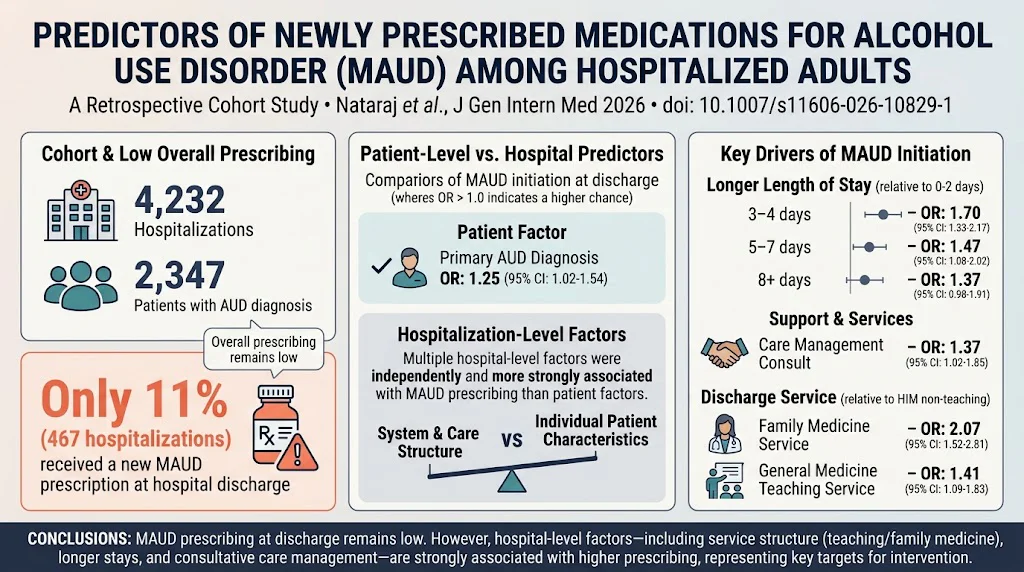
Only 11% of hospitalizations for adults with alcohol use disorder resulted in a new prescription for FDA-approved medications for AUD at discharge.
A primary diagnosis of AUD, longer hospital length of stay, involvement of care management consultation, and discharge from teaching or family medicine services were independently associated with increased prescribing of MAUD.
Prescribing rates remain suboptimal despite evidence supporting MAUD to improve clinical outcomes, identifying hospital-level factors as potential intervention targets.
Study Background
Alcohol use disorder (AUD) affects millions worldwide and poses significant clinical challenges, especially among hospitalized adults. Hospital admission offers a critical opportunity for identifying and initiating evidence-based treatment, yet medications for AUD (MAUD)—such as naltrexone, acamprosate, and disulfiram—are underutilized. The under-prescription at hospital discharge may contribute to poor post-hospitalization outcomes, including readmissions, relapse, and mortality. Understanding which factors influence inpatient initiation of MAUD is crucial to designing effective interventions to improve treatment uptake and ultimately patient outcomes.
Study Design
This retrospective cohort study analyzed hospitalizations from 2018 to 2023 at two hospitals within a large academic medical center without a dedicated inpatient addiction medicine consult service. The study population consisted of adults with an AUD-related diagnosis admitted during this period. The primary outcome assessed was the new prescription of an FDA-approved medication for AUD issued at hospital discharge. Predictor variables encompassed both patient-level characteristics (for example, primary AUD diagnosis versus secondary) and hospitalization-level factors including length of stay, care management consultation, and the clinical service managing the patient. Multivariable analyses, using generalized estimating equations to account for repeated hospitalizations per patient, were conducted to identify independent predictors of MAUD initiation.
Key Findings
A total of 4232 hospitalizations from 2347 unique patients were included. New MAUD prescriptions were observed in 467 hospitalizations, corresponding to an 11% prescribing rate at discharge.
At the patient level, having a primary AUD diagnosis was associated with a higher likelihood of receiving MAUD (adjusted odds ratio [OR], 1.25; 95% confidence interval [CI], 1.02 to 1.54).
Regarding hospitalization-level factors:
Length of stay demonstrated a positive association with MAUD initiation: compared to stays of 0-2 days, the odds of receiving a prescription increased significantly with longer hospitalizations (OR 1.70 for 3-4 days; OR 1.47 for 5-7 days; OR 1.37 for ≥8 days, though the 95% CI for the longest stayed included 1).
Consultation by care management was independently associated with increased likelihood of MAUD prescription at discharge (OR 1.37; 95% CI, 1.02-1.85).
Patients discharged from general medicine teaching services or family medicine services had significantly higher odds of receiving MAUD compared to those discharged from hospitalist internal medicine non-teaching teams (OR 1.41 and OR 2.07, respectively).
Collectively, these results illustrate that both diagnostic clarity (emphasis on AUD as primary diagnosis) and structural factors during hospitalization influence prescribing behavior. However, despite these associations, overall prescribing remained low.
Expert Commentary
The extremely low rates of MAUD prescription at hospital discharge reflect persistent gaps in integration of addiction treatment within inpatient care. The increased prescribing with longer hospital stays may reflect more time for multidisciplinary engagement, assessment, and intervention planning. Similarly, involvement of care management likely facilitates addressing barriers such as medication education, insurance coverage, and outpatient follow-up.
Interestingly, discharge from teaching and family medicine services showed higher prescribing rates, possibly due to greater exposure to academic guidelines, enhanced provider training, or multidisciplinary team approaches inherent to these services. The absence of a dedicated inpatient addiction consult service at the study institutions possibly limits broader prescribing uptake. Incorporating addiction specialists could further improve familiarity and initiation of MAUD during hospitalization.
Limitations include the retrospective design and restriction to two hospitals within a single academic center, which may limit generalizability. Additionally, data did not capture outpatient adherence or longitudinal clinical outcomes post-discharge.
Current AUD guidelines recommend MAUD as standard care, given evidence for reduction in relapse and mortality. This study underscores the urgent need for system-level strategies—such as enhanced provider education, care management integration, and structural support within hospital services—to boost inpatient MAUD initiation rates.
Conclusion
Medication initiation for alcohol use disorder at hospital discharge remains disappointingly low despite clear clinical benefits. This study identifies key hospitalization-level factors—length of stay, care management involvement, and service of discharge—and a primary AUD diagnosis as significant predictors of new MAUD prescriptions. These findings highlight actionable targets for quality improvement initiatives, including enhanced consultation availability and education within hospital services, to close the treatment gap and improve patient outcomes in AUD care. Future research should explore interventions to integrate addiction medicine expertise within inpatient care models and assess their impact on both prescribing rates and longitudinal health outcomes.
Funding and ClinicalTrials.gov
No specific funding or registered clinical trials were reported in the source publication.
References
1. Nataraj N, Colbenson GA, Schroeder DR, Ratelle JT. Predictors of Newly Prescribed Medications for Alcohol Use Disorder Among Hospitalized Adults: A Retrospective Cohort Study. J Gen Intern Med. 2026 Oct 22; PMID: 42918933.
2. Jonas DE, Amick HR, Feltner C, et al. Pharmacotherapy for Adults with Alcohol Use Disorders in Outpatient Settings: A Systematic Review and Meta-Analysis. JAMA. 2014 May 14;311(18):1889–900.
3. O’Malley SS, Sinha R. Medication Treatment for Alcohol Use Disorder. Biol Psychiatry. 2020 Mar 1;87(5):420–432.
4. National Institute on Alcohol Abuse and Alcoholism (NIAAA). Alcohol Use Disorder: A Comparison Between DSM–IV and DSM–5. 2020.
5. Williams EC, Achtmeyer CE, Young JP, et al. Quality of care for alcohol use disorders: missed opportunities and challenges. J Subst Abuse Treat. 2015 Jul;53:44–51.