Highlight
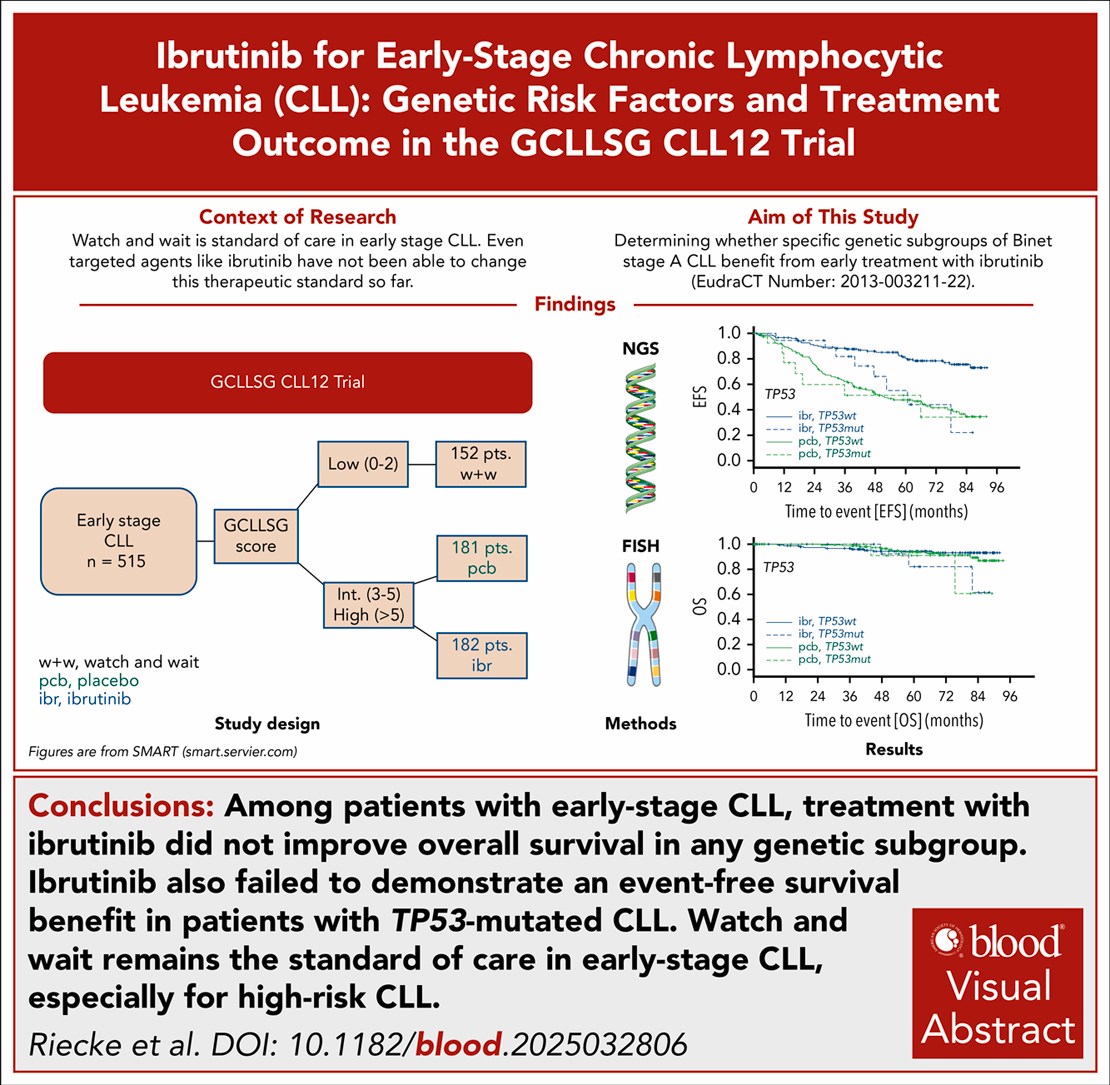
- The GCLLSG CLL12 trial evaluated ibrutinib versus placebo in early-stage CLL patients at intermediate to very high genetic risk.
- Ibrutinib significantly improved event-free survival (EFS) in patients with certain genetic aberrations including unmutated IGHV, del(11q), +12, and mutations in NOTCH1, ATM, and NFKBIE.
- Patients harboring del(17p) or TP53 mutations did not derive an EFS benefit from ibrutinib, supporting continued watch-and-wait in these high-risk groups.
- No overall survival (OS) advantage was observed with ibrutinib across any genetic subgroup after median follow-up of over 5.5 years.
Study Background
Chronic lymphocytic leukemia (CLL) is characterized by clonal proliferation of mature B lymphocytes and exhibits a highly variable clinical course. Early-stage, asymptomatic CLL is traditionally managed with a watch-and-wait strategy due to the indolent nature of the disease and lack of OS benefit from early treatment interventions. However, genetic markers such as deletions of chromosome 17p (del(17p)), 11q (del(11q)), unmutated immunoglobulin heavy variable (U-IGHV) gene status, and mutations in specific genes such as TP53, NOTCH1, ATM, RAS family members, and NFKBIE confer a heterogeneous risk for disease progression.
Ibrutinib, a covalent Bruton’s tyrosine kinase inhibitor (BTKi), is approved for several CLL indications based on demonstrated efficacy in relapsed or high-risk patients. The German CLL Study Group’s CLL12 trial aimed to investigate if early intervention with ibrutinib in patients with early-stage, genetically high-risk CLL could improve clinical outcomes compared to placebo, specifically focusing on event-free survival and OS.
Study Design
The phase III GCLLSG CLL12 trial enrolled 515 patients with asymptomatic, early-stage CLL who were stratified as intermediate to very high risk for progression based on a comprehensive scoring system incorporating clinical parameters and genetic risk markers. Patients were randomized to receive ibrutinib or placebo with a median follow-up of 69.3 months.
Genetic risk assessment included fluorescence in situ hybridization (FISH) for chromosomal abnormalities such as del(17p), del(11q), trisomy 12 (+12), and molecular analyses for IGHV mutation status and mutations in NOTCH1, ATM, TP53, NFKBIE, POT1, and the RAS/RAF pathway (NRAS, KRAS, BRAF).
The primary endpoint was event-free survival (EFS), defined as time to disease progression requiring treatment or death, while secondary endpoints included overall survival (OS) and subgroup analyses based on genetic features.
Key Findings
At over five years follow-up, 166 EFS events and 32 OS events were recorded.
In the placebo arm, adverse genetic features including del(17p), del(11q), trisomy 12, unmutated IGHV, and mutations in NOTCH1, ATM, and the RAS/RAF pathway, as well as NFKBIE mutation, were each associated with significantly shorter EFS.
Ibrutinib treatment yielded a robust EFS benefit among patients with the following markers:
– Unmutated IGHV (U-IGHV)
– del(11q)
– Trisomy 12 (+12)
– NOTCH1 mutations
– ATM mutations
– NFKBIE mutations
Conversely, patients harboring del(17p) or TP53 mutations did not experience a meaningful EFS improvement with ibrutinib relative to placebo. This suggests intrinsic resistance or aggressive disease biology in these subgroups that is less modifiable by early ibrutinib therapy.
Importantly, no patient subgroup showed an improvement in overall survival with ibrutinib within the study period, indicating that early pharmacologic intervention with ibrutinib does not translate to longer life expectancy for asymptomatic early-stage CLL patients, regardless of genetic risk profile.
Multivariable Cox regression analysis identified ibrutinib treatment as an independent favorable prognostic factor for EFS. In contrast, unfavorable prognostic factors included unmutated IGHV, del(17p), and mutations in POT1, the RAS/RAF pathway, and NFKBIE.
Safety and Tolerability
While detailed safety data were not fully provided in the abstract, prior studies and clinical experience note that ibrutinib is associated with adverse events such as bleeding, atrial fibrillation, infections, and hypertension, which must be weighed against the benefits especially in asymptomatic patients.
Expert Commentary
The CLL12 trial’s genetic subgroup analysis refines our understanding of which patients with early-stage CLL might benefit from early BTK inhibition. Findings reinforce that the biologic heterogeneity of CLL critically influences therapeutic responsiveness. Notably, the absence of OS benefit and the lack of efficacy in del(17p)/TP53 mutant cohorts align with the paradigm to conserve therapy until disease progression in these high-risk individuals due to their distinct pathobiology.
These results emphasize the need for precision medicine approaches in CLL, tailoring treatment based on molecular and cytogenetic risk rather than a one-size-fits-all strategy. Further research is warranted to elucidate mechanisms of ibrutinib resistance in del(17p)/TP53 mutated CLL and to explore combination or novel treatments for these high-risk patients.
Conclusion
The GCLLSG CLL12 trial establishes that early treatment with ibrutinib improves event-free survival in genetically intermediate-risk early-stage CLL patients bearing unmutated IGHV, del(11q), trisomy 12, NOTCH1, ATM, and NFKBIE mutations. However, patients with del(17p) and TP53 mutations do not benefit from early ibrutinib, supporting continued watch-and-wait as standard care in these high-risk subgroups.
No overall survival advantage was demonstrated, underscoring that early intervention with ibrutinib in asymptomatic early-stage CLL is not justified outside select genetically defined populations. This study advances personalized patient management based on genomic profiling to optimize timing and choice of therapy.
Funding and Trial Registration
The CLL12 trial was registered at the European Union Drug Regulating Authorities Clinical Trials Database (EudraCT Number: 2013-003211-22). Funding sources were not mentioned in the abstract but were presumably supported by academic and possibly pharmaceutical grants.
References
1. Riecke A, Robrecht S, Yosifov DY, et al. Ibrutinib for early-stage CLL: genetic risk factors and treatment outcome in the GCLLSG CLL12 trial. Blood. 2026 Aug 27;148(9):1108-1114. PMID: 42322115.
2. Hallek M, Fischer K, Fingerle-Rowson G, et al. Addition of rituximab to fludarabine and cyclophosphamide in patients with chronic lymphocytic leukemia: a randomized, open-label, phase 3 trial. Lancet. 2010;376(9747):1164-1174.
3. Burger JA, Tedeschi A, Barr PM, et al. Ibrutinib as Initial Therapy for Patients with Chronic Lymphocytic Leukemia. N Engl J Med. 2015;373(25):2425-2437.
4. Woyach JA, Ruppert AS, Heerema NA, et al. Ibrutinib Regimens versus Chemoimmunotherapy in Older Patients with Untreated CLL. N Engl J Med. 2018;379(26):2517-2528.