Highlight
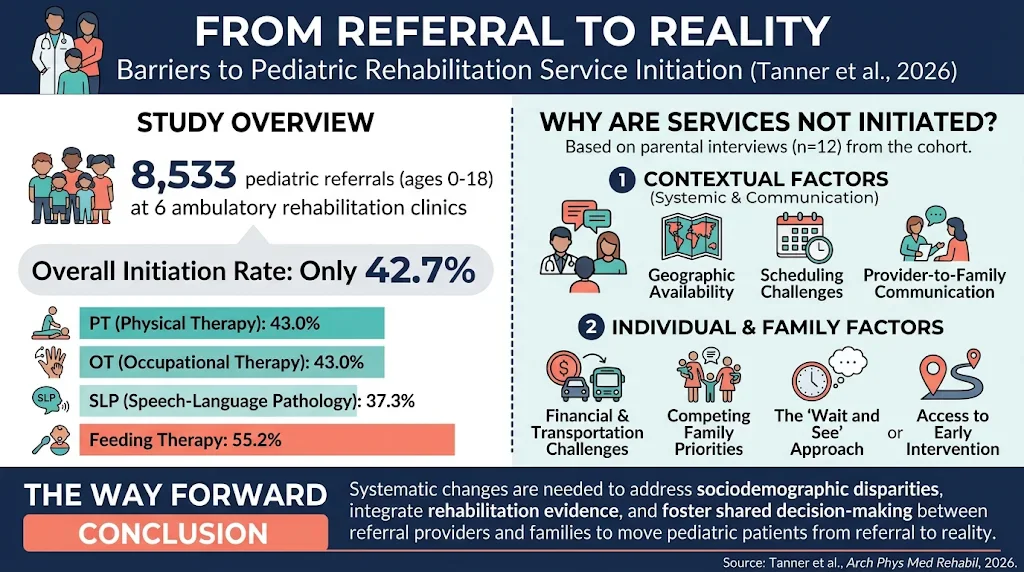
- Only 42.7% of pediatric rehabilitation referrals resulted in service initiation, with variation among therapy disciplines.
- Barriers span geographic availability, scheduling, communication, financial and transportation constraints, and family priorities.
- Parental perspectives reveal complex, intersecting factors influencing decisions around therapy initiation, including a “wait and see” approach.
- System-level changes emphasizing shared decision-making and addressing sociodemographic disparities are essential to improve access and outcomes.
Study Background
Pediatric rehabilitation services—encompassing physical therapy (PT), occupational therapy (OT), speech-language pathology (SLP), and feeding therapy—play a crucial role in optimizing developmental outcomes for children with diverse medical needs. Early intervention is widely recognized as critical for improving functional ability and quality of life. Despite referrals from healthcare providers, a substantial proportion of children do not initiate recommended rehabilitation services. Understanding the barriers to service initiation is vital to bridge the gap between referral and treatment, mitigate long-term disability risk, and ensure equitable healthcare delivery. Prior research has underscored sociodemographic disparities and systemic challenges affecting healthcare access yet comprehensive analyses integrating large-scale quantitative data with in-depth parental experiences remain limited.
Study Design
This investigation employed an explanatory sequential mixed methods design within a pediatric healthcare organization consisting of six ambulatory rehabilitation clinics offering PT, OT, SLP, and feeding therapy. The quantitative cohort included 8,533 pediatric rehabilitation referrals for patients aged 0 to 18 years over a 12-month period from March 2021 to February 2022. The main outcome measure was uptake of rehabilitation services following referral, analyzed across sociodemographic characteristics and therapy discipline. Following quantitative analysis, researchers purposively sampled 12 parents from the referral cohort for semi-structured qualitative interviews to explore detailed experiences and perceptions of barriers to service initiation.
Key Findings
The quantitative analysis revealed an overall pediatric rehabilitation service initiation rate of 42.7%. By discipline, initiation rates were 43.0% for physical and occupational therapy, 37.3% for speech-language pathology, and higher (55.2%) for feeding therapy. This indicates substantial non-initiation despite referrals, raising concerns about unmet rehabilitation needs.
Multifactorial barriers emerged and were broadly grouped into contextual/systemic and individual/family-level factors:
Contextual and Systemic Barriers
- Geographic availability: Families living in underserved areas faced limited access to specialized rehabilitation services, impacting timely initiation.
- Scheduling challenges: Appointment wait times and conflicts with school or parental work schedules impeded engagement with services.
- Communication: How healthcare professionals discussed rehabilitation recommendations influenced parental understanding and motivation to initiate therapy.
Individual and Family-Level Barriers
- Prior experience with rehabilitation: Families with no prior exposure to therapy services expressed uncertainty and skepticism.
- Competing family priorities: Parenting demands, siblings’ needs, and household stress impacted ability to prioritize rehabilitation appointments.
- Financial and transportation difficulties: Costs related to therapy co-pays, travel time, and transportation availability were significant hurdles.
- “Wait and see” approach: Several parents opted to postpone therapy initiation to observe developmental trajectory, reflecting ambivalence or lack of perceived urgency.
- Access to early intervention: Variability in early intervention service availability influenced initiation decisions, particularly in younger children.
The embedded qualitative interviews provided vital context, illustrating how these barriers overlapped and intersected with child age, severity of disability, and family socioeconomic factors. Parents articulated the emotional and logistical complexity underlying rehabilitation initiation decisions, highlighting the need for improved communication strategies and system navigation supports.
Expert Commentary
These findings are consistent with broader literature emphasizing that healthcare access disparities are multidimensional and context-dependent. The relatively low initiation rates despite referrals underscore critical gaps in the care continuum for vulnerable pediatric populations. Experts advocate for system-level reforms such as streamlined referral pathways, tele-rehabilitation access, and flexible scheduling to enhance reach. Importantly, the qualitative insights highlight the vital role of shared decision-making that respects family values and addresses contextual barriers.
Limitations include the single healthcare system setting which may limit generalizability, and the modest qualitative sample size, although interview depth provided meaningful nuance. Future research should evaluate interventions targeting identified barriers and assess long-term child and family outcomes.
Conclusion
Addressing barriers to pediatric rehabilitation service initiation requires holistic strategies that integrate clinical evidence, socioeconomic realities, and family perspectives. Healthcare organizations must prioritize equitable access through geographic service expansion, appointment flexibility, cost mitigation, and culturally sensitive communication. Enhancing shared decision-making between referral providers and families may empower caregivers to navigate complex decisions about therapy initiation. Ultimately, closing the referral-to-initiation gap has the potential to improve functional outcomes and life quality for children with rehabilitation needs.
Funding and Clinical Trials Registry
The study did not report specific funding sources or clinical trial registration.
References
1. Novak I, Honan I. Effectiveness of pediatric occupational therapy for children with disabilities: A systematic review. Aust Occup Ther J. 2019;66(3):238-250. doi:10.1111/1440-1630.12563
2. Khetani MA, Polfuss M, Bhattacharya A, et al. Disparities in access to rehabilitation services among children with cerebral palsy: A population-based study. Arch Phys Med Rehabil. 2021;102(8):1434-1443. doi:10.1016/j.apmr.2021.03.013
3. King G, Law M, King S, Rosenbaum P. Families’ perspectives on enabling and empowering children with disabilities. Phys Occup Ther Pediatr. 2020;40(5):479-495. doi:10.1080/01942638.2020.1777044
4. Sugden D, Chamberlain M. Communicating the need for therapy: Parental and clinician perspectives. Child Care Health Dev. 2022;48(1):45-53. doi:10.1111/cch.12915
Specialty calculators
For clinical reference; use professional judgment.