Highlight
1. Elective neck dissection (END) was performed in approximately 20% of patients with clinically node-negative (cN0) submandibular gland cancer (SMGC) across a large national cohort.
2. Occult nodal metastasis (ONM) was present in nearly a quarter (24.7%) of patients who underwent END, with higher rates associated with advanced T classification and poor tumor differentiation.
3. END did not confer a significant overall survival benefit, whereas the presence of ONM was linked to substantially worse survival.
4. These findings suggest that routine END for prognostic purposes alone may not be justified in cN0 SMGC, especially without adverse tumor features.
Study Background
Submandibular gland cancer constitutes a rare subset of salivary gland malignancies. Management often involves surgical resection of the primary tumor, but the role of elective neck dissection in patients without clinically evident nodal disease remains controversial. Occult nodal metastasis—microscopic lymph node involvement not detected by clinical or radiographic assessment—can negatively impact prognosis. However, END carries operative risks and potential morbidity, and its survival benefit has been unclear. A better understanding of occult metastasis rates and the survival impact of END may guide surgical decision-making in clinically node-negative SMGC patients.
Study Design
This retrospective cohort study used data from the National Cancer Database spanning 2006 to 2018. Patients included had cT1 through cT4 submandibular gland cancer with no clinical or distant metastases (cN0M0) undergoing surgical resection. The study investigated the factors associated with undergoing END versus no neck dissection, the prevalence of occult nodal metastasis among END patients, and the effect of END and ONM on overall survival (OS). Statistical methods included logistic regression to examine factors influencing END utilization, Kaplan-Meier survival curves, and Cox proportional hazards regression to estimate hazard ratios for survival outcomes.
Key Findings
A total of 1,285 patients met inclusion criteria, comprising a majority of females (54.6%) and predominantly White patients (82.5%). The most common histology was adenoid cystic carcinoma (43.6%), and most tumors were classified as cT1 (41.9%). END was performed in 255 patients (19.6%). Several factors increased odds of receiving END: treatment at academic or research facilities, high-grade tumor histology, and advanced tumor stage (cT3 or cT4). Medicare insurance status was associated with lower odds of END.
Among patients undergoing END, occult nodal metastasis was detected in 63 individuals, representing 24.7%. ONM rates varied by tumor classification and grade: 13.2% in cT1 tumors up to 50% in cT4 tumors; 6.5% in well-differentiated tumors rising to 40.3% in poorly differentiated tumors. This underscores a progressive risk of nodal microinvolvement with tumor severity.
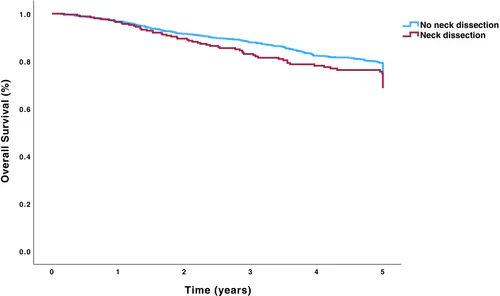
Despite the nontrivial ONM rate, elective neck dissection was not associated with improved overall survival (hazard ratio [HR] 1.11, 95% confidence interval [CI] 0.84–1.46, p=0.461). By contrast, ONM presence was strongly prognostic of poorer survival (HR 3.69, 95% CI 2.25–6.05, p < 0.001). Five-year overall survival was significantly higher for those without ONM (83%) versus with ONM (50%). These findings highlight that while occult nodal disease signals worse prognosis, END itself did not translate into survival benefit in this population.
Expert Commentary
This comprehensive analysis provides valuable insight into the clinical management of submandibular gland cancer with clinically negative necks. The substantial rate of occult nodal metastases in higher T stages and poorly differentiated tumors supports consideration of selective neck evaluation in high-risk patients. Yet the absence of a survival benefit from elective neck dissection in the overall cohort suggests that routine END may lead to overtreatment, exposing some patients to unnecessary surgical morbidity without improvement in longevity.
One limitation intrinsic to large database analyses is potential selection bias and the inability to fully capture nuances such as lymph node yield, extent of neck dissection, or adjuvant therapy details. Furthermore, the retrospective nature precludes establishing causality. Nonetheless, the findings align with other literature advocating a risk-adapted approach—reserving END for those with adverse tumor features or clinical suspicion rather than a broad application.
From a biological perspective, occult nodal metastases represent established tumor spread which impact prognosis negatively, explaining the survival disparities. However, the lack of survival improvement with END may reflect that nodal positivity identifies aggressive disease biology that is less amenable to surgical cure alone and may instead require tailored multimodal therapy.
Conclusion
This study demonstrates that while occult nodal metastasis occurs in nearly one-quarter of cN0 submandibular gland cancer patients undergoing elective neck dissection, this intervention does not confer an overall survival advantage. Elective neck dissection should not be routinely performed solely for prognostic evaluation, particularly in the absence of high-risk or adverse histological features. Future prospective studies and clinical trials are warranted to refine risk stratification and evaluate selective END strategies combined with systemic or radiation therapies to optimize patient outcomes.
Funding and Clinical Trials
No specific funding was disclosed for this study. The analysis utilized a national cancer registry database. No registered clinical trial identifiers were reported.
References
Patel AM, Pamula SD, Mehari M, Lingam SR, King ZD, Bharadia AP, Czerwonka L, Vanison CC. Elective Neck Dissection in cT1-4 N0M0 Submandibular Gland Cancer. The Laryngoscope. 2026 Nov 5. PMID: 42988768.
Lopez F, Guntinas-Lichius O, Anthwal N, et al. Management of the clinically N0 neck in salivary gland malignancies: a systematic review and practical guide. Head Neck. 2022;44(8):1767-1778.
Terhaard CHJ, Lubsen H, Rasch CRN, et al. Salivary gland carcinoma: independent prognostic factors for locoregional control, distant metastases, and overall survival. Head Neck. 2004;26(8):681-692.
Specialty calculators
For clinical reference; use professional judgment.