Highlight
This study compared the impact of referrals to care coordination versus food assistance on diabetes outcomes in a large, community-based cohort. Key findings indicate no clinically meaningful difference in glycemic control, blood pressure, or lipid levels between the two referral types. The results support flexible, patient-centered approaches to integrating social needs interventions in diabetes care.
Study Background
Type 2 diabetes mellitus (T2DM) affects millions worldwide and remains a leading cause of morbidity and mortality due to its chronic complications. Effective management requires comprehensive approaches addressing biomedical and social determinants of health. Food insecurity and other socioeconomic barriers adversely impact diabetes control by limiting access to healthy foods and healthcare resources. Interventions such as care coordination, which may include social services navigation, and direct food assistance are strategies aimed at mitigating these social determinants to improve clinical outcomes. Despite individual evidence supporting both, comparative data on their effectiveness are limited, particularly in real-world community health settings.
Study Design
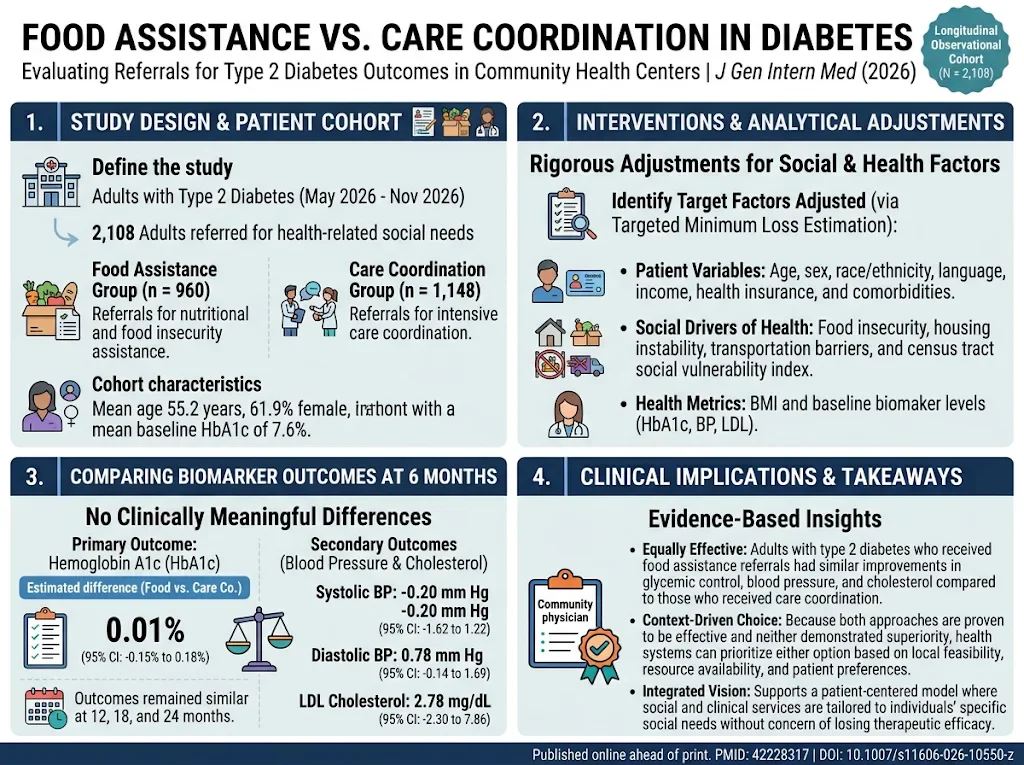
The study was a longitudinal, observational cohort analysis involving 2,108 adults with T2DM receiving care at community-based health centers. Participants were referred either for care coordination services or food assistance interventions. Care coordination entailed structured support to manage health and social needs, while food assistance likely included connections to programs addressing food insecurity. The primary outcome measure was hemoglobin A1c (HbA1c), a biomarker reflecting average glycemic control, assessed at 6 months post-referral, with secondary assessments at 12, 18, and 24 months. Secondary outcomes included systolic and diastolic blood pressure (SBP and DBP) and low-density lipoprotein cholesterol (LDL) levels. The analysis adjusted for multiple confounders such as demographics, socioeconomic indicators, comorbidities, and baseline clinical values using targeted minimum loss estimation.
Key Findings
The cohort had a mean age of 55.2 years, with 61.9% female participants, and a mean baseline HbA1c of 7.6%. Among the participants, 960 received food assistance referrals and 1,148 received care coordination referrals. After adjustment, comparisons at 6 months showed negligible differences in outcomes: HbA1c difference of 0.01% (95% CI -0.15 to 0.18), SBP difference of -0.20 mm Hg (95% CI -1.62 to 1.22), DBP difference of 0.78 mm Hg (95% CI -0.14 to 1.69), and LDL difference of 2.78 mg/dL (95% CI -2.30 to 7.86). These differences were not clinically meaningful and consistent results were observed at later time points up to 24 months. The findings suggest similar effectiveness of either referral type in modifying diabetes-related clinical markers.
Expert Commentary
This study contributes important comparative evidence within the realm of social determinants of health interventions in diabetes care. While both care coordination and food assistance have individually demonstrated benefits, this real-world analysis indicates that either approach can be employed effectively based on context. The lack of difference does not imply ineffectiveness; rather, the findings highlight opportunities for personalized intervention choice guided by feasibility, patient preference, and resource availability. Limitations include the observational design, potential unmeasured confounding, and generalizability constrained to community health center populations. Future randomized controlled trials could provide confirmatory evidence and explore mechanisms underlying intervention impact. Integration of such social needs interventions aligns with growing emphasis on holistic diabetes management in clinical guidelines.
Conclusion
This cohort study found no clinically significant differences in key diabetes outcomes between adults receiving food assistance versus care coordination referrals. Both intervention types remain valuable tools to address social determinants affecting diabetes management. Healthcare providers and clinics should consider patient-specific factors and operational feasibility when implementing such programs. Continued research is warranted to refine intervention strategies and optimize care delivery to vulnerable populations living with diabetes.
Funding and Trial Registration
The study was supported by institutional grants and research funding as reported by the authors. No clinical trial registration number was indicated for this observational cohort study.
References
1. Berkowitz SA, Dankovchik J, Kuhn ML, Ochoa A, LaPoint M, Gao M, Basu S, Hudgens MG, Byhoff E, Gold R. Comparing Care Coordination and Food Assistance Referrals to Improve Diabetes Outcomes: A Cohort Study. Journal of General Internal Medicine. 2026;41(14):4055-4063. PMID: 42228317.
2. Seligman HK, Schillinger D. Hunger and socioeconomic disparities in chronic disease. N Engl J Med. 2010;363(1):6-9. doi:10.1056/NEJMp1000072
3. Berkowitz SA, Basu S. Unemployment Insurance, Health-Related Social Needs, and Diabetes Care during the COVID-19 Pandemic. Diabetes Care. 2021;44(9):2075-2078.
Specialty calculators
For clinical reference; use professional judgment.