Highlight
The R-ALPS phase 3 trial demonstrated that benmelstobart as consolidation immunotherapy after chemoradiotherapy significantly improves progression-free survival (PFS) in unresectable stage III non-small cell lung cancer (NSCLC). Adding anlotinib, a multitargeted tyrosine kinase inhibitor, did not confer additional PFS benefit but increased incidence of severe and fatal treatment-related adverse events. These findings underscore benmelstobart’s role as an effective consolidation agent and highlight the safety concerns when combining with anlotinib.
Study Background and Disease Burden
Non-small cell lung cancer (NSCLC) accounts for approximately 85% of all lung cancer cases worldwide and remains a leading cause of cancer mortality. Unresectable stage III NSCLC constitutes a heterogeneous group of patients with locally advanced disease where standard care involves concurrent or sequential chemoradiotherapy. Consolidation immunotherapy has emerged as a breakthrough, notably with agents targeting PD-1/PD-L1 pathways that enhance anti-tumor immune responses and improve survival outcomes. Despite this progress, disease progression post-chemoradiotherapy remains common, and novel consolidation strategies to further prolong progression-free and overall survival with acceptable safety profiles are urgently needed.
Study Design
The R-ALPS trial was a multicenter, international, double-blind phase 3 randomized clinical study conducted at 42 centers across China between 2020 and 2023. It enrolled 553 patients with unresectable stage III NSCLC who showed no progression after completion of concurrent or sequential chemoradiotherapy. The study was conducted in two stages:
- Stage 1: Patients were randomized in a 1:1:1 ratio to receive (1) benmelstobart plus anlotinib, (2) benmelstobart plus placebo, or (3) placebo plus placebo.
- Stage 2: An additional 163 patients were randomized 1:1 to the two active regimens to power the direct comparison of benmelstobart plus anlotinib versus benmelstobart alone.
The primary endpoint was progression-free survival (PFS) assessed by an independent review committee (IRC). Secondary endpoints included overall survival, safety, and treatment-related adverse events. The data cutoff dates were November 30, 2023 for stage 1 and July 8, 2024 for the pooled analysis.
Key Findings
A total of 553 patients (median age 62 years, 89.5% male) participated: 390 in stage 1 and 163 in stage 2. Results from stage 1 indicated:
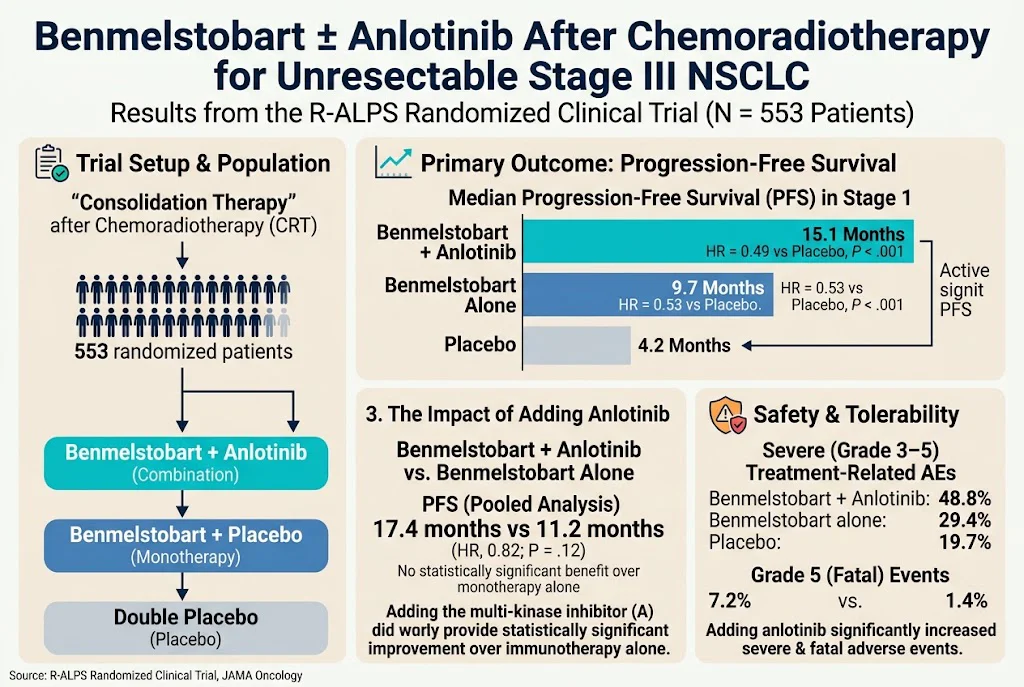
- Median PFS was 15.1 months with benmelstobart plus anlotinib (95% CI, 9.4–21.7), 9.7 months with benmelstobart alone (95% CI, 6.0–34.4), and 4.2 months with placebo (95% CI, 3.2–6.8).
- The hazard ratio (HR) for PFS compared with placebo was 0.49 (95% CI, 0.36–0.66; P < .001) for benmelstobart plus anlotinib, and 0.53 (95% CI, 0.39–0.72; P < .001) for benmelstobart alone, showing significant improvement over placebo.
In the pooled analysis combining stages 1 and 2, median PFS was 17.4 months (95% CI, 12.5–24.8) in the benmelstobart plus anlotinib group versus 11.2 months (95% CI, 7.0–20.7) for benmelstobart alone. However, the difference did not reach statistical significance (HR 0.82; 95% CI, 0.63–1.08; P = .12).
Safety Profile
Grade 3 to 5 treatment-related adverse events were notably higher in the combination arm: 48.8% experienced severe toxicities compared with 29.4% in the benmelstobart alone group and 19.7% in the placebo group. Grade 5 events (fatal adverse events) occurred in 7.2% of patients receiving benmelstobart plus anlotinib, which was appreciably higher than the 1.4% and 1.5% rates observed with benmelstobart alone and placebo, respectively. The increased toxicity profile raises important considerations about the risk-benefit balance when adding anlotinib.
Expert Commentary
Consolidation immunotherapy has revolutionized care for unresectable stage III NSCLC, with prior landmark trials such as PACIFIC establishing durvalumab as the standard of care. Benmelstobart, another immune checkpoint inhibitor, now demonstrates comparable efficacy in this setting to extend time to progression significantly. However, the addition of anlotinib, targeting angiogenesis and tumor proliferation pathways, did not statistically improve progression-free survival despite initial numerical advantages.
The higher incidence of severe and fatal adverse events observed with the combination calls for caution. Potential biological explanations include overlapping toxicities of immune checkpoint blockade alongside tyrosine kinase inhibition, potentially amplifying immune-mediated tissue damage or vascular complications. These findings align with other studies reporting increased adverse outcomes when combining targeted therapies with immunotherapy without clear additive efficacy.
Limitations of the R-ALPS trial include its predominantly male population (89.5%), which may limit generalizability, and the relatively short follow-up period for overall survival analysis, which is vital for confirming long-term benefit. Further biomarker analyses and subgroup exploration may clarify which patients stand to benefit from combination approaches.
Conclusion
The R-ALPS randomized clinical trial establishes benmelstobart as a highly effective consolidation immunotherapy agent after chemoradiotherapy for unresectable stage III NSCLC, substantially improving progression-free survival compared with placebo. However, the addition of anlotinib does not provide a statistically significant PFS benefit and significantly increases the risk of severe and fatal adverse events, limiting its clinical utility in this context. The results reinforce the importance of balancing efficacy with safety and underscore the need for continued research into optimized consolidation strategies to improve outcomes for this challenging patient population.
Funding and Clinical Trial Registration
This study was registered under ClinicalTrials.gov Identifier: NCT04325763. Specific funding sources were not detailed in the available abstract but typically involve institutional and possibly governmental support for multicenter trials in China.
References
- Ji Y, Li Q, Chen L, et al. Benmelstobart With or Without Anlotinib After Chemoradiotherapy for Unresectable Non-Small Cell Lung Cancer: The R-ALPS Randomized Clinical Trial. JAMA Oncology. 2026; epub. PMID: 42955021.
- Antonia SJ, Villegas A, Daniel D, et al. Durvalumab after chemoradiotherapy in stage III non–small-cell lung cancer. N Engl J Med. 2017;377(20):1919-1929.
- Herbst RS, Morgensztern D, Boshoff C. The biology and management of non-small cell lung cancer. Nature. 2018;553(7689):446-454.
Specialty calculators
For clinical reference; use professional judgment.