Highlight
This comprehensive study provides updated national prevalence estimates of severe hemolytic disease of the fetus and newborn (HDFN) in the United States, focusing on three key red cell alloantibodies: anti-D, anti-K, and anti-c. It shows that while alloimmunization is relatively common in pregnant women, the progression to severe HDFN remains uncommon. Using over 8.8 million pregnancy data points and advanced modeling techniques, the study enhances understanding of the clinical burden and informs risk stratification and resource allocation in maternal-fetal medicine.
Study Background
Hemolytic disease of the fetus and newborn (HDFN) is a potentially severe alloimmune condition resulting from maternal antibodies targeting antigens on fetal red blood cells. Such alloimmunization can lead to fetal anemia, hydrops fetalis, and stillbirth, or necessitate intensive postnatal interventions. The RhD antigen (anti-D) is the most historically significant cause of HDFN, having been mitigated substantially by prophylactic anti-D immunoglobulin administration. However, other antibodies such as anti-Kell (anti-K) and anti-c continue to contribute to clinically significant disease. Understanding the contemporary epidemiology of severe HDFN is critical for optimizing prenatal screening programs and preventive strategies. Prior estimates of national burden were limited by sample size and regional bias. This study sought to estimate the U.S. national burden of severe HDFN attributed to the three most clinically relevant alloantibodies using a robust national laboratory database normalized to demographic distributions.
Study Design
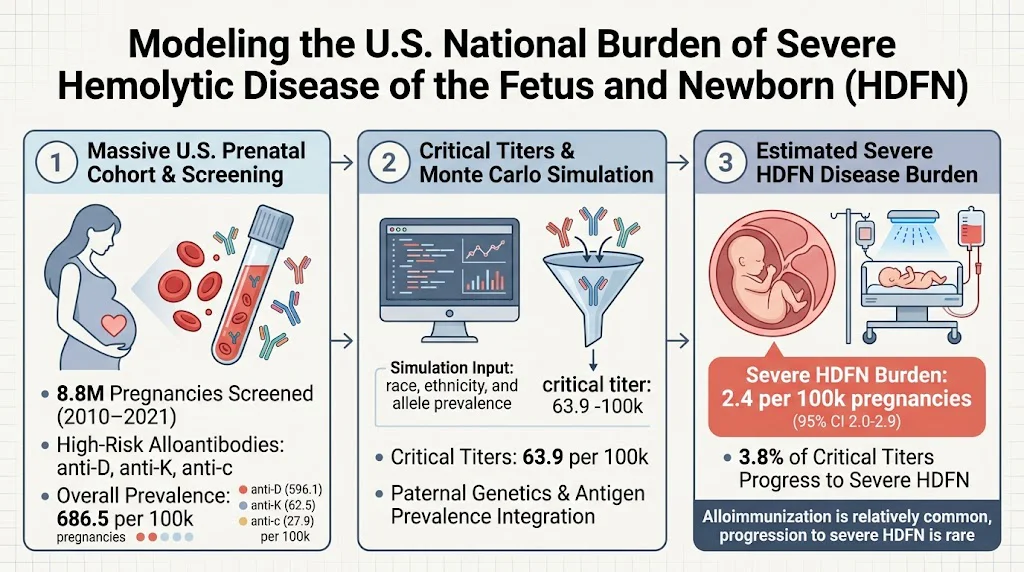
This retrospective modeling study utilized prenatal red blood cell alloantibody screening data collected from a national laboratory database encompassing 8,809,993 pregnancies between 2010 and 2021. The cohort was adjusted to reflect U.S. birth demographics by race, ethnicity, and geographic region per 2020 Census data to ensure representativeness. The analysis incorporated key parameters including prevalence of high-risk antibody titers, pregnancy continuation rates, distribution of paternal race and ethnicity, antigen allele frequency among paternal groups, and documented rates of HDFN progression. Monte Carlo simulations with probabilistic modeling were employed to integrate these variables and estimate the national incidence of severe HDFN attributable to anti-D, anti-K, and anti-c antibodies. The use of a large, diverse dataset and robust statistical modeling enhanced the accuracy and generalizability of the findings.
Key Findings
Among the nearly 9 million pregnancies analyzed, the normalized national prevalence of any high-risk alloantibody was estimated at 686.5 per 100,000 pregnancies. Breaking down by antibody specificity, anti-D alloantibodies accounted for the majority (596.1 per 100,000), followed by anti-K (62.5 per 100,000) and anti-c (27.9 per 100,000). Importantly, antibodies reaching critical titer levels—indicating higher risk for fetal impact—were present in 63.9 per 100,000 pregnancies: 20.6 for anti-D, 41.3 for anti-K, and 1.9 for anti-c.
Applying paternal antigen prevalence and disease progression rates, the estimated national burden of severe HDFN was calculated as 2.4 per 100,000 pregnancies (95% confidence interval [CI] 2.0-2.9). The risk of progression to severe disease among pregnancies with critical titers was approximately 3.8% (95% CI 3.1-4.5).
These results emphasize that while maternal alloimmunization is relatively frequent, the transition to severe fetal disease is rare. Notably, anti-K antibodies, despite lower overall prevalence than anti-D, accounted for a substantial proportion of severe HDFN cases, reflecting the high pathogenic potential of anti-K. Anti-c antibodies, though less common, also contribute but to a lesser extent.
Expert Commentary
The study’s strength lies in its scale and methodologic rigor, leveraging a decade of nationwide laboratory data combined with demographic normalization and advanced probabilistic modeling. This approach overcomes prior limitations of smaller, regionally focused cohorts and provides nuanced insight into population-level risk of severe HDFN. The findings reaffirm the continuing importance of anti-D monitoring despite prophylaxis successes, and highlight the clinical significance of anti-K alloimmunization—which is increasingly recognized as a leading cause of severe disease. Anti-c antibodies, while less prevalent, warrant consideration in comprehensive prenatal screening protocols.
One limitation is that the model relies on available laboratory and demographic data which might not capture all biological or clinical variables influencing disease progression, such as variations in titer management or delivery practices. Nonetheless, the confidence intervals and sensitivity analyses bolster confidence in the estimates. The study aligns with and supplements current ACOG guidelines advocating for universal antenatal antibody screening and targeted management of at-risk pregnancies.
Conclusion
This landmark analysis provides a contemporary, data-driven estimate of the national burden of severe HDFN caused by the three most clinically significant alloantibodies in the United States. Despite a relatively high prevalence of maternal alloimmunization, progression to severe fetal disease remains rare. These findings underscore the effectiveness of current prenatal screening and intervention strategies but also signal the need for continued vigilance and optimized management for high-risk antibody specificities such as anti-K. Future research should focus on refining individual risk prediction and enhancing targeted prevention and treatment approaches to further reduce morbidity and mortality from HDFN.
Funding and Clinical Trials
The original study did not specify funding sources or clinical trial registration. Further details can be sought from the primary publication.
References
1. Moise KJ. Management of rhesus alloimmunization in pregnancy. Obstet Gynecol. 2008;112(1):164-176.
2. Murray NA, Roberts IA. Haemolytic disease of the newborn. Arch Dis Child Fetal Neonatal Ed. 2007;92(2):F83-F88.
3. American College of Obstetricians and Gynecologists. Practice Bulletin No. 181: Prevention of Rh D alloimmunization. Obstet Gynecol. 2017;130(1):e57-e70.
4. Zipursky A, Osmond M, de Costa C, Harvey W. Incidence and outcome of anti-K-induced hemolytic disease of the newborn. Transfusion. 2011;51(6):1220-1227.
5. Abels EA, Louie JZ, Jacobs JW, et al. Modeling the U.S. National Burden of Severe Hemolytic Disease of the Fetus and Newborn. Obstet Gynecol. 2026 Oct 27. PMID: 42945505.
Specialty calculators
For clinical reference; use professional judgment.