Highlight
– Removal of prior authorization in British Columbia increased use of guideline-recommended long-acting muscarinic antagonists (LAMA) in COPD management.
– Use of inhaled corticosteroids/long-acting beta-agonists (ICS/LABA), often overused contrary to guidelines, decreased after policy change.
– Improvements were seen in medication adherence and initiation patterns without raising total drug costs.
– Policy changes demonstrate effective health system strategies to optimize chronic disease treatment concordance.
Study Background
Chronic obstructive pulmonary disease (COPD) represents a significant global public health burden, characterized by persistent respiratory symptoms and airflow limitation. Maintenance inhaled therapies are foundational for preventing exacerbations and improving quality of life. Clinical practice guidelines unequivocally recommend long-acting muscarinic antagonists (LAMA) as first-line maintenance therapy, reflecting evidence from large trials demonstrating efficacy in reducing exacerbations and improving lung function.
Despite these recommendations, real-world data have repeatedly shown suboptimal adherence to guidelines. Many patients receive inhaled corticosteroids combined with long-acting beta-agonists (ICS/LABA) without concordance to the clinical profile that justifies their use, often exposing patients to unnecessary side effects and healthcare costs. Administrative hurdles such as prior authorization requirements can delay or limit access to preferred medications, thus potentially contributing to this discordance.
In July 2020, British Columbia’s (BC) universal drug plan altered drug coverage policies for COPD medications by removing prior authorization requirements for LAMA coverage while restricting ICS/LABA coverage. This natural policy experiment presents an opportunity to assess whether reduced administrative barriers translate into improved guideline-concordant prescribing for COPD maintenance therapy.
Study Design and Methods
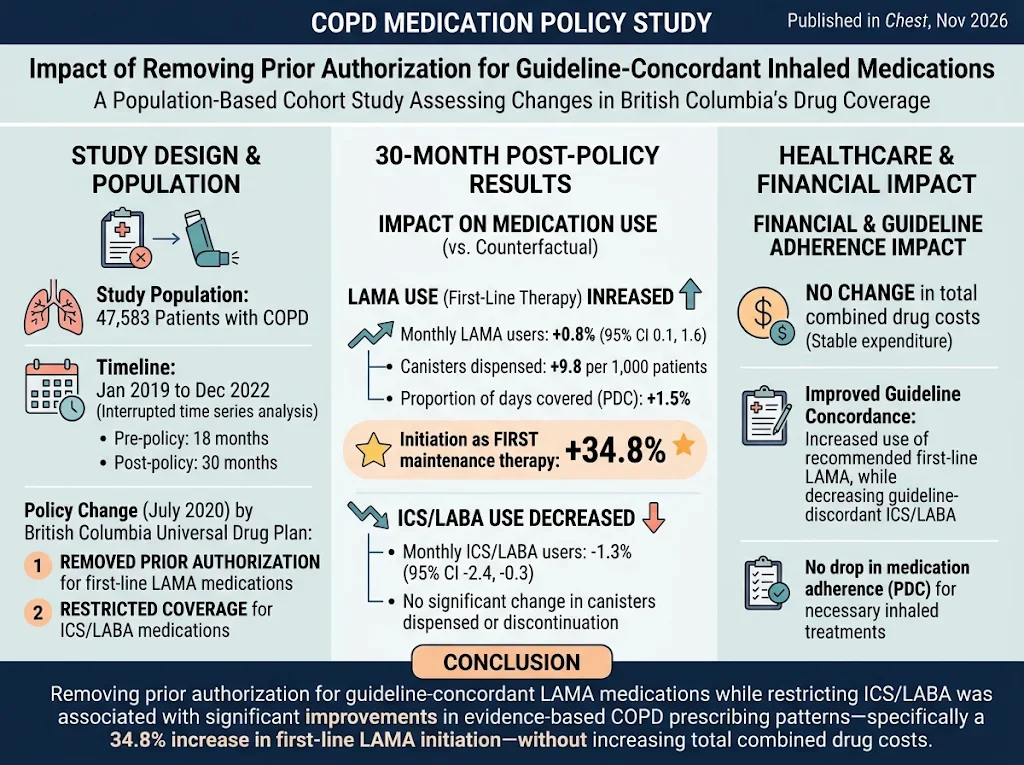
This population-based retrospective cohort study used comprehensive administrative health data from BC, identifying 47,583 patients with COPD using a validated case definition. Patients were followed from January 2019 to December 2022, covering 18 months before and 30 months after the policy implementation.
The primary intervention was the policy change removing prior authorization for LAMA coverage, with associated restrictions on ICS/LABA coverage reflecting updated provincial drug reimbursement criteria.
Interrupted time series analyses evaluated monthly trends in:
• The proportion of patients filling prescriptions for LAMA and ICS/LABA.
• Mean canisters dispensed (reflecting medication volume).
• Proportion of days covered (PDC), an adherence metric.
• Rates of ICS/LABA discontinuation.
• (Re)initiation rates of LAMA.
• Initiation of LAMA as the first maintenance therapy.
• Total combined drug costs.
Absolute differences between observed and counterfactual (predicted had the policy not changed) outcomes at study end were reported with 95% confidence intervals.
Key Findings
The cohort had a mean age of 71.5 years, 46.5% female, and a mean follow-up of 31.7 months.
Thirty months post-policy change, key changes included:
– ICS/LABA use decreased by -1.3% (95% CI -2.4, -0.3), indicating reduced discordant use.
– LAMA use increased by 0.8% (95% CI 0.1, 1.6), supporting enhanced alignment with guidelines.
– No significant changes were found in ICS/LABA canisters dispensed, PDC, or discontinuation rates.
– Mean LAMA canisters dispensed increased by 9.8 per 1,000 patients (95% CI 1.0, 18.7), with a 1.5% increase in PDC (95% CI 0.5, 2.4), reflecting improved adherence and medication volume.
– (Re)initiation of LAMA or initiating LAMA as maintenance therapy increased by 0.2% (95% CI 0.02, 0.3) and notably by 34.8% (95% CI 22.3, 48.6), respectively, demonstrating a marked shift toward first-line treatment adoption.
– Total combined drug costs remained stable, suggesting economic feasibility of policy changes.
Expert Commentary
This study provides robust, population-level evidence that policy modifications easing access to recommended COPD therapies can meaningfully improve treatment concordance. The significant increase in LAMA initiation underscores the influence of administrative requirements on prescribing behaviors. Restricting ICS/LABA use aligns with current guideline strategies to minimize unnecessary corticosteroid exposure, reducing potential adverse effects such as pneumonia risk.
Limitations include reliance on administrative data, which lack detailed clinical parameters such as symptom severity or spirometry results. Thus, residual confounding related to disease severity cannot be excluded. Furthermore, adherence metrics were indirect and may overestimate true medication use. However, the interrupted time series design strengthens causal inference by controlling pre-existing trends.
These findings complement existing literature emphasizing the importance of health policy in facilitating evidence-based treatment uptake. Similar strategies could be considered in other jurisdictions to optimize chronic respiratory disease management and reduce health system costs associated with inappropriate therapy.
Conclusion
In conclusion, the removal of prior authorization for LAMA inhalers within British Columbia’s drug plan led to improved guideline-concordant therapy for COPD patients without increased overall drug expenditure. Health policy interventions that reduce administrative barriers can enhance appropriate medication use, promoting better clinical outcomes and resource stewardship. Future research should evaluate the impact on patient-centered outcomes such as exacerbation rates and hospitalizations, as well as generalizability beyond BC.
Funding and Trial Registration
This study was supported by the BC Ministry of Health and conducted using provincial administrative health data. The corresponding clinical trial or registry number was not applicable to this observational policy analysis.
References
1. Global Initiative for Chronic Obstructive Lung Disease (GOLD). Global Strategy for the Diagnosis, Management, and Prevention of COPD. 2023 Report.
2. Vestbo J, Hurd SS, Agustí AG, et al. Global Strategy for the diagnosis, management, and prevention of chronic obstructive pulmonary disease: GOLD executive summary. Am J Respir Crit Care Med. 2013;187(4):347-365.
3. Gershon AS, Mecredy GC, Guan J, Victor JC. Trends in the use of inhaled corticosteroids for chronic obstructive pulmonary disease: a population-based study. Chest. 2019;156(1):55-63.
4. Johnson KM, Cheng L, Duan KI, Law MR. The impact of removing prior authorization for guideline-concordant maintenance inhaled medications for COPD: a population-based cohort study. Chest. 2026 Nov 5; PMID: 42988324.
5. Suissa S, Drazen JM, Etminan M, et al. Inhaled corticosteroids in chronic obstructive pulmonary disease: effectiveness and safety. Lancet Respir Med. 2020 Jun;8(6):678-690.
Specialty calculators
For clinical reference; use professional judgment.