Highlight
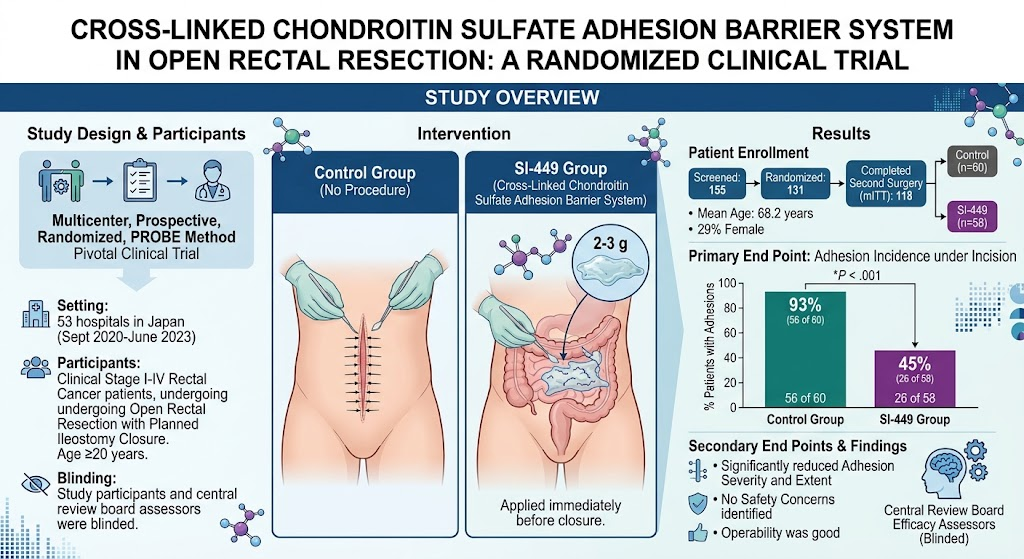
- SI-449, a cross-linked chondroitin sulfate powder, used as an adhesion barrier, significantly reduces adhesion incidence after open rectal resection for cancer.
- The randomized, multicenter Japanese clinical trial demonstrated a reduction in adhesion incidence from 93% in controls to 45% in patients receiving SI-449.
- The application of SI-449 was safe, well-tolerated, and easy to use in open abdominal surgery settings.
- SI-449 represents a promising new anti-adhesion strategy addressing challenges posed by uneven organ surfaces where traditional materials struggle.
Study Background
Postoperative adhesion formation is a frequent and serious complication following abdominal and pelvic surgeries, including rectal cancer resections. Adhesions—bands of fibrous scar tissue—can cause chronic pelvic pain, intestinal obstructions, and infertility, imposing a substantial burden on patient quality of life and long-term health. Despite the availability of several anti-adhesion materials, many are limited by difficulty in application on irregular organ surfaces and variable effectiveness. Thus, there remains a significant unmet clinical need for easily applicable, effective, and safe adhesion barriers suitable for complex surgical fields.
Chondroitin sulfate (CS) is a glycosaminoglycan component of extracellular matrix, with biocompatible and anti-inflammatory properties favoring tissue healing. SI-449 is a novel cross-linked, powder-form CS adhesion barrier designed to conform readily to uneven pelvic and abdominal surfaces, potentially overcoming limitations of existing adhesion prevention materials.
Study Design
This pivotal randomized clinical trial employed a prospective, multicenter, open-label design with blinded endpoint assessment (PROBE method) and was conducted at 53 hospitals in Japan between September 2020 and June 2023.
Eligible participants were patients aged 20 years or older with clinical stage I through IV rectal cancer undergoing open rectal resection with planned subsequent ileostomy closure surgery. After initial open rectal resection, patients were randomized to receive either no adhesion barrier (control group) or application of 2 to 3 grams of SI-449 powder before abdominal closure (experimental group).
Blinded independent central reviewers assessed adhesion outcomes during scheduled ileostomy closure surgeries.
The primary endpoint was incidence of adhesions under the surgical incision at reoperation. Secondary endpoints included adhesion number, severity, extent, adhered organ types, and number of adhesions per organ. Safety and device operability were also evaluated.
Key Findings
Of 155 patients screened, 131 met criteria and were randomized in equal numbers to control (n=65) and experimental (n=66) groups. Ultimately, 118 patients underwent second surgery and constituted the modified intention-to-treat population (control: 60; experimental: 58). The mean age was 68.2 years; females represented 29% of the cohort.
Adhesion Incidence:
Adhesions were observed in 93% (56/60) of control patients, reflecting the high baseline risk of postoperative adhesions after open rectal surgery. In contrast, only 45% (26/58) of patients treated with SI-449 developed adhesions, representing a highly significant reduction (P<0.001).
Adhesion Severity and Extent:
Beyond lowering incidence, SI-449 treatment significantly reduced adhesion severity and the overall extent of adhered tissue involved, suggesting that adhesions, when present, were less debilitating.
Adhered Organs:
There was a significant reduction in the number of organs adhered as well as the number of adhesions per organ in the SI-449 group, consistent with a more favorable peritoneal environment.
Safety and Operability:
No safety concerns were identified attributable to SI-449, and surgeons reported good operability and ease of application of the powder barrier in the open surgical field. There were no statistically significant differences in postoperative complications between groups.
Expert Commentary
These findings align with accumulating evidence supporting glycosaminoglycan-based adhesion barriers as biocompatible and effective interventions. Cross-linking likely confers durability to the CS powder, maintaining a physical barrier during the critical healing window.
This trial’s multicenter design and blinded, independent adhesion assessments strengthen the validity and generalizability of its results. The large absolute reduction in adhesion incidence—from over 90% to under 50%—is clinically compelling, as adhesions contribute heavily to morbidity and potential reoperations.
Some limitations include open-label patient and surgical team allocation, an unavoidable design choice given the nature of barrier application, and follow-up limited to reoperation at ileostomy closure, which may miss longer-term adhesion consequences. Additionally, this trial focused exclusively on open rectal resections; future research should explore applicability in minimally invasive surgery.
Conclusion
The SI-449 cross-linked chondroitin sulfate powder adhesion barrier significantly and safely reduces postoperative adhesion formation following open rectal cancer resections. Its easy-to-use powder form allows effective application on uneven pelvic and abdominal surfaces, overcoming important limitations of existing barriers.
SI-449 offers an important new tool for surgeons aiming to minimize the debilitating sequelae of postoperative adhesions. Wider clinical adoption may improve long-term patient outcomes in colorectal surgery and other abdominal operations at high adhesion risk.
Funding and Registration
This investigator-initiated clinical trial was conducted in Japan. The trial was registered under identifier jRCT1080225247 at jrct.mhlw.go.jp. No specific funding disclosures were noted in the publication.
References
1. Kanemitsu Y, Hashizume E, Suto T, et al. Cross-Linked Chondroitin Sulfate Adhesion Barrier System in Open Rectal Resection: A Randomized Clinical Trial. JAMA Surg. 2026 Aug 26. PMID: 42647025.
2. Holmdahl L, Risberg B. Adhesion prevention after surgery. Br J Surg. 2004 Jun;91(6):731-8.
3. Ten Broek RP, Issa Y, van Santbrink EJ, et al. Burden of adhesions in abdominal and pelvic surgery: systematic review and meta-analysis. BMJ. 2013 Jul 2;347:f5588.
4. DiZerega GS. Peritoneal repair and post-surgical adhesion formation. Hum Reprod Update. 1996 Mar-Apr;2(2):142-8.
5. Parker MC, Wilson MS, Menzies D, et al. The SCAR PA study: 5-year adhesion-related readmission risk following lower abdominal surgical procedures. Colorectal Dis. 2005 Oct;7(5):551-8.
6. Liakakos T, Thomakos N, Fine PM, et al. Peritoneal adhesions: etiology, pathophysiology, and clinical significance. Dig Surg. 2001;18(4):260-73.