Highlight
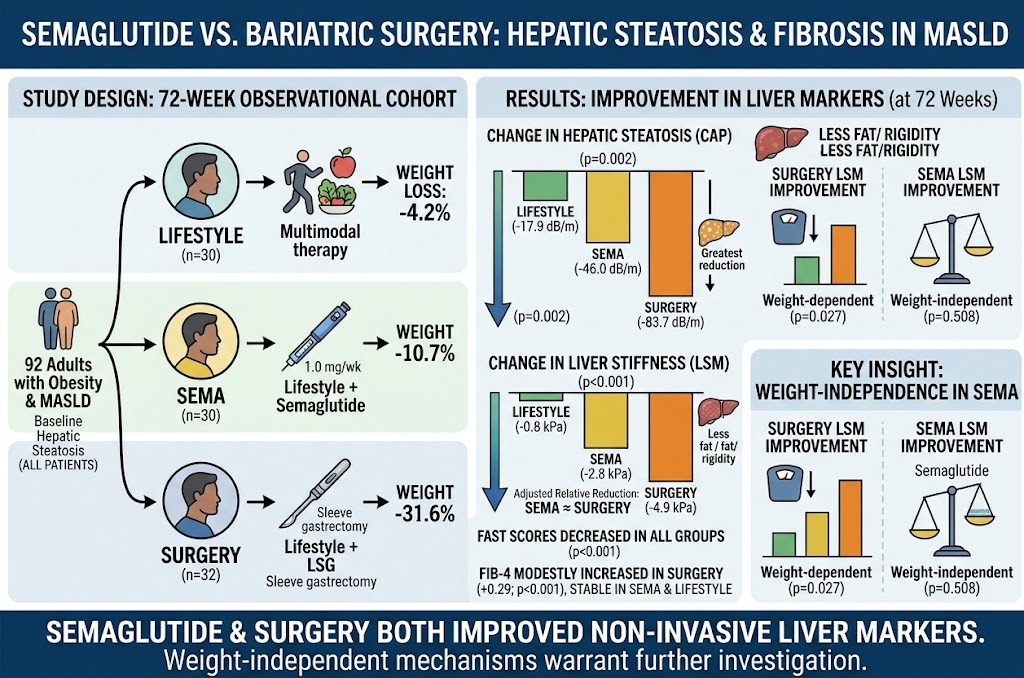
This study prospectively evaluated the comparative effects of lifestyle intervention alone, semaglutide pharmacotherapy, and laparoscopic sleeve gastrectomy (LSG) on non-invasive liver health markers in obese individuals with metabolic dysfunction-associated steatotic liver disease (MASLD). Both semaglutide and bariatric surgery significantly improved hepatic steatosis and fibrosis indicators compared to lifestyle intervention alone. Notably, semaglutide-induced improvements in liver stiffness occurred independently of weight loss, suggesting additional mechanisms beyond weight reduction contribute to hepatic benefit.
Study Background
Metabolic dysfunction-associated steatotic liver disease (MASLD), formerly known as nonalcoholic fatty liver disease (NAFLD), is a highly prevalent consequence of obesity and metabolic syndrome. Characterized by excessive hepatic fat accumulation and often progressing to fibrosis, MASLD poses significant risks for cirrhosis, hepatocellular carcinoma, and cardiovascular morbidity. Current mainstays of treatment focus on weight loss through lifestyle modification, but sustained change is challenging and effective pharmacotherapy options remain limited. Bariatric surgery has been established as an effective intervention for obesity and related liver disease, while glucagon-like peptide-1 receptor agonists such as semaglutide have emerged promisingly in improving metabolic parameters and steatosis markers. However, direct comparative data on semaglutide versus bariatric surgery on liver health indices are sparse, motivating this study to elucidate their relative impacts on noninvasive markers of hepatic steatosis and fibrosis in MASLD.
Study Design
This was a single-center, prospective, observational cohort study including 92 adults with obesity and MASLD, followed for 72 weeks. Participants were assigned to three intervention groups based on treatment choice: lifestyle-based multimodal therapy alone (LIFESTYLE; n=30), lifestyle plus semaglutide therapy (SEMA; n=30; mean dose 1.0±0.4 mg/week), or lifestyle plus laparoscopic sleeve gastrectomy surgery (SURGERY; n=32). All interventions included lifestyle optimization involving diet and physical activity counseling. Key endpoints included noninvasive assessments of hepatic steatosis and fibrosis: controlled attenuation parameter (CAP) in decibels per meter (dB/m) measuring liver fat content, liver stiffness measurement (LSM) in kilopascals (kPa) as a surrogate for fibrosis severity, Fibrosis-4 (FIB-4) and FibroScan-AST (FAST) scores as validated composite fibrosis and steatohepatitis markers. Changes in these parameters were tracked at baseline and over 72 weeks, with weight loss percentages also recorded to explore correlations with hepatic outcomes.
Key Findings
At baseline, all participants demonstrated hepatic steatosis per CAP values. Over 72 weeks, CAP significantly decreased in all groups with pronounced differences: LIFESTYLE group showed a modest reduction of -17.9±14.0 dB/m; SEMA group experienced a greater reduction of -46.0±14.0 dB/m; and the SURGERY group demonstrated the largest decrement at -83.7±10.0 dB/m (overall p=0.002). Liver stiffness measurement (LSM), reflecting fibrosis, also improved significantly across all groups with declines of -0.8±1.0 kPa (LIFESTYLE), -2.8±0.8 kPa (SEMA), and -4.9±1.1 kPa (SURGERY) (overall p<0.001). While absolute LSM reductions were greatest after SURGERY, relative improvements comparing semaglutide and surgery did not differ significantly (p=0.428). FAST scores decreased considerably over time in all groups (p<0.001), indicating amelioration of fibrosis plus steatohepatitis severity. Interestingly, FIB-4 scores increased modestly after surgery (+0.29; p<0.001) but remained stable in the semaglutide and lifestyle groups. As expected, weight loss varied substantially: LIFESTYLE -4.2±1.8%, SEMA -10.7±1.5%, SURGERY -31.6±1.5%. Notably, improvement in LSM correlated with weight loss only in the SURGERY group (p=0.027), while in the SEMA cohort, LSM improvement occurred independently of weight reduction (p=0.508). These findings highlight semaglutide’s potential weight-independent effects on liver fibrosis markers.
Expert Commentary
This study reinforces the pivotal role of weight loss in ameliorating MASLD but critically reveals that semaglutide may exert beneficial hepatic effects beyond mere weight reduction. The independent improvement in liver stiffness without a strong correlation to weight loss suggests glucagon-like peptide-1 receptor agonists influence hepatic inflammation, steatosis, or fibrogenesis through additional metabolic or anti-inflammatory pathways. The modest increase in FIB-4 after surgery warrants caution and may reflect transient changes in liver biochemistry post-surgery rather than true fibrosis progression. Limitations include the observational design, potential selection biases, and lack of histological validation for fibrosis changes. Moreover, it remains unclear if these findings translate into long-term clinical endpoints such as reduced progression to cirrhosis or hepatic decompensation. Confirmatory randomized controlled trials with paired biopsy endpoints could further elucidate mechanistic underpinnings and long-term efficacy.
Conclusion
In obese patients with MASLD, both semaglutide pharmacotherapy and laparoscopic sleeve gastrectomy significantly improve non-invasive markers of hepatic steatosis and fibrosis, surpassing lifestyle intervention alone. While surgery achieves more pronounced weight loss and liver fat reduction, semaglutide confers hepatic stiffness improvement independently of weight change, highlighting potential novel mechanisms. These data support integrating semaglutide into MASLD management paradigms, offering an effective pharmacologic alternative or adjunct to surgical intervention. Further research is needed to confirm long-term hepatic outcomes and refine therapeutic strategies targeting MASLD’s complex pathophysiology.
Funding and ClinicalTrials.gov
Details on funding sources or clinical trial registration were not provided in the original publication.
References
1. Lünswilken P, Worobiec K, Braun LS, Altrogge J, Schenk A, Jegodzinski L, Wilms B, Marquardt JU, Meyhöfer S. Effects of Semaglutide versus Bariatric Surgery on Noninvasive Markers of Hepatic Steatosis and Fibrosis in Obesity with MASLD. The Journal of Clinical Endocrinology and Metabolism. 2026 Aug 27. PMID: 42657770.
2. Younossi ZM, et al. Global epidemiology of nonalcoholic fatty liver disease—Meta-analytic assessment of prevalence, incidence, and outcomes. Hepatology. 2016;64(1):73-84.
3. Armstrong MJ, et al. GLP-1 receptor agonists and NAFLD: Emerging opportunities and clinical challenges. Gut. 2020;69(6):1145-1154.
4. Rinella ME. Nonalcoholic fatty liver disease: A systematic review. JAMA. 2015;313(22):2263-2273.