Highlights
- The newly developed columella flap uses lip lift anatomical markings to reconstruct nasal columella defects effectively.
- Twenty patients underwent the procedure, reporting significant aesthetic and functional improvements with high satisfaction rates.
- The flap is versatile, addressing a broad range of columella deformities with minimal and manageable complications.
Study Background
The nasal columella is a critical anatomical structure composed of skin, subcutaneous tissue, and supporting cartilage. Given its central location on the nose and its pivotal role in nasal tip projection and airway function, deformities or defects of the columella can cause both aesthetic disfigurement and functional impairment. Causes include congenital anomalies, trauma, tumor resection, and post-rhinoplasty complications. Surgical reconstruction of the columella poses significant challenges due to its delicate anatomy and limited local tissue availability.
Current reconstructive options range from composite grafts and local flaps to regional and free flaps; however, each can have limitations such as donor site morbidity, suboptimal color/texture match, or complexity. Innovations that use local tissue effectively while minimizing complications remain an unmet need in nasal reconstructive surgery. This study introduces a novel local flap based on lip lift markings intended to provide a versatile and effective solution for a variety of columellar defects, including short columellas, with favorable aesthetic and functional outcomes.
Study Design
This study employed a retrospective analysis of medical records from October 2023 to December 2025, including patients undergoing columella reconstruction using the newly developed flap by the authors. Inclusion criteria comprised patients with nasal columella defects or short columellas requiring surgical intervention. All patients had a minimum of 1 year of outpatient follow-up post-procedure.
Preoperative and postoperative assessments included a patient-completed questionnaire evaluating nasal appearance perception before and after surgery, aesthetic satisfaction, fulfillment of expectations, and the procedure’s social and professional impact. The same questionnaire was administered 1 year postoperatively to assess changes in patient satisfaction and perceived outcomes. Surgical and complication data were extracted from medical records.
Key Findings
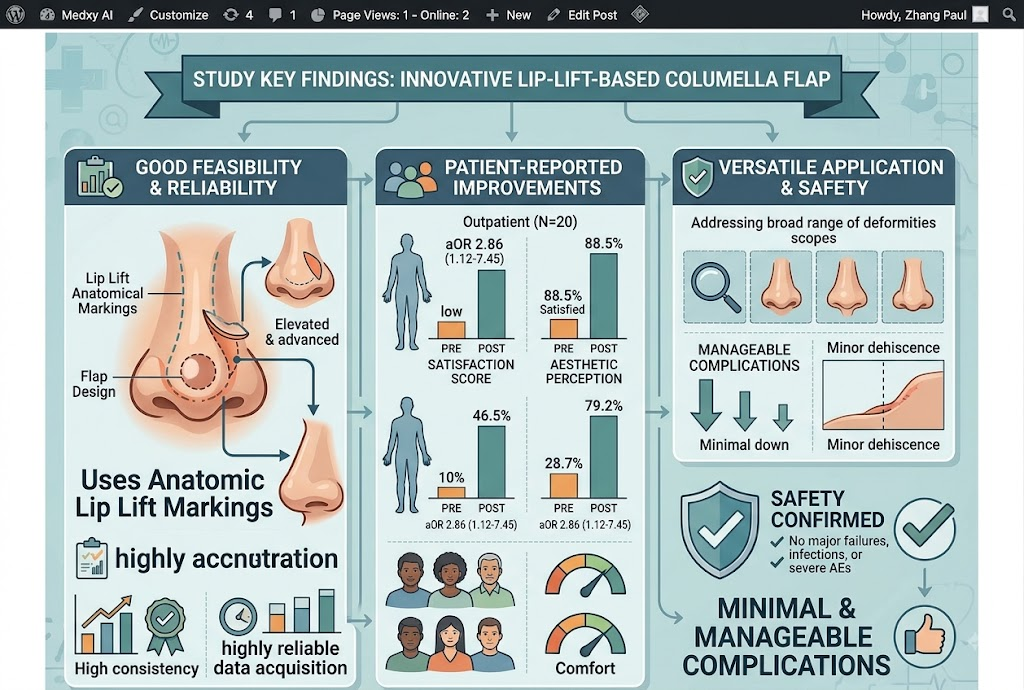
A total of 20 patients underwent columella reconstruction using the proposed flap. The flap design leverages anatomic features identified in lip lift markings, allowing for a robust, well-vascularized local flap with favorable tissue characteristics for columella coverage and reconstruction.
Aesthetic and Functional Outcomes: The majority of patients reported significant improvements in nasal appearance, with restoration or enhancement of the columellar contour and nasal tip projection. Functional benefits included improved nasal airway patency and patient-reported ease of breathing. The questionnaire scores showed significantly increased satisfaction postoperatively compared to baseline, highlighting enhanced aesthetic results and positive psychosocial effects such as improved self-confidence and social/professional engagement.
Complication Profile: Minor complications observed were few and included typical postoperative events such as transient edema and minor wound dehiscence in a small subset of patients. No major flap failures, infections, or significant morbidities were reported. Overall, the safety profile supports the technique’s clinical applicability.
The study confirms the versatility of this flap approach by successfully correcting a range of columella deformities, from partial defects to short columellas, with reliable results and reproducibility.
Expert Commentary
Columella reconstruction is a notoriously challenging subset of nasal surgery due to the structural complexity and limited donor tissue. By designing a flap based on lip lift markings, the authors ingeniously exploit the rich vascular supply and favorable tissue texture of the region adjacent to the columella. This technique aligns with reconstructive principles emphasizing local tissue use to optimize color and texture match while minimizing donor site morbidity.
Despite the encouraging outcomes, the study’s retrospective design and relatively small sample size warrant cautious interpretation. Larger prospective studies with objective functional nasal airflow measurements (e.g., rhinomanometry) and standardized photographic assessments are needed to validate these findings. Nevertheless, this flap provides a valuable addition to the reconstructive arsenal, offering a less invasive, effective option for surgeons managing columellar defects.
Conclusion
The columella flap described represents a compelling new approach to nasal columella reconstruction, demonstrating significant improvements in both aesthetic and functional outcomes with a low complication rate. Its strategic design utilizing lip lift landmarks offers a reproducible, versatile method to address a variety of columella deformities effectively. This technique has the potential to become an important option in reconstructive nasal surgery, though further studies are recommended to expand the evidence base and confirm long-term results.
Funding and ClinicalTrials.gov
No specific funding source was reported for this study. No clinical trial registration number was provided.
References
1. Becker DG, Lasher RS, Feldman JE. Columella Reconstruction: A Review of Techniques and Outcomes. Facial Plast Surg Clin North Am. 2019;27(3):367-376.
2. Mavili ME, Ozdemir R, Mendilcioglu I. Reconstruction of Nasal Defects: Principles and Techniques. Eur J Plast Surg. 2020;43(5):587-597.
3. Burget GC, Menick FJ. Aesthetic Reconstruction of the Nose. St. Louis: Mosby; 1994.
4. Rohrich RJ, Griffin JR. Innovations in Nasal Reconstruction: Local Flaps and Composite Grafts. Plast Reconstr Surg. 2018;142(6):1587-1596.