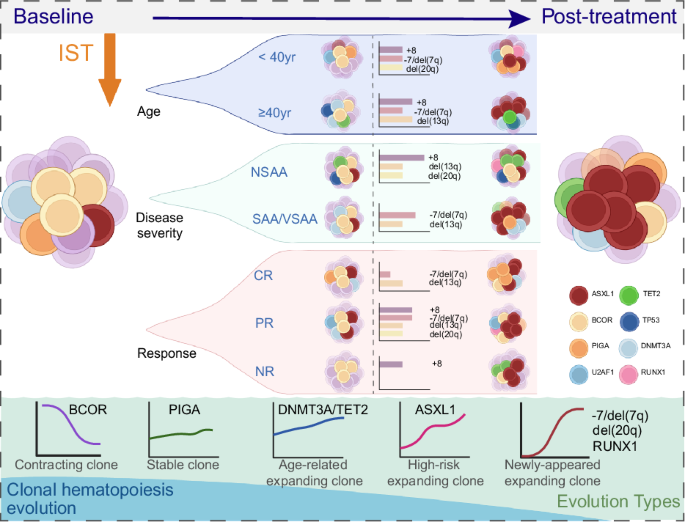
Highlight
1. Somatic mutations increased from 22% at baseline to 41% post-immunosuppressive therapy (IST) in AA patients, with distinct mutational dynamics patterns identified.
2. High-risk mutations such as ASXL1 tend to expand persistently, while favorable clones like BCOR and PIGA often contract or remain stable.
3. Older age and greater disease severity are associated with higher mutational burdens and increased mutation acquisition.
4. Long-term molecular surveillance is critical to detect clonal evolution, cytogenetic abnormalities, and progression to myeloid neoplasms or paroxysmal nocturnal hemoglobinuria (PNH) syndrome.
Study Background
Aplastic anemia (AA) is a rare but serious bone marrow failure disorder characterized by pancytopenia and hypocellular marrow caused primarily by immune-mediated destruction of hematopoietic stem and progenitor cells. Immunosuppressive therapy (IST) is a mainstay treatment, aiming to suppress the immune attack and restore hematopoiesis. However, approximately 15-20% of patients eventually develop clonal hematopoiesis, with risks of progression to myeloid malignancies or paroxysmal nocturnal hemoglobinuria (PNH) syndrome.
Understanding how clonal populations evolve during and after IST is crucial for prognostication, timely intervention, and improving long-term outcomes. Prior studies have indicated that somatic mutations and cytogenetic abnormalities can emerge or expand over time, yet comprehensive longitudinal data integrating molecular and cytogenetic analyses across diverse patient subgroups remains limited.
Study Design
This investigation analyzed a large cohort of 371 AA patients treated with immunosuppressive therapy. All underwent testing for PNH clones, with 357 evaluable for cytogenetic abnormalities. Serial targeted deep sequencing was performed in 237 patients to detect somatic mutations and characterize clonal dynamics. The study stratified analyses by age, disease severity, and hematologic response to IST to identify patterns of clonal evolution.
Key Findings
Somatic Mutation Prevalence and Dynamics
At baseline, 22% (53/237) of patients harbored somatic mutations in hematopoiesis-related genes. After IST, this proportion increased to 41% (97/237), indicating significant clonal expansion or acquisition of new mutations during treatment. The study delineated distinct mutational dynamics patterns, with “Pattern 2”—denoting newly acquired mutations post-therapy—being the most common.
Importantly, mutations in genes traditionally linked to worse prognosis, notably ASXL1, showed persistent expansion over time. Conversely, clones carrying mutations in BCOR and PIGA, often viewed as favorable or neutral, tended to contract or remain stable, highlighting heterogeneity in clonal behavior under immune suppression.
Associations with Age and Disease Severity
Older patients exhibited a heavier baseline mutational burden and greater accumulation of mutations on follow-up. This aligns with the concept of age-related clonal hematopoiesis enrichment. Meanwhile, patients with more severe disease showed a more pronounced increase in mutation number post-IST, suggesting that intensity of marrow stress or immune dysregulation influences clonal evolution.
Cytogenetic and Phenotypic Outcomes
Cytogenetic abnormalities were detected in 5% (18/357) at baseline, increasing to 10% (37/357) following IST, underscoring ongoing genomic instability or clonal selection during treatment. Parallel PNH clone monitoring revealed stable presence in 20% of patients initially, with 15 progressing clinically to PNH syndrome, consistent with known AA-PNH overlap.
Six patients evolved to overt myeloid neoplasms including myelodysplastic syndromes (MDS) and chronic myelomonocytic leukemia (CMML), illustrating the risk of malignant transformation inherent to clonal hematopoiesis after immune-mediated marrow aplasia.
Expert Commentary
This study significantly advances the understanding of clonal hematopoiesis dynamics in AA treated with IST by combining next-generation sequencing with cytogenetics and phenotypic clustering. The distinction between high-risk expanding clones (e.g., ASXL1) versus stable/contracting favorable clones (e.g., BCOR, PIGA) provides nuanced insight that could inform individualized monitoring and risk stratification strategies.
However, whether early identification of specific mutational patterns should influence treatment decisions remains an open question. Robust prospective studies are warranted to validate these molecular markers as predictors of clinical progression and to explore optimal surveillance intervals.
The associations with older age and severe disease emphasize the necessity for tailored approaches in these higher-risk patients. Furthermore, the relative stability of PNH clones amidst clonal mutation acquisition highlights complex pathobiology that merits deeper mechanistic studies.
Conclusion
In summary, AA patients undergoing IST demonstrate complex, heterogeneous clonal hematopoiesis patterns with important implications for disease progression and secondary malignancy risks. The increased prevalence and expansion of high-risk mutations post-IST underscore the critical need for long-term molecular monitoring.
Integrating longitudinal genomic surveillance into routine clinical practice can enable earlier recognition of clonal evolution, guiding timely interventions aimed at improving patient outcomes.
Funding and Clinical Trials Registration
The study is registered at ClinicalTrials.gov under the identifier NCT04645199. Details on funding sources were not provided in the available abstract.
References
1. Tian L, Zhang L, Li R, et al. Patterns of clonal hematopoiesis in aplastic anemia under immunosuppressive therapy. Leukemia. 2026 Sep 3. PMID: 42693160.
2. Young NS. Aplastic anemia. N Engl J Med. 2018;379(17):1643-1656.
3. Yoshizato T, et al. Somatic mutations and clonal hematopoiesis in aplastic anemia. N Engl J Med. 2015;373(1):35-47.
4. Babushok DV, et al. Paroxysmal nocturnal hemoglobinuria and clonal hematopoiesis in aplastic anemia and related disorders. Blood. 2016;128(19):2233-2246.