Highlight
1. Pediatric patients demonstrate a significantly higher 5-year risk of cholesteatoma recidivism than adults, primarily due to early residual disease rather than true recurrence.
2. Independent risk factors for recidivism include pediatric age, involvement of the supratubal recess, mastoid extension, and omission of mastoidectomy compared to canal wall-down techniques.
3. The sinus tympani is a frequent site of cholesteatoma recidivism in pediatric cases.
4. The evidence supports a rigorous 12-18 month postoperative surveillance period and long-term follow-up tailored to patient risk profiles.
Study Background
Cholesteatoma is an abnormal growth of keratinizing squamous epithelium in the middle ear and mastoid that can lead to chronic infection and significant complications if untreated. Surgical removal is the mainstay of treatment; however, the disease notoriously tends to recur or persist, a phenomenon termed recidivism. Pediatric cases are often considered at higher risk for disease recurrence, yet it remains unclear whether this risk is attributable to intrinsic pediatric factors or simply reflects more extensive disease at presentation. Accurate prediction of cholesteatoma recidivism is crucial for optimizing surgical planning and post-operative monitoring, ultimately improving clinical outcomes and reducing hearing-related morbidity.
Study Design
This retrospective cohort study evaluated 128 primary cholesteatoma surgeries in 126 patients (128 ears), with a median follow-up period of 5.8 years. The study population was stratified into pediatric (< 20 years) and adult (≥ 20 years) groups using a data-driven threshold determined by maximally selected rank statistics. Disease extent was categorized using the EAONO/JOS and SAMEO-ATO classifications, including assessments of etiology, anatomical extent (STAM: sinus tympani, tympanic cavity, attic, mastoid), and surgical approach. The primary endpoint was cholesteatoma recidivism, defined as residual or recurrent disease confirmed during follow-up. Statistical analysis involved Group Lasso for variable selection and Firth's penalized Cox regression to estimate hazard ratios (HR) adjusting for multiple confounders.
Key Findings
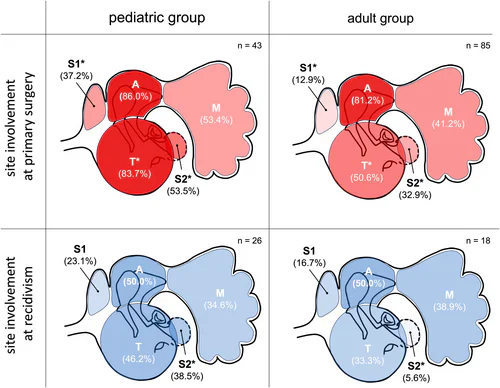
The study revealed distinct differences in cholesteatoma recidivism between pediatric and adult patients. Among 43 pediatric ears, 21 (48.8%) exhibited recidivism, compared to 16 (18.8%) of 85 adult ears. The 5-year cumulative risk was significantly elevated in children at 53.9% versus 19.1% in adults (log-rank p < 0.001). Importantly, this increased risk was predominantly due to early residual disease detected within approximately 14 months postoperatively, whereas true recurrence showed a nonsignificant trend (p = 0.058) towards higher rates in pediatrics.
Topographically, the sinus tympani (S2) was a notable site of recidivism in children (38.5% of cases) versus adults (5.6%), indicating this region as a surgical challenge in younger patients (p = 0.016). Multivariable analysis identified four independent predictors of cholesteatoma recidivism:
- Pediatric age (HR 2.24; 95% CI, 1.09-4.63)
- Supratubal recess involvement (HR 3.41; 95% CI, 1.56-7.45)
- Mastoid extension of disease (HR 2.43; 95% CI, 1.01-5.84)
- Omission of mastoidectomy compared to canal wall-down technique (HR 8.67; 95% CI, 1.95-38.41)
The significant hazard associated with surgically omitting mastoidectomy underscores the critical role of adequate mastoid clearance to prevent disease persistence and recurrence.
Expert Commentary
This rigorous, well-powered analysis clarifies that pediatric age itself is an independent predictor of cholesteatoma recidivism beyond the anatomical extent, highlighting potential biological or anatomical differences in pediatric middle ear structures that predispose to residual disease. The pronounced involvement of the sinus tympani and supratubal recess—regions known for their complex anatomy and limited surgical accessibility—calls for heightened surgical vigilance and possibly advanced visualization techniques or imaging to achieve complete disease eradication in children.
The study also validates the superiority of canal wall-down mastoidectomy techniques in reducing recidivism, although the decision must be individualized to balance functional outcomes such as hearing preservation. The predominance of early residual disease suggests that more meticulous intraoperative assessment and postoperative imaging could be beneficial, especially in high-risk pediatric cases.
Limitations include the retrospective design and potential variability in surgical technique and follow-up imaging protocols over the extended median observation period. Nonetheless, these findings should inform updated clinical guidelines and surveillance protocols, emphasizing a risk-stratified approach.
Conclusion
Cholesteatoma recidivism is substantially more prevalent in pediatric patients, driven predominantly by early residual disease and involving challenging anatomical sites such as the sinus tympani and supratubal recess. Independent prognostic factors include pediatric age, specific disease extension, and surgical technique, emphasizing the need for individualized surgical planning and stringent postoperative monitoring. Adopting active surveillance protocols extending 12-18 months post-surgery with long-term follow-up aligned to risk profiles may improve early detection and reduce morbidity. Future prospective studies should explore surgical innovations and perioperative adjuncts that enhance disease clearance in pediatric populations.
Funding and ClinicalTrials.gov
No specific funding or registered clinical trial information was reported for this study.
References
- Homolac M, Svejdova A, Skoloudik L, Mejzlik J, Dedkova J, Chrobok V. Cholesteatoma Recidivism in Pediatric Versus Adult Patients: Disease Extent and Prognostic Factors. The Laryngoscope. 2026 Nov 5. PMID: 42989494.
- Lewis K, Brown K. Pathogenesis and surgical management of cholesteatoma in children. Otolaryngol Clin North Am. 2020;53(4):689-705.
- Yung M, et al. EAONO/JOS Joint Consensus Statements on the Classification of Middle Ear Cholesteatoma. Otol Neurotol. 2017;38(1):e1-e6.
- Marchioni D, et al. Management of the Sinus Tympani during Cholesteatoma Surgery—a Clinical and Anatomical Perspective. J Int Adv Otol. 2019;15(3):326-333.
Specialty calculators
For clinical reference; use professional judgment.