Highlights
- Healthcare professionals (HCPs) exhibit prevalent modifiable cardiovascular risk factors, including excess body weight, hypertension, and hyperlipidaemia.
- Awareness of hyperlipidaemia among HCPs is higher compared to the general population, yet use of guideline-directed pharmacotherapies remains suboptimal, particularly in primary and secondary prevention.
- Subclinical atherosclerosis is common among HCPs without established ASCVD, signaling hidden cardiovascular risk despite professional knowledge.
- Implementation strategies tailored to HCPs are urgently needed to bridge treatment gaps and reinforce cardiovascular risk management within this key population group.
Background
Healthcare professionals occupy a pivotal position in cardiovascular prevention, acting as educators, clinicians, and role models for health behaviors. Despite this central role, their own cardiovascular health profiles and management practices have been insufficiently characterized. As cardiovascular disease (CVD) remains the leading cause of morbidity and mortality worldwide, understanding risk factors and preventive care adherence among HCPs is crucial. The 2025 European Society of Cardiology (ESC) Congress Cardiovascular Health Check represents a landmark comprehensive evaluation of cardiovascular risk profiles, treatment patterns, and subclinical atherosclerosis among HCPs, benchmarking them against similar unmatched populations from the general public.
Key Content
Cardiovascular Risk Profile of Healthcare Professionals
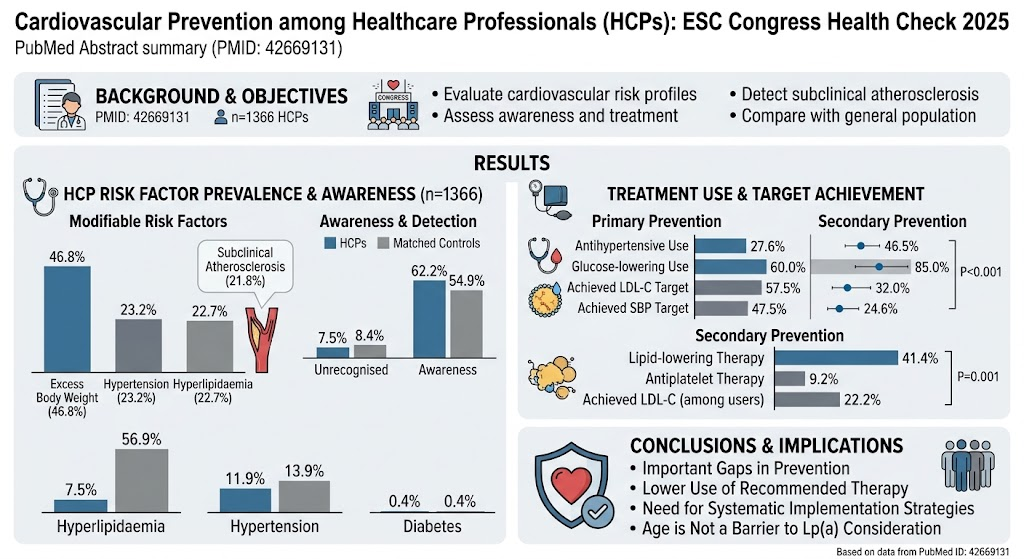
The ESC Congress Cardiovascular Health Check 2025 evaluated 1,366 HCPs using standardized clinical assessments including blood pressure measurements, lipid panels, glucose assessments, medication usage, and carotid ultrasound for subclinical atherosclerosis. Excess body weight emerged as the most prevalent modifiable risk factor (46.8%), followed by hypertension (23.2%), and hyperlipidaemia (22.7%). Established atherosclerotic cardiovascular disease (ASCVD) was identified in 11.1% of HCPs. Among those without diagnosed ASCVD, subclinical atherosclerosis was present in 21.8%, underscoring significant latent cardiovascular risk.
Comparative Analysis with Age- and Sex-Matched General Population
Using data from the REACT initiative, 2,732 age- and sex-matched individuals were used as controls. Prevalence of unrecognised hypertension (11.9% vs 13.9%, P=0.079), diabetes (0.4% vs 0.4%, P=0.864), and hyperlipidaemia (7.5% vs 8.4%, P=0.293) were statistically similar between HCPs and controls, suggesting that occupational health advantages might be limited. However, awareness rates for hyperlipidaemia were significantly higher among HCPs (62.2% vs 54.9%, P=0.049), potentially reflecting their medical expertise.
Treatment Patterns and Target Achievement
Despite higher awareness, prescription and adherence gaps were evident. In primary prevention, HCPs were less frequently prescribed antihypertensive medications (27.6% vs 46.5%, P<0.001) and glucose-lowering drugs (60.0% vs 85.0%, P=0.001). Nonetheless, HCPs more often met LDL-C (57.5% vs 32.0%, P<0.001) and systolic blood pressure targets (47.5% vs 24.6%, P=0.003), suggesting effective lifestyle or non-pharmacologic management strategies. In secondary prevention, lipid-lowering therapy was used by only 41.4% of HCPs, with a negligible 9.2% on antiplatelet agents, and a low LDL-C target achievement rate (22.2% among treated). These figures reveal critical therapeutic gaps in high-risk cohorts.
Related Evidence on Lifestyle Interventions and Digital Strategies
Supporting literature highlights the importance of physical activity and dietary management facilitated by healthcare professionals. For example, digital health interventions like the aktivplan app demonstrated feasibility in sustaining physical activity in patients post-cardiac rehabilitation, with high adherence rates and positive feedback from HCPs (Wenzl et al., 2026). Cluster randomized trials on multicomponent interventions show promising results in improving adherence to heart-healthy diets and glycemic control when supported by healthcare professional-led education and digital tools (EIRA study, 2022; INDICA study, 2020). Such strategies could be translatable to HCPs themselves, addressing gaps in cardiovascular risk management.
Cardiovascular Risk Amplification Factors in Healthcare Professionals
The COVID-19 pandemic context intensified cardiovascular risk notably among healthcare workers, as reported by increases in SCORE-2 risk scores corresponding to lifestyle disruptions and increased stress (2023 study). Burnout and work-related stress have been linked to unfavorable cardiovascular profiles, particularly in nursing staff exposed to high workload and COVID-related stressors. This underscores the need for healthcare systems to integrate occupational health with cardiovascular prevention tailored to HCP populations.
Implications for Clinical Practice and Health Systems
Despite their expertise, healthcare professionals may neglect primary and secondary cardiovascular prevention measures, potentially due to time constraints, perceived invulnerability, or occupational stress. The ESC Congress findings emphasize the paradoxical underuse of guideline-recommended therapies amid adequate risk awareness. Integration of systematic cardiovascular health checks, personalized counseling, and digital health tools within occupational health programs could improve cardiovascular outcomes in HCPs and reinforce their role as preventive care exemplars.
Expert Commentary
The ESC Congress Cardiovascular Health Check 2025 provides critical insights into an often-overlooked population at significant cardiovascular risk. The data reveal that awareness does not uniformly translate into application of evidence-based interventions, challenging assumptions about knowledge sufficiency among HCPs. The underutilization of antihypertensive and glucose-lowering therapies despite target achievements indicates possible reliance on lifestyle modification, or selective prescribing behaviors possibly influenced by concerns about medication effects or stigma.
Mechanistically, high prevalence of subclinical atherosclerosis in ostensibly healthy HCPs suggests cumulative exposure to occupational stressors and possible lifestyle constraints impeding optimal cardiovascular health. Additionally, the COVID-19 pandemic’s impact on risk profiles highlights the compounded vulnerability due to prolonged stress and altered behaviors.
The heterogeneity in treatment and risk factor control calls for tailored implementation science approaches focusing on interprofessional collaboration, digital technology leverage, and behavioral interventions. Trials such as PREDIAPS demonstrate that sequential, nurse-led interprofessional collaboration can enhance lifestyle prescription adherence, a model potentially applicable in healthcare workplaces to engage HCPs as patients. Digital health platforms have demonstrated efficacy and user acceptability in supporting behavior change and risk factor management, warranting integration into occupational health programs.
Limitations include cross-sectional design constraints in inferring causality and possible volunteer bias among congress attendees. However, the large sample size and robust control comparisons lend credibility. Future research should explore barriers to pharmacotherapy uptake among HCPs and evaluate targeted intervention strategies including decision support, peer engagement, and stress mitigation.
Conclusion
The ESC Congress Cardiovascular Health Check 2025 highlights significant gaps in cardiovascular prevention among healthcare professionals, particularly regarding pharmacological therapy adherence despite adequate risk factor awareness. Given their critical preventive role, improved systematic identification and management of cardiovascular risk within HCPs is imperative. Multifaceted interventions incorporating digital tools, interprofessional collaboration, and occupational health integration hold promise. Addressing these needs will benefit not only HCP health but also patient care quality through enhanced role modeling and credibility in cardiovascular prevention.
References
- Wenzl FA, Wang Y, Mass V, et al. Cardiovascular Prevention among Healthcare Professionals: the ESC Congress Cardiovascular Health Check 2025. Eur Heart J. 2026 Aug 30; PMID: 42669131.
- Schmidt S, et al. Feasibility of the aktivplan Digital Health Intervention for Supporting Regular Physical Activity Following Phase II Rehabilitation: Randomized Controlled Pilot Feasibility Study. JMIR Form Res. 2026;10:e90203. PMID: 42610731.
- Mendizabal M, et al. Effectiveness of a multiple health-behaviour-change intervention in increasing adherence to the Mediterranean Diet in adults (EIRA study): a randomized controlled hybrid trial. BMC Public Health. 2022 Nov 19;22(1):2127. PMID: 36401247.
- Viana MV, et al. Effectiveness of Internet-Based Multicomponent Interventions for Patients and Health Care Professionals to Improve Clinical Outcomes in Type 2 Diabetes: The INDICA Study. JMIR Mhealth Uhealth. 2020 Nov 2;8(11):e18922. PMID: 33136059.
- De Siqueira E, et al. Cardiovascular risk and the COVID-19 pandemic: A retrospective observational study in a population of healthcare professionals. Nutr Metab Cardiovasc Dis. 2023 Jul;33(7):1415-1419. PMID: 37230874.
- Montero-Sánchez FJ, et al. Effectiveness of two procedures for deploying a facilitated collaborative modeling implementation strategy to optimize type 2 diabetes prevention in primary care: the PREDIAPS cluster randomized hybrid type II trial. Implement Sci. 2021 May 27;16(1):58. PMID: 34044869.
- Pan A, et al. Leisure time physical activity is associated with better metabolic control in adults with type 1 and type 2 diabetes mellitus: A cross-sectional study in Chile. Prim Care Diabetes. 2019 Aug;13(4):360-369. PMID: 30795921.
- Hackam DG, et al. Effect of a Multifaceted Quality Improvement Intervention on the Prescription of Evidence-Based Treatment in Patients at High Cardiovascular Risk in Brazil: The BRIDGE Cardiovascular Prevention Cluster Randomized Clinical Trial. JAMA Cardiol. 2019 May 1;4(5):408-417. PMID: 30942842.