Highlight
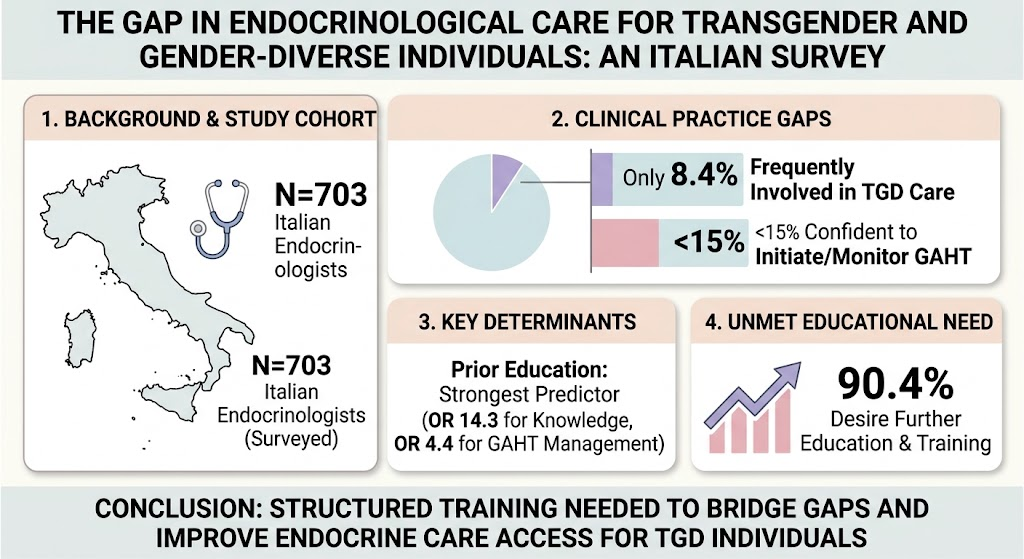
- Only 8.4% of Italian endocrinologists frequently engage in clinical care of transgender and gender-diverse (TGD) patients.
- Less than 15% feel competent to initiate and monitor gender-affirming hormone therapy (GAHT).
- Previous formal education in transgender care strongly associates with better knowledge and clinical confidence.
- Over 90% express interest in further training, underscoring unmet educational needs.
Study Background
Transgender and gender-diverse (TGD) individuals often require specialized medical interventions, notably gender-affirming hormone therapy (GAHT), to align physical characteristics with gender identity. Adequate endocrine care is essential to improve health outcomes and psychological well-being in this population. Despite increasing recognition of transgender health needs, many healthcare systems face challenges, often stemming from lack of provider knowledge and training. In Italy, data quantifying endocrinologists’ preparedness to deliver such care have been limited.
Study Design
The Association of Medical Endocrinologists (AME), in partnership with the Italian Society for Gender, Identity and Health (SIGIS), conducted a nationwide survey in 2023 targeting all registered AME members (Italian endocrinologists). The survey evaluated providers’ knowledge, clinical practice habits regarding transgender healthcare, self-reported competence in managing GAHT, and interest in dedicated education on gender-affirming care. Multivariable logistic regression analysis was performed to identify factors influencing knowledge and clinical ability related to transgender care.
Key Findings
A total of 703 endocrinologists completed the survey. Key results include:
- Only 8.4% of respondents reported frequent involvement in the clinical management of TGD patients, indicating limited direct experience.
- Fewer than 15% considered themselves capable of initiating and monitoring GAHT, reflecting a substantial clinical competence gap.
- Prior formal education or training in gender-affirming care emerged as the most significant predictor of both greater knowledge (odds ratio [OR] 14.3, 95% confidence interval not provided) and reported ability to manage GAHT (OR 4.4).
- Interestingly, younger endocrinologists demonstrated higher levels of knowledge but did not necessarily feel more competent in clinical management.
- An overwhelming 90.4% expressed clear interest in receiving more education about TGD care, signaling a pressing need for structured training programs.
Expert Commentary
This survey highlights critical deficiencies affecting endocrine care for TGD individuals in Italy, which mirror challenges observed internationally. The strong association between prior education and competence underscores the pivotal role of systematic training. While younger physicians may be more aware of transgender health issues, their lack of confidence suggests that knowledge is insufficient without practical experience or mentorship. Structured inclusion of transgender health topics in endocrinology curricula and continuing medical education could address this.
Study limitations include potential response bias, as more interested or knowledgeable clinicians may have been more likely to participate. The findings might not extrapolate to other specialties involved in TGD care, such as primary care or psychiatry.
Conclusion
The readiness of Italian endocrinologists to provide competent transgender healthcare is currently inadequate. This gap poses direct consequences on quality and accessibility of care for TGD populations requiring GAHT. Implementation of comprehensive, standardized educational programs is imperative to enhance endocrinologists’ expertise, confidence, and ultimately, patient outcomes. These efforts align with broader healthcare equity and inclusion objectives.
References
- Parazzoli C, Delbarba A, Scala A, et al. The Gap in Endocrinological Care for Transgender and Gender-Diverse Individuals: An Italian Survey. J Clin Endocrinol Metab. 2026 Sep 10. doi:10.1210/jc.42721289
- Wylie K, Barrett J, Besser M, et al. Good Practice Guidelines for the Assessment and Treatment of Adults with Gender Dysphoria. Sexual and Reproductive Healthcare. 2014;5(2):95-101.
- Hembree WC, Cohen-Kettenis PT, Gooren L, et al. Endocrine Treatment of Gender-Dysphoric/Gender-Incongruent Persons: An Endocrine Society Clinical Practice Guideline. J Clin Endocrinol Metab. 2017;102(11):3869-3903.