Background
Lung cancer remains the leading cause of cancer-related mortality worldwide, largely due to late-stage diagnosis. Early detection through lung cancer screening (LCS) using low-dose computed tomography (LDCT) significantly reduces mortality by identifying cancer at curable stages. Despite guideline endorsements, LCS uptake rates remain disproportionately low, especially among marginalized populations including low-income groups, racial/ethnic minorities, and rural residents. Barriers to screening are complex and multilayered, involving patient-level factors (e.g., knowledge deficits, mistrust), provider-level factors (e.g., time constraints, awareness), and broader healthcare system challenges (e.g., access, cost, coordination). While previous studies have explored patient and provider perspectives, there is a relative paucity of research focusing on healthcare staff such as nurses and medical assistants who are pivotal in screening workflows. Understanding their insights can illuminate practical and systemic challenges that impede equitable LCS access and receipt.Study Design
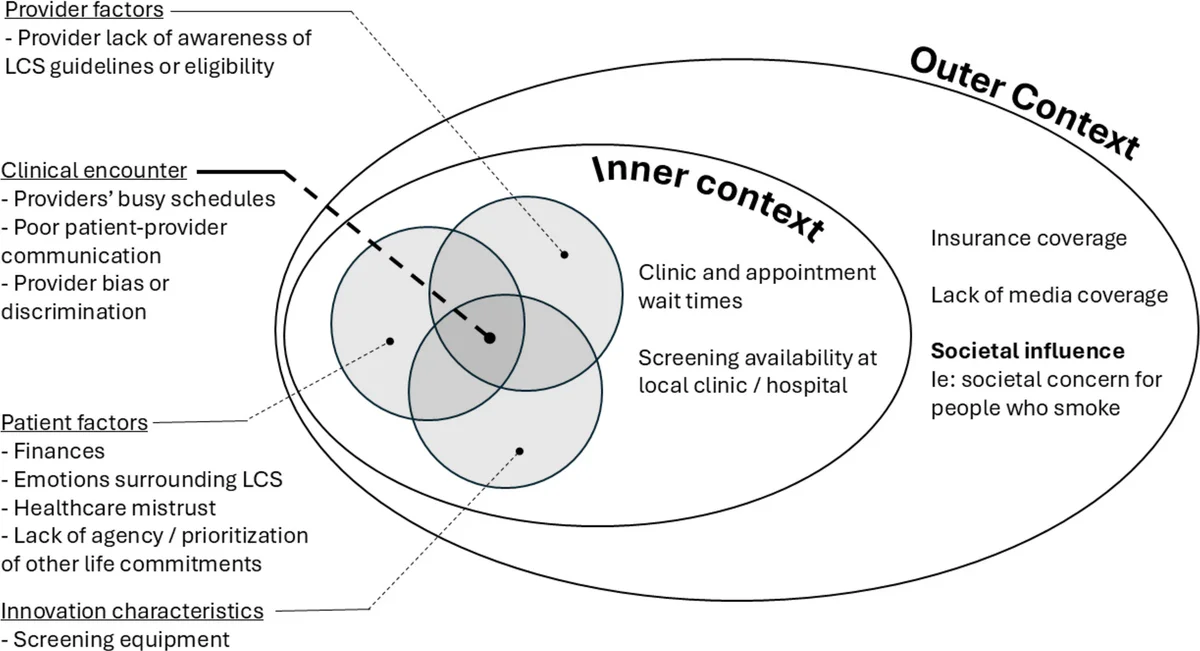
This qualitative study involved virtual, semi-structured interviews with 15 healthcare staff members from the United States engaged in lung cancer screening care processes. The sample included nurses, medical assistants, and other allied health professionals. Interviews explored participants’ perceptions of barriers to LCS utilizing the Health Equity Implementation Framework (HEIF), which assesses determinants of equitable intervention implementation across levels: patient, provider, clinical encounter, inner healthcare system (e.g., clinic processes), and outer healthcare system (e.g., policy, community context). Thematic analysis was conducted using a combined deductive-inductive approach with template analysis methods to identify recurring themes spanning HEIF levels. This approach allowed integration of pre-defined framework domains with emerging participant-driven insights.Key Findings
Limited Clinical Knowledge and Awareness
Most participants reported limited detailed clinical knowledge about LCS guidelines and eligibility criteria, though they recognized the importance of early detection benefits. This lack of familiarity sometimes limited their ability to advocate for or educate patients effectively, underscoring the need for targeted staff training.Patient-Level Barriers
Participants identified multiple patient concerns impacting LCS uptake including claustrophobia related to imaging procedures, mistrust of healthcare due to historical or personal experiences, stigma associated with smoking history, and anxiety about potential diagnosis. Cost concerns and transportation challenges were prominent, particularly affecting older, under-resourced, and rural patients. Some staff noted societal attitudes that devalue marginalized populations, resulting in implicit neglect of their screening needs.Provider-Level Barriers
Limited time during clinical encounters was frequently cited as a barrier for providers to discuss LCS thoroughly with eligible patients. Participants also mentioned provider unawareness or lack of familiarity with screening programs as impeding referrals and follow-up. Instances of provider bias or discrimination, sometimes implicit, were recognized as barriers discouraging patients from engaging with LCS.Healthcare System-Level Barriers
At the inner system level, participants described challenges related to fragmented workflows, insufficient integration of LCS reminders or prompts in electronic health records, and inadequate staffing support. Outer system-level barriers included limited media coverage and public health messaging around LCS, inadequate transportation infrastructure, and cost-related policies that disproportionately affect marginalized groups.Interconnectedness of Barriers
A salient theme was the interconnection of barriers across HEIF levels—for example, provider time constraints (provider level) compounded by lack of system workflow support (inner system) hindered patient education and scheduling, while societal stigma (outer system) reinforced patient mistrust. This multilevel interplay underscores the complexity of improving equitable LCS access.Expert Commentary
This study provides valuable insight into the often-overlooked perspectives of healthcare staff intimately involved in the operationalization of lung cancer screening. Their observations complement patient and physician viewpoints, revealing nuanced system and workflow issues. Prior literature has emphasized provider and patient barriers; incorporating staff viewpoints enriches understanding of implementation challenges. The findings align with recommendations from major societies such as the American Thoracic Society and the National Comprehensive Cancer Network, which highlight multilevel interventions including provider education, patient navigation, and health system process improvements. Staff training that equips nurses and medical assistants with knowledge and communication skills could improve patient engagement. Addressing provider-level biases and time constraints requires organizational commitment to workflow redesign and staffing adequacy. Outer-system efforts should focus on public awareness campaigns and policy adjustments to reduce cost and transportation barriers. Limitations include the small sample size and potential selection bias toward staff engaged or interested in LCS, which may affect generalizability. Nevertheless, the study emphasizes the critical role of frontline staff in influencing equitable healthcare delivery.Conclusion
Healthcare staff perspectives reveal multilevel, interconnected barriers to equitable lung cancer screening access spanning patient fears and stigma, provider knowledge and time constraints, and systemic workflow and societal obstacles. Interventions designed to improve LCS uptake must therefore operate across multiple levels of the Health Equity Implementation Framework. Prioritizing healthcare staff education and empowerment, addressing structural healthcare system issues, combating stigma, and enhancing supportive policies are essential to bridging current care gaps. Future research should test multilevel implementation strategies informed by these insights to reduce disparities and improve lung cancer outcomes.Funding and Clinical Trial Registration
The original study by Nguyen et al. did not specify funding sources or clinical trial registration details.References
1. Mazzone PJ, Silvestri GA, Patel S, et al. Screening for Lung Cancer: CHEST Guideline and Expert Panel Report. Chest. 2018;153(4):954-985. doi:10.1016/j.chest.2018.01.013 2. Humphrey LL, Deffebach M, Pappas M, et al. Screening for Lung Cancer with Low-Dose Computed Tomography: A Systematic Review to Update the US Preventive Services Task Force Recommendation. Ann Intern Med. 2013;159(6):411-420. doi:10.7326/0003-4819-159-6-201309170-00690 3. Roberts MB, Wheeler K, Sussman AL, et al. Barriers and Facilitators to Lung Cancer Screening Program Implementation: A Systematic Review. J Natl Cancer Inst. 2021;113(11):1451-1460. doi:10.1093/jnci/djab038 4. Dickson JL, Simonsen SE, Hunter MD, et al. Patient-Reported Barriers to Lung Cancer Screening. Clin Lung Cancer. 2020;21(4):e319-e325. doi:10.1016/j.cllc.2019.12.006 5. American Thoracic Society. Addressing Health Disparities in Lung Cancer Screening. ATS Policy Statement. Am J Respir Crit Care Med. 2022;205(7):756-759. doi:10.1164/rccm.202201-0008PSSpecialty calculators
For clinical reference; use professional judgment.