Recent breakthroughs in protein biology suggest that frontier large language models are acquiring capabilities once considered exclusive to specialized scientific AI. The implications extend far beyond protein design, raising fundamental questions about the future of medical AI and the competitive value of domain-specific models.
MedXY | AI & Healthcare Insights | November 24, 2026
General-Purpose AI Is Entering the Territory of AlphaFold
Since the breakthrough of AlphaFold2 in 2020, specialized artificial intelligence has transformed protein biology.
Tools such as AlphaFold, RFdiffusion, ProteinMPNN, and ESMFold have become essential components of modern biological research, enabling scientists to investigate protein structures, molecular interactions, and novel therapeutic candidates.
For years, the prevailing assumption was that these highly specialized scientific tasks required dedicated AI models trained on biological data.
General-purpose large language models (LLMs) were primarily used to interpret scientific literature, generate code, and coordinate specialized computational tools.
That distinction is beginning to change.
In a November 24, 2026, news report, Nature highlighted emerging evidence that frontier general-purpose AI models, including Anthropic’s Claude and OpenAI’s GPT-6 family, are developing capabilities previously associated with specialized protein AI.
The findings have sparked a broader debate: Could general-purpose foundation models eventually outperform specialized scientific models, even in some of the most technically demanding areas of biology?
Claude Surpasses Specialized Protein Language Models
On November 16, 2026, Xinming Tu, a researcher at the AI biotechnology company Phylo, and Leo Tianlai Chen, a computational biologist at Harvard Medical School, published an investigation into the protein sequence capabilities of leading LLMs.
Their evaluation involved relatively understudied microbial proteins, providing a challenging test of the models’ ability to recognize biological sequence patterns.
The results were unexpected.
Anthropic’s Claude Fable 5.2 and Claude Opus 5.5 demonstrated substantial proficiency in predicting amino acids within protein sequences. Claude Fable 5.2 outperformed every open-source protein language model included in the evaluation, while Claude Opus 5.5 achieved performance comparable to a leading specialized model.
Other general-purpose models evaluated in the study did not demonstrate equivalent capabilities.
The findings suggest that some frontier LLMs may be acquiring biological representations traditionally associated with specialized protein models.
However, amino acid prediction is not equivalent to complete protein structure prediction. The researchers also inferred that extensive exposure to protein sequence data during training may have contributed to Claude’s performance.
Nevertheless, the results challenge the assumption that a dedicated protein model is always necessary to achieve advanced protein-related capabilities.
GPT-6 Moves Beyond Prediction into Experimentally Validated Protein Design
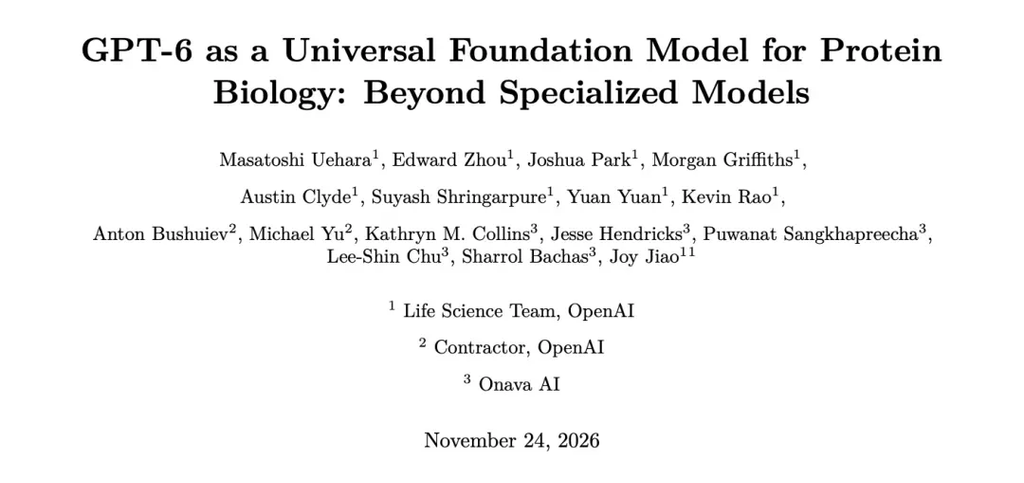
On November 24, 2026, OpenAI announced another important development through its research, GPT-6 as a Universal Foundation Model for Protein Biology: Beyond Specialized Models.
The work explored whether general-purpose AI could participate directly in protein design rather than merely coordinate external scientific tools.
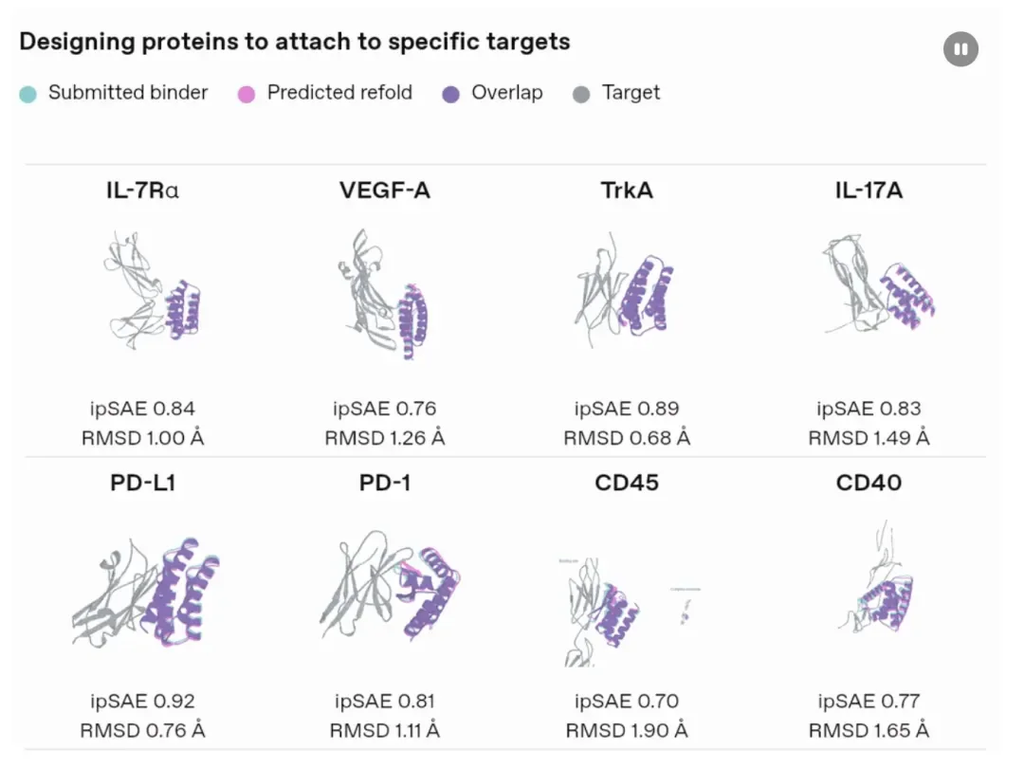
OpenAI researchers demonstrated that GPT-6.2 could generate three-dimensional designs for novel proteins targeting five biologically relevant molecules. Specialized AI tools were subsequently used to complete additional design and screening steps before experimental testing.
Of the 322 candidate proteins evaluated in the laboratory, 35 demonstrated binding to their intended targets, representing a hit rate of approximately 11%.
The researchers also reported promising results in protein sequence design and antibody redesign. Across several computational tasks, OpenAI’s latest internal research models achieved performance comparable to, or exceeding, certain specialized tools.
Importantly, substantial limitations remain.
In full protein structure prediction, frontier LLMs continued to perform considerably worse than dedicated structure-prediction systems. Moreover, the laboratory workflow still relied on specialized AI models for essential downstream steps.
Experimental evidence of binding also does not establish therapeutic efficacy, biological safety, or clinical utility.
These findings should therefore be interpreted as an early proof of concept, rather than evidence that GPT-6 has comprehensively replaced AlphaFold or other specialized protein-design platforms.
What makes the development significant is that general-purpose AI is beginning to contribute directly to scientific design.
From Scientific Tool Users to Scientific Creators
The implications of these developments extend beyond individual benchmarks.
Historically, computational biology has relied on a collection of specialized tools, each designed to solve a narrowly defined problem.
General-purpose LLMs initially added value by coordinating these tools, reducing the complexity of computational workflows, and improving research efficiency.
Frontier models are now beginning to participate more directly in the underlying scientific tasks.
Joy Jiao, who leads life sciences research at OpenAI, has described a vision in which scientists could communicate their research objectives in natural language, allowing AI to interpret and adapt to a broad range of scientific design requirements.
Such flexibility could fundamentally change how scientists interact with computational research infrastructure.
Instead of organizing scientific investigations around the limitations and interfaces of individual tools, researchers could increasingly organize their work around the scientific questions themselves.
A general-purpose model may draw simultaneously on biology, chemistry, physics, mathematics, and computational science, allowing it to approach problems from multiple perspectives.
This cross-disciplinary capacity could become particularly valuable in scientific discovery, where progress often depends on identifying unexpected connections between previously separate bodies of knowledge.
However, a major scientific question remains unresolved: To what extent do these models genuinely generalize biological principles beyond their training data?
Some observed capabilities could reflect memorization or extensive exposure to biological sequences rather than a deep understanding of biological mechanisms.
Although emerging experimental evidence supports the possibility of meaningful generalization, independent evaluations and prospective laboratory validation remain essential.
A Broader Industry Shift: The Changing Role of Specialized AI
The growing capabilities of general-purpose AI are also influencing how leading technology companies organize their research.
On November 13, 2026, Fortune reported that OpenAI had reorganized its standalone robotics team, integrating researchers into its broader research and applied technology organizations.
OpenAI emphasized that robotics remains a strategic priority and that the restructuring was intended to accelerate progress rather than discontinue robotics research.
Nevertheless, the development raises an important strategic question.
As foundation models become capable of performing increasingly diverse tasks, does every specialized domain still require an independent AI model development pathway?
For years, vertical AI has been built around the assumption that healthcare, finance, law, robotics, and scientific research require separate, domain-specific intelligence.
The rapid evolution of foundation models is challenging that assumption.
Specialization may increasingly occur at the system and application levels, rather than exclusively at the underlying model level.
Healthcare is likely to be one of the most consequential areas affected by this transition.
General-Purpose AI Is Already Challenging Specialized Clinical AI
Evidence of this trend has also emerged in clinical medicine.
A study published in Nature Medicine on June 12, 2026, independently compared three frontier general-purpose LLMs with two specialized clinical AI tools.
The evaluation included medical knowledge questions, assessments of agreement with clinical experts, and real-world queries submitted by practicing physicians.
The general-purpose models demonstrated stronger overall performance across the three evaluation frameworks.
The MedQA results illustrate the narrowing—and potential reversal—of the traditional performance advantage associated with specialized medical AI.
| AI System | Category | MedQA Accuracy |
|---|---|---|
| Gemini 3.1 Pro | General-purpose LLM | 97.4% |
| GPT-5.2 | General-purpose LLM | 94.2% |
| Claude Opus 4.6 | General-purpose LLM | 90.2% |
| OpenEvidence | Specialized clinical AI tool | 89.6% |
| UpToDate Expert AI | Specialized clinical AI tool | 88.4% |
The study does not establish that general-purpose models are superior in every medical specialty or clinical setting. It also did not demonstrate superior clinical safety, and the proprietary architectures of the specialized tools were not available for detailed analysis.
Nevertheless, its findings raise a fundamental issue:
Domain specialization does not necessarily translate into superior domain intelligence.
Taken together, recent developments in protein biology and clinical medicine suggest that the relationship between general-purpose and specialized AI is undergoing a significant transformation.
The MedXY Perspective: Medical Knowledge Is Not the Same as Medical Intelligence
At MedXY, we believe that the greatest long-term challenge facing specialized medical language models may not be their medical knowledge, but the capabilities of their underlying foundation models.
Many specialized medical LLMs are developed by adapting relatively compact foundation models using medical literature, clinical guidelines, electronic health records, and other healthcare-specific datasets.
This approach offers meaningful advantages, including computational efficiency, domain familiarity, lower inference costs, and strong performance on well-defined tasks.
However, domain-specific fine-tuning may not fully compensate for limitations in foundational intelligence.
Complex medical reasoning often requires capabilities that extend far beyond the retrieval of specialized knowledge.
Diagnosing rare diseases requires recognizing relationships among seemingly unrelated clinical findings. Personalized treatment requires integrating genetics, pharmacology, pathophysiology, patient preferences, and clinical evidence.
Scientific discovery requires something more: the ability to identify previously unrecognized relationships, formulate new hypotheses, and explore possibilities beyond established knowledge.
As foundation models become more capable, certain complex or emergent abilities that are less developed in smaller models may become increasingly important.
Parameter count alone is not a reliable measure of intelligence, and greater model scale does not automatically produce creativity or scientific understanding.
Nevertheless, advances in model architecture, training quality, computational scale, and reasoning capabilities may create a higher ceiling for scientific and medical intelligence.
Medical knowledge determines what an AI system knows. Foundational intelligence determines what it can do with that knowledge.
The recent breakthroughs in protein biology make this distinction particularly relevant.
The Evolution of Medical AI: From Knowledge to Reasoning to Creativity
MedXY views the long-term evolution of medical AI as a progression through three interconnected stages.
Stage 1: Knowledge-Driven AI
The initial stage focuses on making existing medical knowledge more accessible.
Applications include medical literature retrieval, clinical guideline searches, evidence synthesis, and standardized medical question answering.
The primary competitive advantages are knowledge quality, domain coverage, and information retrieval efficiency.
Stage 2: Reasoning-Driven AI
The next stage involves integrating diverse sources of clinical information to address increasingly complex medical problems.
AI systems can combine patient histories, laboratory results, medical imaging, clinical guidelines, and scientific evidence to support differential diagnosis, treatment selection, and personalized medicine.
Foundational reasoning capabilities become increasingly important at this stage.
Stage 3: Creativity-Driven AI
The most transformative stage extends beyond applying existing medical knowledge.
AI begins to contribute to the generation of new knowledge by identifying scientific questions, proposing disease mechanisms, generating testable hypotheses, and participating in therapeutic discovery.
Recent advances in AI-driven protein biology offer an early indication of this potential.
Creativity in medicine does not mean generating unsupported clinical recommendations. Rather, it means exploring new scientific possibilities within a rigorous framework of evidence, experimentation, clinical validation, and safety.
Future medical AI systems may not only help humanity make better use of existing knowledge but also contribute to expanding the boundaries of that knowledge.
The Future Architecture: Combining Specialized Efficiency with General-Purpose Intelligence
At MedXY, we do not believe that the future of healthcare AI requires a binary choice between specialized medical models and general-purpose foundation models.
Instead, the most promising approach may be to combine their complementary strengths.
OpenAI’s recent protein research illustrates this principle: frontier AI contributed to scientific design, specialized models supported complementary computational tasks, and laboratory experiments provided external validation.
A similar collaborative architecture could become increasingly important in healthcare.
Smaller specialized models can provide speed, efficiency, lower computational costs, and consistent performance on defined tasks.
Frontier foundation models can contribute deeper reasoning, broader knowledge integration, flexibility, and creative problem-solving.
A next-generation medical AI system could incorporate six complementary components:
| System Component | Strategic Value |
|---|---|
| Specialized Medical Models | Speed, efficiency, and routine medical tasks |
| Frontier Foundation Models | Complex reasoning and scientific creativity |
| Medical Evidence Infrastructure | Current, traceable, high-quality clinical knowledge |
| Specialized Scientific and Clinical Tools | Precision analysis and domain-specific computation |
| Intelligent Model Orchestration | Dynamic task allocation and model selection |
| Clinical Safety and Quality Assurance | Verification, validation, and risk management |
Routine medical tasks could be assigned to smaller, highly efficient models, while complex clinical reasoning and scientific exploration could be escalated to more capable frontier models.
Evidence retrieval, clinical tools, independent verification, and appropriate human oversight would provide additional layers of reliability.
Such a system could achieve a better balance between computational efficiency, medical expertise, reasoning, creativity, and clinical safety.
It would also allow medical AI platforms to continuously benefit from advances in foundation models without depending entirely on the development of a single proprietary medical LLM.
The Competitive Moat of Medical AI Is Changing
As frontier foundation models advance, simply fine-tuning an open-source language model on medical datasets and marketing it as a specialized medical AI may become an increasingly difficult strategy to sustain.
The long-term competitive advantage of healthcare AI companies is likely to depend on their ability to transform general-purpose intelligence into specialized, clinically valuable systems.
Key sources of differentiation may include:
- High-quality, continuously updated medical knowledge and evidence infrastructure.
- Deep understanding of real-world clinical workflows and healthcare needs.
- Intelligent orchestration of multiple models, agents, and scientific tools.
- Integration with healthcare information systems and clinical applications.
- Rigorous clinical validation, medical quality assurance, and safety evaluation.
- The ability to translate AI capabilities into measurable healthcare and scientific value.
Healthcare AI companies do not necessarily need to independently develop the world’s most powerful foundation model.
They need to build the infrastructure, expertise, and systems capable of transforming the world’s most advanced intelligence into reliable medical value.
The Future Belongs to Specialized AI Systems
From Claude’s emerging protein sequence capabilities to GPT-6’s experimentally validated contributions to protein design, general-purpose AI is beginning to cross boundaries once considered exclusive to specialized scientific models.
Specialized AI models are unlikely to disappear. Their role, however, may fundamentally change.
Rather than serving as standalone sources of domain intelligence, they may increasingly become efficient, precise components within more sophisticated intelligent systems.
At MedXY, we envision a future in which the efficiency of specialized models is combined with the reasoning and creativity of frontier foundation models, supported by medical evidence, scientific tools, and rigorous clinical safety mechanisms.
The ultimate objective is not simply to develop an AI model that knows more about medicine.
It is to build an intelligent system capable of understanding, reasoning, discovering, and continuously improving healthcare.
The next era of medical AI may not be defined by who builds the most specialized model, but by who builds the most intelligent specialized system.
From Specialized AI Models to Specialized AI Systems.
MedXY.ai
References
- Nature. Watch out, AlphaFold: Claude and ChatGPT’s new biology skills wow scientists. November 24, 2026. https://doi.org/10.1038/d41586-026-03836-z
- Tu X, Chen LT. Claude was trained on protein sequences at scale. November 16, 2026. https://xinmingtu.cn/blog/2026/claude-opus-5-5-protein-sequences/
- OpenAI. GPT-6 models demonstrate intrinsic protein-design capabilities. November 24, 2026. https://openai.com/index/gpt-6-models-demonstrate-intrinsic-protein-design-capabilities/
- General-purpose large language models outperform specialized clinical AI tools on medical benchmarks. Nature Medicine. 2026. https://doi.org/10.1038/s41591-026-04431-5
- Jumper J, Evans R, Pritzel A, et al. Highly accurate protein structure prediction with AlphaFold. Nature. 2021;596:583–589. https://doi.org/10.1038/s41586-021-03819-2
- Watson JL, Juergens D, Bennett NR, et al. De novo design of protein structure and function with RFdiffusion. Nature. 2023;620:1089–1100. https://doi.org/10.1038/s41586-023-06415-8
Specialty calculators
For clinical reference; use professional judgment.