Highlight
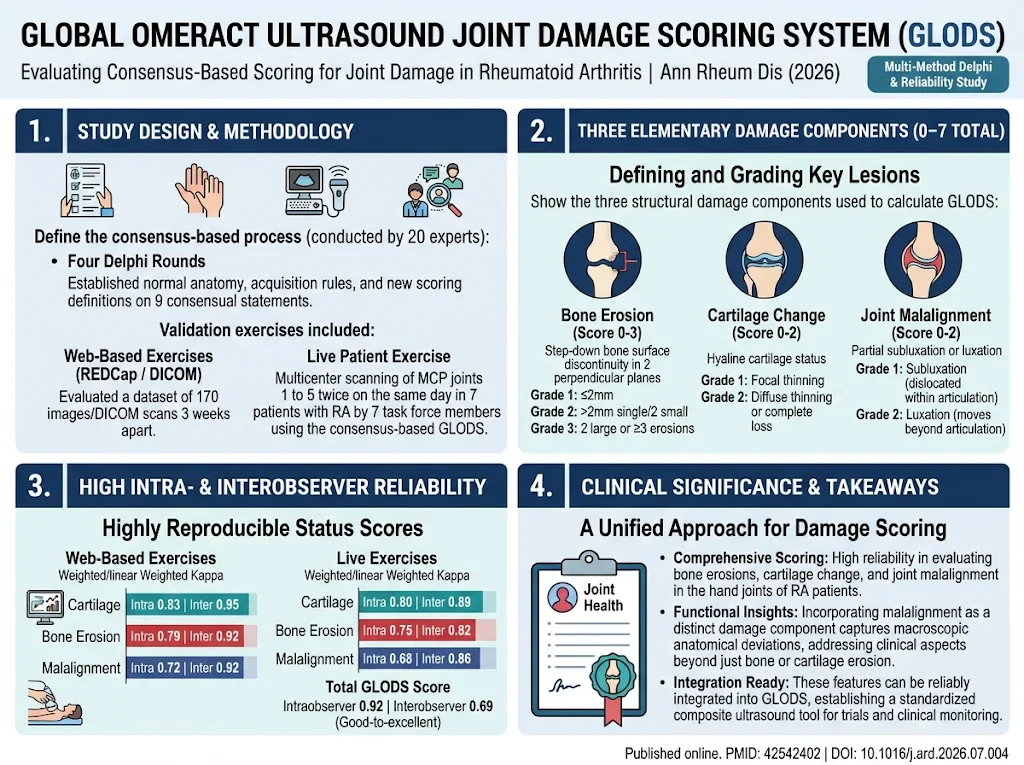
- The Global OMERACT Ultrasound Joint Damage Scoring System (GLODS) standardizes ultrasound assessment of joint structural damage in rheumatoid arthritis (RA).
- GLODS reliably evaluates bone erosions, cartilage changes, and joint malalignment using a semiquantitative scoring method validated by expert consensus and reliability testing.
- Intraobserver and interobserver reliability of the scoring system range from good to excellent, supporting its clinical and research utility.
Study Background
Rheumatoid arthritis (RA) is a chronic inflammatory autoimmune disease characterized by synovitis that frequently leads to progressive structural joint damage, including bone erosions, cartilage loss, and joint malalignment. Accurate assessment of structural damage is essential for optimal disease monitoring, treatment decisions, and prognostic evaluation. While conventional radiography has traditionally been the standard for detecting structural joint damage, it is relatively insensitive to early changes. Musculoskeletal ultrasound has emerged as a sensitive, accessible imaging modality capable of visualizing early erosions, cartilage abnormalities, and joint alignment with real-time dynamic assessment. Despite its promise, ultrasound evaluation of structural damage in RA has suffered from heterogeneity in scanning protocols, definitions, and scoring systems. This lack of standardization limits comparability across studies and impedes clinical adoption. The Outcome Measures in Rheumatology (OMERACT) Ultrasound Working Group aimed to address this need by developing a globally accepted, validated ultrasound joint damage scoring system — termed GLODS — that incorporates clearly defined features of damage and employs a semiquantitative scale amenable to reliable application in both research and clinical settings.Study Design
This methodological study involved a multi-phase consensus and validation process undertaken by a multinational task force of ultrasound experts within OMERACT. Initially, a Delphi survey comprising statements about normal joint ultrasound appearance, recommended scanning techniques, and novel definitions and scoring criteria for three components of structural joint damage (bone erosions, cartilage changes, and joint malalignment) was circulated. Statements reaching at least 75% agreement on a Likert scale (grades 4-5) after four rounds were accepted. Subsequently, comprehensive datasets of ultrasound images representing a spectrum of these damage grades were created and used in two web-based exercises to assess intraobserver and interobserver reliability. Finally, a live exercise was conducted by scanning the metacarpophalangeal joints (MCP 1-5) of 7 RA patients twice on the same day by 7 task force members, independently scoring the three components using the GLODS semiquantitative scale. Weighted kappa statistics measured reliability.Key Findings
Consensus was reached on nine critical statements defining the ultrasound appearance and scoring methodology of structural damage after four Delphi rounds, including precise descriptions of bone erosions, cartilage alterations, and patterns of joint malalignment. The reliability results were robust across settings: in the web-based exercises, intraobserver and interobserver weighted kappa values ranged from 0.72 to 0.97, indicating good to excellent agreement. The live patient-based exercise similarly demonstrated good to excellent reliability with intraobserver kappa values between 0.68 and 0.89. For the composite GLODS total score, intraobserver reliability was excellent (kappa = 0.92), and interobserver reliability was good (kappa = 0.69). These findings confirm that the GLODS system can be implemented with consistent reproducibility among different experienced sonographers.Expert Commentary
This study represents a significant advancement in the imaging assessment of RA joint damage. Ultrasound offers distinct advantages over conventional radiographs and MRI, such as immediate bedside availability, dynamic evaluation, and superior resolution of small anatomical details. The rigorous Delphi methodology ensured broad expert agreement, enhancing acceptance among the rheumatology ultrasound community. The GLODS scoring system’s semiquantitative nature facilitates nuanced but practical differentiation of damage severity. However, adoption in community settings outside expert centers requires appropriate training to maintain reliability. Additionally, the study focused on MCP joints; extension of validation to other key joints involved in RA, such as wrists, knees, and feet, is warranted. Cross-validation against radiographic and MRI scoring systems will further establish clinical relevance.Conclusion
The Global OMERACT Ultrasound Joint Damage Scoring System (GLODS) provides a standardized, reliable approach to assessing structural joint damage components – bone erosions, cartilage changes, and malalignment – in rheumatoid arthritis patients. It addresses a critical unmet need by harmonizing definitions and scoring across international experts, thereby improving measurement consistency for clinical trials and routine practice. As ultrasound is increasingly integrated into RA management pathways, validated tools like GLODS enhance disease monitoring and treatment optimization. Further research is encouraged to expand GLODS validation across diverse joints, longitudinal responsiveness, and correlation with patient outcomes.Funding and Clinical Trials
The research was conducted under the auspices of the OMERACT Ultrasound Working Group, supported by institutional collaborations from multiple rheumatology centers worldwide. Specific funding or clinical trial registration details were not provided in the source publication.References
Mandl P, Gessl I, Kun L, Filippou G, Kortekaas M, Pineda C, et al. A global OMERACT ultrasound joint damage scoring system (GLODS) in rheumatoid arthritis. Ann Rheum Dis. 2026 Aug 1;85(11):2119-2128. PMID: 42542402. Naredo E, Möller I, Wakefield RJ, et al. Validity, reproducibility, and responsiveness of a quantitative ultrasound system in the assessment of synovitis and joint damage in RA. Ann Rheum Dis. 2010;69(9):1632-7. Wakefield RJ, D’Agostino MA, Iagnocco A, Filippucci E. Musculoskeletal Ultrasound including definitions for ultrasonographic pathological findings in rheumatic disorders: consensus through Delphi processes. Ann Rheum Dis. 2005;64 Suppl 1:i2-7.Specialty calculators
For clinical reference; use professional judgment.