Highlight
Recent data reveal a measurable increase in the representation of underrepresented in medicine (URiM) racial and ethnic groups among oncology trainees, especially after 2020. The largest gains were seen in radiation oncology and surgical specialties. Despite these positive trends, URiM representation continues to fall short compared to U.S. population demographics.
Efforts by oncology societies and training programs to address diversity and inclusion appear to be making an impact, but sustained and targeted interventions remain necessary.
Study Background
Racial and ethnic disparities in cancer incidence, treatment outcomes, and access to care remain persistent challenges in oncology. A more diverse oncology physician workforce has been shown to improve cultural competence, patient-provider communication, and health equity. However, historically, underrepresented racial and ethnic groups have been inadequately represented in oncology training programs, limiting progress toward equitable cancer care.
Against this backdrop, professional oncology societies have focused on enhancing diversity in recent years, especially since 2020, when increased societal attention to systemic inequities galvanized specific initiatives. This study aims to evaluate the effectiveness of these efforts by analyzing longitudinal trends in URiM representation among oncology and related specialty trainees.
Study Design
This repeated cross-sectional study analyzed trainee demographic data from the Accreditation Council for Graduate Medical Education (ACGME) database spanning 2011 through 2025. The specialties studied were medical oncology, radiation oncology, surgical oncology, general surgery, and primary care—selected because their practitioners commonly provide cancer-related care.
The URiM classification comprised individuals identifying as American Indian or Alaskan Native; Black or African American; Hispanic, Latino, or of Spanish origin; and Native Hawaiian or Pacific Islander. The main endpoints were the proportional representation of URiM trainees annually and the odds ratios for URiM representation pre- and post-2020, estimated via segmented logistic regression analysis.
Key Findings
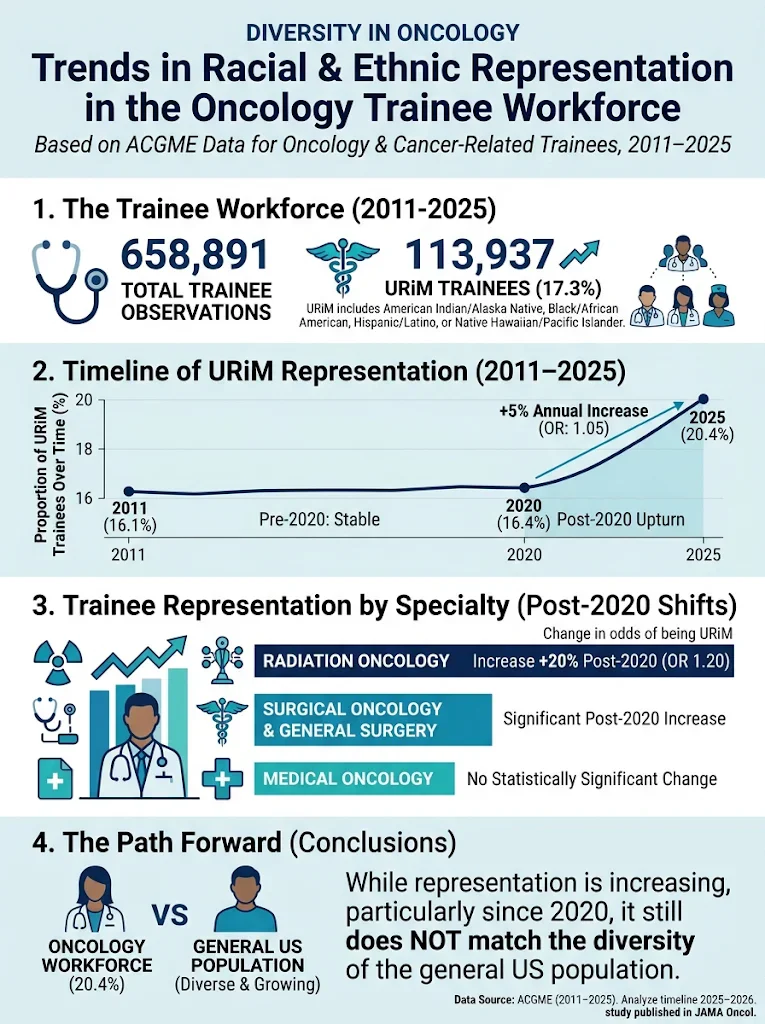
The study cohort included 658,891 trainee observations, with 113,937 (17.3%) identified as URiM. From 2011 to 2020, the proportion of URiM trainees remained relatively stable, hovering around 16%. After 2020, a notable increase occurred, rising to 20.4% by 2025.
Segmented regression demonstrated a significant 5% increase in the likelihood of trainees being URiM overall immediately after 2020 (OR 1.05, 95% CI 1.03-1.08) and an additional 5% annual increase in URiM odds thereafter (OR 1.05, 95% CI 1.05-1.06).
Specialty-specific analyses revealed heterogeneous patterns. Radiation oncology exhibited the most pronounced post-2020 increase in URiM representation (OR 1.20, 95% CI 1.11-1.30). Surgical oncology and general surgery also showed statistically significant upward trends. In contrast, medical oncology trainees did not demonstrate a statistically significant change in URiM representation during the study period.
Despite these improvements, the URiM proportion among trainees in 2025 remained below the demographic diversity of the general U.S. population, indicating persistent gaps.
Expert Commentary
The findings highlight progress attributable to intensified diversity and inclusion efforts in oncology training, particularly post-2020. The marked gains in radiation oncology and surgical fields may reflect targeted recruitment or retention strategies, pipeline programs, or cultural shifts within these specialties.
The lack of improvement within medical oncology suggests potential unique barriers in this specialty or slower adaptation of diversity initiatives that warrant further investigation. Factors might include entrenched institutional cultures, mentorship availability, or differential awareness of diversity programs.
Limitations of the study include reliance on administrative data, which may be subject to misclassification or incomplete reporting of race and ethnicity. Also, the cross-sectional design precludes causal inference. Future research should explore qualitative insights from trainees and program directors to better understand facilitators and barriers to URiM recruitment and retention.
Conclusion
This comprehensive analysis confirms increasing representation of underrepresented racial and ethnic minorities among oncology trainees in the United States, particularly after 2020, likely reflecting the impact of concerted diversity efforts in oncology professional societies and training programs.
Nevertheless, URiM representation remains insufficient relative to the general population, underscoring the need for continued systemic and structural interventions. Sustained commitment to culturally tailored mentorship, equitable recruitment, and inclusive training environments is essential to build a cancer care workforce that mirrors the diverse patient populations it serves.
These findings can inform policymakers, academic institutions, and oncology societies to refine and intensify strategies aimed at fostering a diverse and inclusive oncology workforce, ultimately improving cancer outcomes across all racial and ethnic groups.
Funding and Clinical Trials
No specific funding or clinical trial registration was reported for this analysis.
Specialty calculators
For clinical reference; use professional judgment.